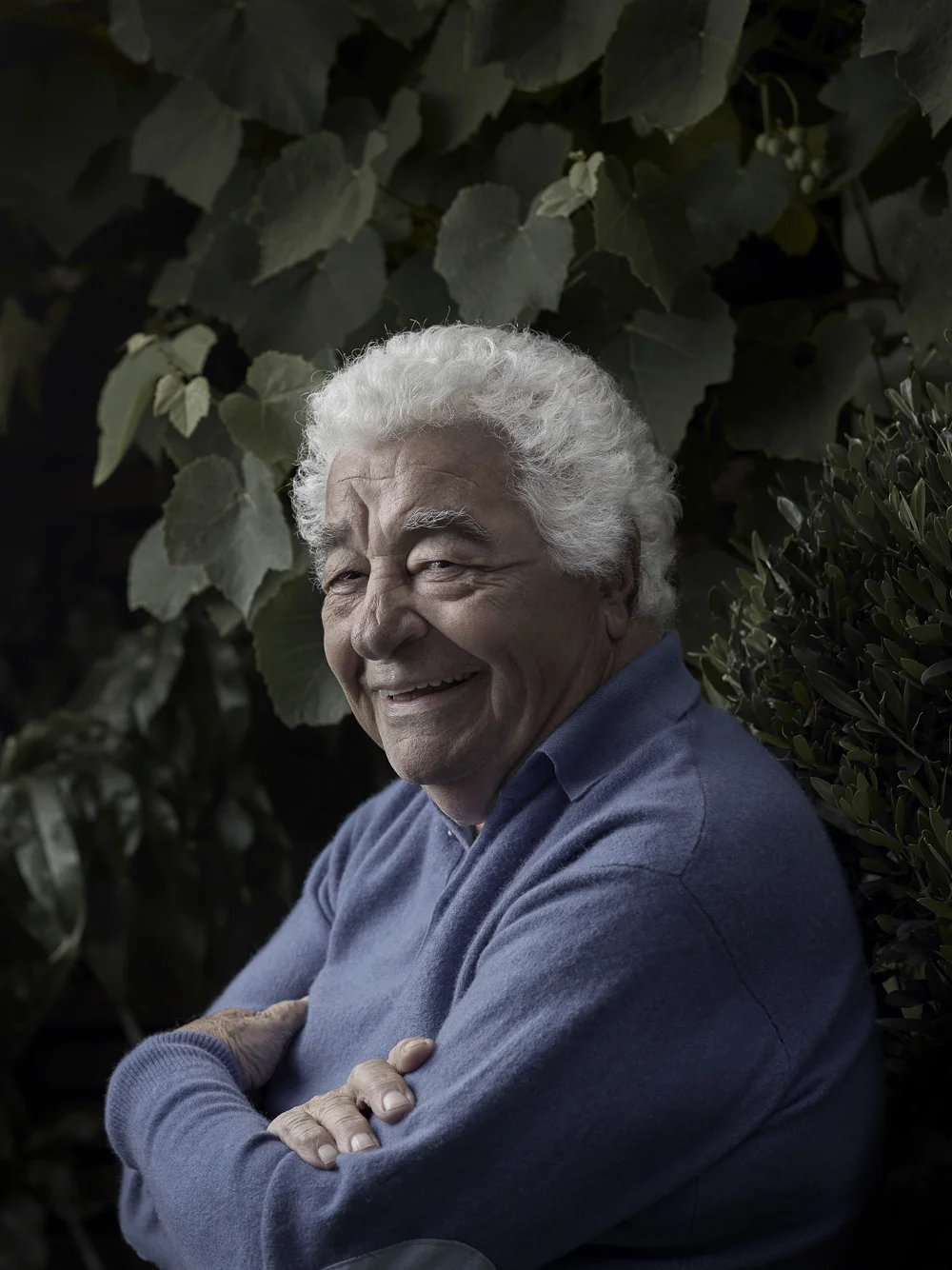
Food, Life and Love with Antonio Carlucio
The chef’s chef …
Interview by Liz Schaffer & Photographs by Tom Bunning
Very sadly Commendatore Antonio Carluccio OBE passed away in November last year. We hope you'll enjoy reading this interview with him, first published in Lodestars Anthology Issue 4, Italy.
Proudly declaring himself to be a cook rather than a chef (by his own definition a chef is professional while a cook does it for passion), Antonio Carluccio was the quintessential Italian about London. Driven by his zest for food, life and Italy, it was the passing on of wisdom that inspires much of Carluccio’s work. Arriving in England via Austria and Germany, where he worked as a wine merchant for almost a decade, Carluccio launched a fleet of eponymous restaurants, ran some of the capital’s culinary icons, became a BBC fixture and was awarded an OBE, which he retitled his Order Boletus Edulis - the Latin name for mushroom, his signature. Young at heart, Carluccio’s enthusiasm was invigorating; proof that life should be lived in the pursuit of pleasure, ardour and flavour.
Your background and training are quite unconventional. Can you tell us about this and how you came to be a cook?
I was born on the Amalfi Coast and was the fifth son of a stationmaster. [We were] transported up North where I grew up near Asti, then I moved a little further up and worked for Olivetti. At the time Olivetti was something fantastic but I didn’t like it very much and I was thinking I could holiday on the Riviera and [there] I met an Austrian girl and we fell in love. She came to work in Olivetti and when my youngest brother died in 1960 she said, “why didn’t I come to Vienna?”.
I cooked all the time because in Vienna to have the food my mother used to [make] I had to cook. I remembered what she was doing because in Italy when you are the young son you participate in everything.
In Vienna I started to cook what I knew. I didn’t know very much but I cook and cook and I’m sharing it with friends and frequenting bohemian cafes. You meet incredible people and I like art so I met Oskar Kokoschka and Max Ernst and we were sharing pasta. I was having fun and cooking all the time. It was only when I came to England in 1975 [and] I was still cooking, that my ex-wife [suggested], “why you don’t [enter] the best cook competition of The Sunday Times?”. I did and I was in the final but for me it wasn’t professional, I was a wine merchant, but funnily enough the press began to contact me. For them I was ‘the Italian’, flamboyant and believing in mushrooms and pasta, and so I was in the press.
At the same time my ex-brother-in-law Terence Conran, the owner of the Neal Street Restaurant in Covent Garden, asked me to run the restaurant and I said, “look I don’t cook, I don’t do administration, but I will be there doing the restaurant and running it”, which I did. Then came the BBC and I did quite a [few] food and drink programmes. My first Italian series was going to Italy doing twelve half an hours in all the regions. The other series was with Gennaro Contaldo but I did quite a lot in between and I was also writing books. I can’t stay doing nothing.
Do you think people are drawn to the Italian attitude towards food?
Italians live for food. When we were children going to school in the morning you’re already preoccupied by what you would eat in the day. It was the end of war time and the question to other children was “what will you eat for lunch?” and after the meal it was “what did you have for lunch?”, constantly. I remember in the afternoon, when you’re boys you do things, sometimes we were stealing a cabbage from the field and cutting it very, very thinly. Somebody [brought] olive oil, somebody a bit of vinegar and salt and pepper and we were making salad with bread. It was the best salad ever.
Is there an ethos or technique that sets your food apart?
I created a motto for my cooking, ‘mof mof’, minimum of fuss, maximum of flavour, and as such I don’t go to the lengths to elaborate on food because the most important thing is the taste. If you have the taste the look can be indifferent.
In fact we have items in Italy called brutte ma buone, ugly but good; fruit, even biscuits, that show you the possibility of the flavour. I dedicate everything to that which is obtained by regional food. Italy is famed for its 20 diverse regions.
What do you think makes them so distinctive?
Italy was unified in 1861 but I think in spirit each region is a country. You find culture in Italy from everywhere because each one was coming, the French, the Persians, everybody, to Italy. Even Alexander the Great was there. They united Italy in 1861 but there are different languages, different dialects, different customs. But they are united in thinking of the food as one of the best things.
They may be united by a love of food but is there still competition between the regions?
Between little villages! If somebody makes a dish someone in the next village will say, “ahh but I do it with this and this and this”. Immediately there is a conversation. I remember as a child if you were encountering somebody on road and it was lunchtime you would say, “do you want to have lunch?”. It was very simple. They would come home with you. So this is the attitude of the Italian, they really care. I always say that Italy has two or three million Michelin starred chefs, they’re all the housewives.
What do you love most about Italian cooking?
The Italians, what they have in front of others, the Germans, Austrians, English, French, is the attitude. I remember when we used to live in the train station my mother would say, “go downstairs and see if the trains are departing on time” in order to put the pasta in the water so that when papa was coming up the pasta was perfect. When you grow up with this sense of procedure and [significance] then you know food is important. She was really thinking to please other people because cooking for others is an act of love.
[Because of the various regions and diversity] I think that Italy has a more complete menu. There are 600 shapes of pasta and each can be done as a specialty with a special sauce, special ingredients. Italians want good taste and they’re prepared to use all those wonderful shops. In Napoli especially there were shops selling only pasta, and the pasta was loose, not in packets but in drawers, and all the leftovers were put into one ‘special’ and this is for pasta e fagioli - bean soup with pasta - which is wonderful, all bits and pieces. So they really have fun. While other nations have fun in eating the Italian has fun in thinking and imagining it.
What advice do you have for prospective chefs?
You have to desire food, not being greedy but being discerning about what you eat, and pay attention and love your food. If you don’t have those three things you stop cooking because there would be no point, it would just be a job, no fun. Food, it’s not only preparation but fun in eating. It’s good for the brain, for the body, the spirit, for everything.
The British Journal of Photography: Creative Brief
An interview with editor Liz Schaffer.
Extract from The British Journal of Photography, December 2017 Journalist, photographer and lover of independent magazines, Liz Schaffer moved from Sydney to London in 2011, a city that “felt like the epicentre of all things creative”, she says. Combining her passions with an innate curiosity for travelling, she launched Lodestars Anthology in September 2014 with the England issue, subsequently dedicating each journal to the exploration of a single country, including Scotland, Italy, Sweden and Canada. Together with her team and ever-growing list of contributors worldwide, she has also recently released her first compendium book, titled Lodestars Anthology: Pathways.
What are the first steps you take when working on a new issue? It’s a fluid process – our country of choice [for the issue] and the contributors we work with play a crucial role in shaping the publication. Sometimes we select a country when a photographer sends through work that we simply have to publish – a ‘love at first sight’ reaction. At other times it’s a friendly suggestion or an awareness that we are yet to cover a particular corner of the globe.
Do you select photographers based on their location? I always strive to create content based on experience. So getting in touch with photographers and writers on the ground, those who know a destination like only a local can, is crucial. That said, over the years we’ve built up an amazing and invaluable network of contributors, so we also come up with pieces by attempting to match a photographer’s style with the perceived feel of a place, and then send them out to capture it. When doing this we want to give them as much time on the ground as possible; when shooting for travel you’re quite often at the mercy of the elements, making time and flexibility essential. A minimum of five days is ideal, but I’ll do all I can to make this longer.
Do you have any guiding principles about collaborating with people? As obvious as it may sound, a good working relationship is crucial. I am in awe of the work we are sent – images that do seemingly impossible things with light, reveal the magic of the wild or capture a community’s verve and vibrancy. I do my best, whenever possible, to let my photographers know their creative worth. It’s also important to be friendly and open. Magazines, especially independent ones, tend to be incredibly personal endeavours. Budgets are tight, the hours are ridiculous and a work/life balance isn’t always there, so being able to get on and laugh with those you work with, getting genuinely excited when their name pops up in your inbox, more than justifies the difficult days.
How has the focus changed for independent magazines? One of the trends I adore is the increased space and respect given to illustration and photography – it feels like a return to the sweep and scope afforded press photographers in the 1960s and 70s. There is less reliance on stock imagery and a growing appreciation for originality and tailored commissions, which goes hand in hand with the reimagining of the magazine as a moreish physical object. People have begun to collect again. It’s understood that the magazines that sell are those that invest in their contributors and offer amazing content – a sense of escape and wonder that only exceptional images and writing can allow.
Are there any photographers you have particularly enjoyed working with? I adore different photographers for different reasons but two people we have worked with on multiple issues, and asked to contribute to our new book, Lodestars Anthology: Pathways, are Tom Bunning and Renae Smith. Both have such unique styles – they clearly see the world quite differently. Tom can make any landscape magical and his ability to manipulate light and shadow is almost otherworldly. He also puts his subjects at ease like no one else and, as a result, what he captures is wonderfully authentic.
Renae has a much lighter look and there is a calmness to her work. Interestingly, I see their styles as direct opposites. But you need that with travel; an ability to capture the diversity of our world, and to do so in an original, honest way.
Extract from The British Journal of Photography, December 2017
A glimpse of under-the-radar Nasu in Tochigi Prefecture.