Misc Jen HB Misc Jen HB

A Long Way Home

A New Zealand road trip.

Not only will this country soothe your soul, leave you speechless and make you yearn for more . . .

 A Long Way Home

Words by Claire Nelson & Photographs by Lara Miller  

Crossing Aotearoa’s South Island in search of whitebait, weather and a sense of connection.

The door blew shut on the ferry lounge, leaving behind the fragrant whiff of sheep from the livestock truck in the vehicle bay where, earlier, 100 woolly faces had greeted us onboard. Every pair of brown eyes had asked the question: where were we going? ‘South’, I’d winked back, which was about as much as I knew myself. For a New Zealander I was shamefully out of touch with New Zealand. Being Auckland-born and Wellington raised I’d traversed the North Island a thousand times over, while the South remained stuck on my to-do list - somewhere at the bottom at that. New Zealand’s grass was never green enough for me and I was bored, preoccupied with romantic notions of overseas. As soon as I could I emigrated to the UK, spending more than a decade revelling in ancient history and effortless travel until, in 2016, I became a British citizen. I reckon it was at this point my mother decided enough was enough - how could I be a certified Brit when I was still so uninitiated in my own backyard? It was time to come home and tackle that to-do list. So here we were, my mum and I, on the Cook Strait Ferry as it coasted through the lush valleys of the Marlborough Sounds, heading for the unchartered territory of my motherland.

The West Coast

My sum total knowledge of the West Coast was that it had whitebait and weather, and plenty of both. Sure enough, we arrived to rain and thick cloud, my mother navigating the winding road through a complete white-out. This untamed coast is beautiful regardless; the wild churning sea, hills shrouded in mist, the road flanked by tall nīkau palms. Forget Lord of the Rings, this is Jurassic Park territory. We stopped in Punakaiki and followed a cliffcut trail through beds of flax to see the famous Pancake Rocks; ancient stacks of limestone born out of the seabed over millions of years and eroded by the elements. Continuing south we made a detour to Blackball, a former coal mining settlement turned backwater town renowned for two notable highlights: the local salami company (where we stocked up on snacks) and a grand turn-of-the-century hotel once called The Blackball Hilton. Although it was named after the bloke who ran the old mine, the global Hilton chain came knocking and demanded they change the name. And so they did. In a nod to good ol’ stubborn Kiwi humour it’s now Formerly The Blackball Hilton.

Avenues of tall kahikatea trees saluted us as we made our way to glacier country, the drizzle following us all the way. We arrived in Fox, a small town at the foot of the Southern Alps dedicated almost entirely to mountain pursuits, such as the glacier heliflight we’d booked for the following day. But the peaks above us were obscured by ominous cloud. “The helicopters,” chimed the woman checking us into our motel, “haven’t been up all week.” When people in the UK tell me that I must miss the weather back home, they’re confusing us with sunny Australia. For in New Zealand the only thing you can predict about the weather is its changeability. We were lucky then to wake up to blue skies, giving us the chance to witness the mountain ranges reflected in Lake Matheson’s much-photographed mirrored surface and keep our date with Fox Glacier. Our pocket-sized helicopter hovered up the great sweeping frozen river, pure white ice rippled with translucent blue, made all the more humbling for the fact nature almost didn’t let us in.

Having encountered all weather varieties we went in search of that ultimate Kiwi delicacy: whitebait fritters, fresh from the pan and served on no-frills, generously buttered white bread with a wedge of lemon. In Haast we came upon Otoko Espresso, a rust-brown, corrugated-iron cart serving hot coffee and whitebait sarnies on the side of the road. We ate where we stood, juices running down our chins, as proprietor Robyn rested her elbows on the counter and told us how she parks here for the summer holidays. “My kids are playing over there somewhere,” she says, waving an arm towards the park. “They’ll come back when they’re hungry.” Oh my word, if only we could do the same.

Otago 

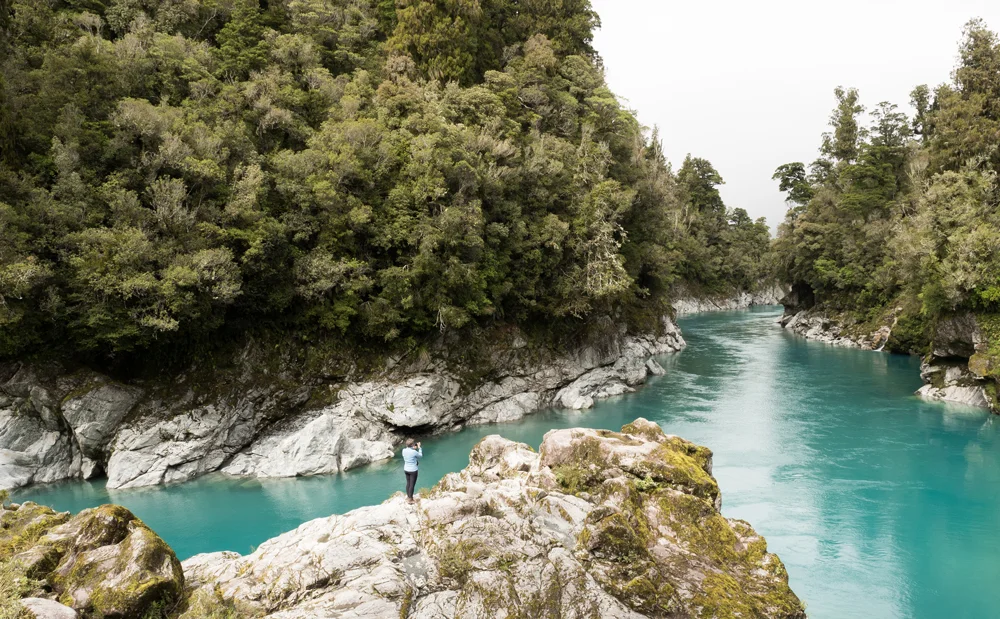
We ventured inland across the Alps, through the beech forest and rugged schist ravines of the Haast Pass - once an ancient Māori greenstone trail - emerging into what appeared to be an entirely different country. The moody greys and greens of the west coast had been replaced by sandy browns and bright blues of Lake Wanaka, backed by mountains beyond mountains and Lake Hawea, which is a startling shade of turquoise. Mum’s little red Mazda carried us over the Crown Range, the highest main road in the country and one hell of a scenic drive, golden valleys appearing at every hairpin turn. Having made it to the other side we stopped for a drink at the Cardrona Hotel, an iconic coaching inn dating back to 1863, which is seriously old when you consider that the country was only founded in 1840. Its wooden facade is original as is the vintage Chrysler parked out front, while round the back the rose-bordered beer garden is the perfect spot for a cold one.

We spent two nights in Arrowtown, set at a welcome distance from the summer crowds of nearby Queenstown and a place that benefits from a proper nosey. Retaining its gold rush charm, the main street is a cluster of heritage-style shops and restaurants, merging with a tree-lined avenue of original miners’ cottages. A horse was tethered outside the pub where a jazz band had people on their feet and dancing in the beer garden. Surrounded by all this it was easy to imagine the lives of families who’d emigrated here to make their fortune panning the Arrow River for gold. New Zealand may not have seen the rise and fall of empires, or had the likes of Shakespeare walk its streets, but our country has an intrepid history all its own, something I was only now beginning to appreciate.

Back on course, we followed the long straight country roads, passing Cromwell as we went, the town once drowned and rebuilt to make way for the great Clyde Dam. We were heading for Oamaru - a place I’d known nothing about and was pleasantly surprised to find contained beautiful neo-classical architecture of white stone, a preserved Victorian precinct and, most surprisingly, a quirky museum claiming Oamaru as the birthplace of steampunk. We strolled the avenues of the old town, browsing curiosities in ye olde bookshops and eclectic vintage stores before heading along the coast to neighbouring Moeraki, which is famous for its own curiosities. Here you’ll find oft-photographed circular boulders scattered across a small patch of beach, strangely otherworldly, as if some mythical giant had dropped his marbles long ago.

My favourite curiosity of all was Fleur’s Place, a seafood shack lovingly installed on the Moeraki harbourside by chef Fleur Sullivan. We arrived for dinner, the evening sun glinting off the ocean as gulls twirled above the ramshackle restaurant built from marvellous bits and bobs - old doors, pieces of boat, a spiral staircase rescued from a demolished hotel. We tucked into freshly grilled hoki and monkfish, while all around us the walls were covered in Sharpie scrawls from previous diners, love notes to a good meal. And then there was Fleur, with a cloud of white hair and a greenstone hung about her neck who, despite being in her seventies, was hustling through the restaurant with a steel tray of fish. Stopping for a chat, she told us how the ample supply of local food motivated her to open the restaurant in 2002. “I’d go out on the boats and see how much went to waste - they’d chuck the fish heads overboard. And I thought, that would make a bloody good stock!” Next thing I knew Fleur was tugging on my arm and mum and I were encouraged to come ogle another diner’s fish supper. “This bream was caught about two hours ago,” she announced, clearly as delighted as we were. Here was a woman who appreciated what was right on her doorstep. New life mantra: be more like Fleur.

Canterbury 

We had arrived in lake country, passing Lake Aviemore, where ‘freedom campers’ congregated in their laundry-draped campervans, then the eye-wateringly blue Lake Pukaki, and Lake Benmore, with its colossal hydropower dam. Punctuating all this water are the Clay Cliffs, found just outside of Omarama. Five dollars in an honesty box beside the gate grants entry to what looks like the Australian Outback - a dry, arid landscape spiked with huge pinnacles of rock and riddled with walking trails. Then, it was back to blue for the rest of the day, our digs a tiny cabin on the edge of Lake Tekapo alongside the compact tents of committed cycle-tourers. Mum and I sat on the porch, sharing fish and chips with a family of ducks and waiting for nightfall; this place is a UNESCO dark sky reserve, the undiluted darkness a perfect opportunity for stargazing.

The morning brought a palette of colour as we hit the road through trails of lupins, an immigrant wildflower that mottled the roadside with watercolour shades of pink and purple. We were heading for Akaroa, a pretty port that the English and French had competed to claim in 1840. After a long and epic voyage the French arrived to see the British flag up on the hill. They were 48 hours too late. Nevertheless, the town still adopted a little French flavour, as evident in the street names and the boulangeries serving crépes and croque monsieur. From the pier, pint-sized catamarans come and go, taking wildlife-watchers to meet the little native Hector’s dolphins that play in the harbour. Then there’s the uniquely Akaroan The Giant’s House, the home of blue-haired artist Josie Martin, reinvented as a bonkers fantasyland of mosaics - a world of characters she created out of tiles, glass and chipped crockery and which has a je ne sais quoi all its own. Our road trip was meant to end in Kaikoura with a visit to Nin’s Bin, an iconic, retro caravan selling crayfish on the beachfront. But a few weeks before the region was rattled hard by a 7.8-magnitude earthquake, cutting off access roads and heaving up the seabed (decimating the crayfish with it). Here, quakes are a part of life. Kaikoura would rebuild and I would come back. In the meantime, we reset our route to Hanmer Springs, a splendid place to conclude a road trip, as it turns out. Hanmer has been an oasis of geothermal hot springs for more than 150 years and its steamy mineral pools are ideal for soaking weary bones and car-contorted limbs. It seems that with one hand nature may taketh away but it giveth back with the other.

On our last morning we hit the road early, the peaks of the Southern Alps striking against the pale sky. We stopped for fuel and flat whites in Springs Junction, possibly the only place to actually benefit from the earthquake. This little one-horse town was fielding all the rerouted traffic from Kaikoura and local business was booming. As I juggled our takeaway coffees a tattooed truckie smiled and held the cafe door open for me. I felt a long-overdue surge of affection for my little country and its people, grateful it had so warmly welcomed back its prodigal daughter. In Nelson Lakes National Park we made our final scenic stop, at beautiful Lake Rotoiti, where I wandered barefoot to the end of its creaky wooden jetty and felt the sun on my skin. And I finally got it. There really is no place like home. I’d just had to go to the other side of the world and back to get here.

Read More
Contributors, Do, Journal, Misc, See Liz Schaffer Contributors, Do, Journal, Misc, See Liz Schaffer

In Iceland - the Water and the Sky

Iceland_Day_3_100716_0944.jpg

Photographs by Tom Bunning In winter our thoughts turn to candlelit rooms and warming fires.  But Tom Bunning's photography reminds us that the cold comes in many guises and draws our gaze to Icelandic landscapes - the waterfalls, the birds wheeling under eggshell blue skies and the endless snowbound vistas.  Be warned though, if you venture out into the cold, you may not come back again...


Land Rover Iceland - Photographed by Tom Bunning

Land Rover Iceland - Photographed by Tom Bunning

Read More
Do, Eat, Journal, Misc, See, Stay, Talk Liz Schaffer Do, Eat, Journal, Misc, See, Stay, Talk Liz Schaffer

The Canada Magazine

1-60.jpg

This week the Canada issue of Lodestars Anthology - officially released in the UK on October 18 - will be avalible through our online store. So we thought we'd celebrate by sharing some of the wild and wonderful images and illustrations that fill the pages of issue 6. Thank you as always to our truly spectacular contributors - the world is indeed filled with some rather talented beings. You can order the magazine here.

Lodestars Anthology Canada

About the magazine: Canada is a land where lakes glow, mountains soar and island life prevails. Wild, rugged and unfazed by time, luxury resides in unexpected corners, cities delight and outdoor adventure beckons, for nature is indeed all around. You yearn to explore, to get lost, to reconnect with a pristine beauty so hard to encounter in the modern world. The seasons astound - from frozen winters to summer’s never-setting sun - while waterfalls carve canyons, rivers become frozen highways and people smile, aware of their heritage and all that this land has gifted them. You’ll find snow and maple syrup, art and architecture and a landscape both inspiring and eternal. Greetings from the Great White North.

Lodestars Anthology Canada

Some featured destinations:

Clayoquot Wilderness Resort Fogo Island Inn Vancouver Toronto Montreal The flavours of Canada Cosman & Webb maple syrup Left Field Brewery Canoe North Adventures The Yukon in winter Northwest Territories Nova Scotia Halifax Lobster Boil Ontario wines The Canadian Rockies Prince Edward Island Calgary The Canadian

Lodestars Anthology Canada

Lodestars Anthology Canada

Lodestars Anthology Canada

Lodestars Anthology Canada

Lodestars Anthology Canada

Lodestars Anthology Canada

Lodestars Anthology Canada

Lodestars Anthology Canada

Lodestars Anthology Canada

Lodestars Anthology Canada

Lodestars Anthology Canada

Lodestars Anthology Canada


Read More
Misc Liz Schaffer Misc Liz Schaffer

Etna Moments

DSC_0010-L-copy.jpg

Words by Ed Henry and Photographed by Renae Smith.

On an island off Italy’s boot you quickly learn that if it’s not Baroque, don’t fix it.

When you think of Sicily, what comes to mind?

The answers I received were split between those who hadn’t travelled there and those who had. The former would mumble something vague or hesitant - “it looks nice,” or “the birthplace of the Mafia right?”. The latter would gush a living eulogy for an island that captures the imagination and remains lodged there well after the holiday’s end. Now that I was visiting, I was suddenly a member of this club, the cognoscenti if you will. And in keeping with the island’s own warmth and generosity I will extend an invite, or provide a window at least, into this rocky triangular mass in the Mediterranean.

A whiff of context: Italy and I have history, from a grandfather who called it home to friends scattered across the North. I have had the privilege of seeing this country from many angles and so my objectivity is questionable. But this was my first jaunt to Sicily, and for my (much) better half, her first trip anywhere south of the Alps.

Sicily is a place that Italian mainlanders very consciously visit, such is the distinct identity that the island enjoys. Not forced, it is forged through the rich history that simply doesn’t exist anywhere else. Sicily is distinctly Italian, and the architecture and gastronomic traditions are on full display, alongside other axiomatically Italianate amusements. But it’s been combined and entwined with Greek flavours and Arabic influences, not to mention Spanish rule, and much more besides. I say this not to intimate a deep knowledge of the island but because it’s there for you to see, smell and taste. To the visitor more accustomed to the waterways of Venice or the sleek Milan cityscape, Sicily offers a warm, rugged and almost rough embrace.

Sicily, Italy

Trains do snake their way around the island, but your own set of wheels is thoroughly recommended. For a fully immersive experience, we plumped for a Fiat 500 (new model), but it wasn’t available, so they gave us one with a retractable roof. Oh fine, if you must. A less composed traveller would have squealed with excitement.

From Catania on the Ionian Sea we pointed the car north and meandered up the coast to our first base: Taormina, which is in no way defined by its undoubtedly touristy centre. We used the town as a launchpad for the surrounding area, and were handsomely rewarded. I do caveat that point, and indeed all of this article, by saying that we travelled in June. Intentionally so, as the temperature is a happy 30oC at this time of the year, rather than a sweltering 40oC plus. More crucially, we avoided the period between late July and the end of August which sees the mainland descend upon the island for tanning and indulgence.

Sicily, Italy

Once installed in our apartment (more immersive than a hotel), we spent days visiting nearby beaches, sunning ourselves on Spisone, sea kayaking around the grottoes and walking up Isola Bella. Later we trundled down the coast to Siracusa, a functioning commercial city. Whilst it does have spots for archeology enthusiasts, and some top eating experiences, the big draw is the historic centre, Ortigia. To be blunt, it’s stunning. An afternoon walking around Ortigia’s backstreets is sheer joy, the main square a deep white, dominated as it is by the Duomo - I didn’t think places like this existed anymore. Ortigia itself is an island off an island, so if you walk for much more than ten minutes in any direction you’ll come upon the azure abyss that surrounds it.

At this point you think you’re aesthetically there, at the apotheosis, and that you can relax with a cool beer. Not so, or Noto so - if you will. A winding 40 minutes’ drive away is Noto, which would scream UNESCO heritage site, if only it weren’t so tranquil. The cathedral gleams in the Mediterranean light, the numerous supporting cast of churches and palaces resplendent under the sun. It’s a visual feast, and if you’re into architecture, it will probably satisfy more needs besides.

The best way to wind down from such an experience is to step into one of the local ice cream shops. Not just any gelateria, mind. Where do you think the best gelato is? That place in Soho? Don’t joke. San Crispino in Rome? It’s up there. But the number one and number two are within 50 metres of each other in Noto. A locale called Caffè Sicilia sounds like a tourist trap, but it’s not. It does to your mouth what the rest of the town does to your eyes. I’ll leave it there, and say to you go. Go.

The inner island is matched in beauty by what you find on the coast - picturesque beaches lapped by clear blue waters. They all deserve a mention, but only one gets that honour. Riserva Naturale Orientata Oasi Faunistica di Vendicari, as the names suggests, is a nature reserve, one where you can walk through ancient ruins, jump (cautiously) from rocks into the cooling waves below, or tiring of that, find your own spot on the pristine stretch of coastline.

Sicily, Italy

Subsumed in the beauty of the landscape, we avoided Sicily’s cities apart from a brief drive through Catania. This city has more to offer than suicidal driving, but it’s a different trip. Its vibe is long weekend, not a week unwinding in the sun. The single greatest thing about the city however, is the elephant in the room of this piece so far. Mount Etna, which stands behind Catania, dominates the skyline up and down much of the coast, which means that you can have your own Etna moment no matter where you are as it’s visible from, well, everywhere. The classic way to take it in is from the amphitheatre in Taormina, although others prefer to see it in contrast with Catania’s urban grit. We found our Etna moment when looking down at the valleys and beaches from picture- perfect Castelmola, a hilltop town you wouldn’t believe existed until you saw it. The only thing towering over us? Etna herself. The millennial traveller is accustomed to mountains, au fait with tropical climate and quite frankly used to white sand. A volcano is a treasure of nature not often seen. If you leave Sicily in any doubt, you won’t arrive home with it; as the plane climbs into the sky it skims Etna just above her peak.

The food. Oh yes. I’ve saved the food for the end so as to contain it, for memories of my trip, as with much of life, are marked, or should that be stained, by what I ate at the time. The food here excites and subverts and is as much of an experience as any of the vistas. You farewell Sicily with a new found love of aubergines, you’ll remember how wonderful tomatoes can actually taste and best of all, you’ll discover that fish needn’t be dry, bland and deep-fried.

Sicilian food is independent of mainland Italian cuisine. The two styles are not unrelated, but think of Sicilian food as a proud cousin. The same historical and imperial forces responsible for Sicily’s formation, have brought similar import to its cuisine. This is not to say that classical Italian strands are not evident: my travelling companion’s dish of the tour was the definitive Pasta alla Norma served at La Piazzetta in Taormina. Named after the work of one of Catania’s most famous sons, this dish became almost a standard for restaurants up and down the east coast.

Not every meal can be indulged in print, but it would be remiss not to pull out a couple of highlights. Osteria da Carlo was a gem hidden in Ortigia. We had the legendary six- course fish menu, for the grand sum of €35, washed down with the best bottle of €5 house plonk I’ve ever swilled. If it swam in the sea nearby, then it was on that menu. You order sea bass, and not one, but two of the fullest, freshest fillets turn up, naturally served in the juice of the finest fruit Sicily has on land: lemon.

Flavours on the island, like the setting, shall not date. Consistency, textures, even viscosity are all different, all exciting. Entirely Sicilian. As Sicily’s perhaps most prominent literary son, Giovani di Lampedusa, proffered: “Sicily is Sicily - 1860, earlier, forever”. Long may she be, and proudly too. More’s the better for me, as I will be back soon.

Sicily, Italy

Sicily, Italy

Sicily, Italy

Read More