
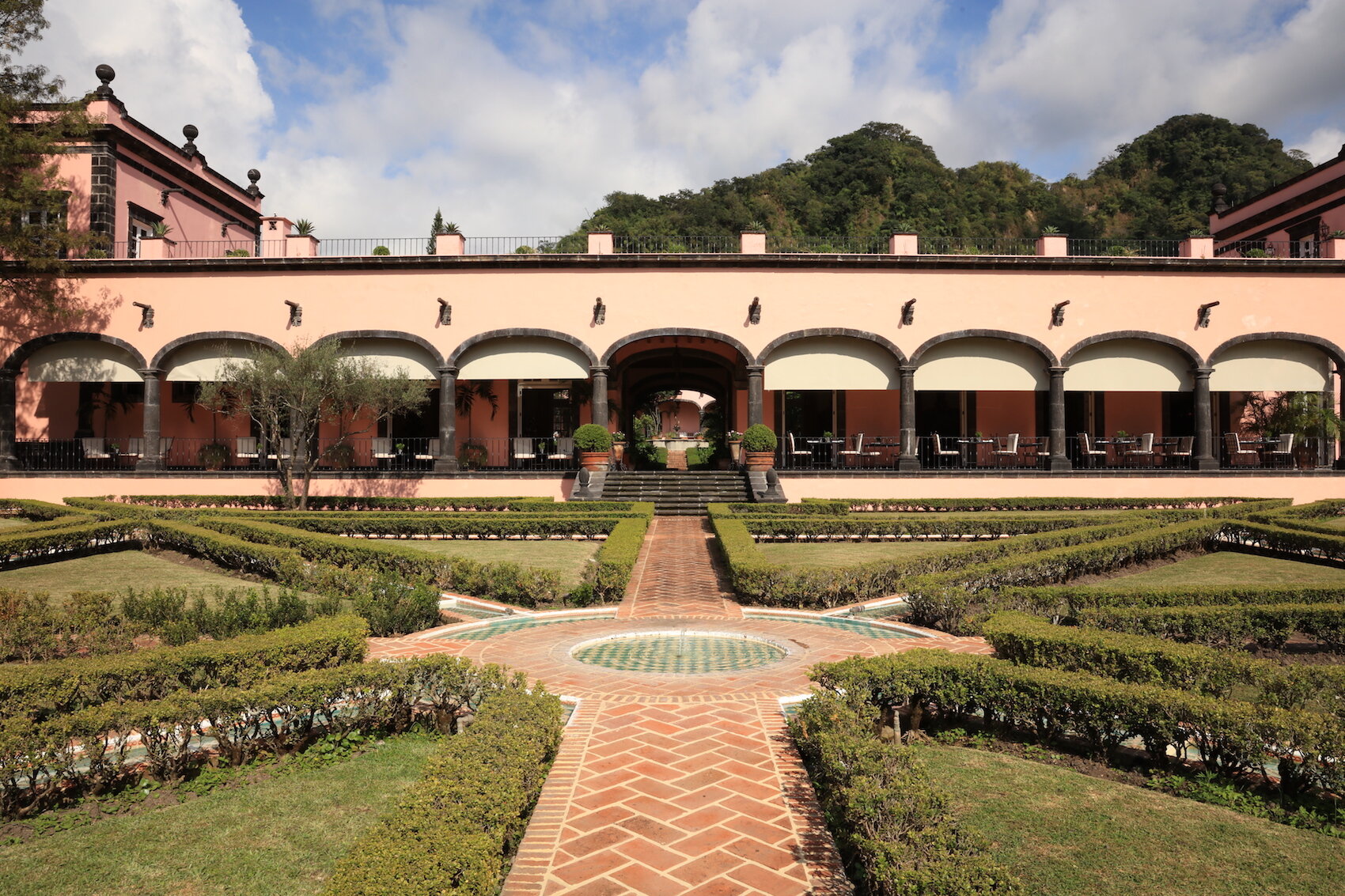
Hotel Review - Hacienda de San Antonio
An extract from the Mexico magazine.
Words by Liz Schaffer & Photographs by Angela Terrell
It’s funny how quickly a place can feel like home. Within minutes of arriving at the blush-hued, forest-framed Hacienda de San Antonio, it was mine. This historic hideaway is an oasis, an art-and-colonnade-adorned delight, a hotel with character - its personality reflected in its geometric gardens, sprawling fields and staggering heights. The star though is Volcán de Colima, a magnificent beast entwined with the hacienda’s story; backdropping the homestead and enriching the soil and scenery of the attached, 2,000-hectare Rancho Jabalí.

Although poolside-lounging and cocktail-sipping are encouraged, to fully understand Hacienda de San Antonio and the land it stands upon, a guided ranch tour is essential - after all, Rancho Jabalí supplies the hacienda with around 80 percent of its organic produce. You can visit its cheese factory, where greenery sprouts from the roof and the cobbles are dotted with fallen walnuts. 300 resident cows (who roam free and feast on corn and coconuts) produce 500 litres of milk each day, alongside an army of goats. From this milk, 19 varieties of cheese are made - the most scrumptious of which is the burrata that I ordered with every meal and justifiably refused to share. Or there’s the neighbouring coffee factory, a vestige of the hacienda’s coffee-growing heyday. Production may now be boutique but the beans (picked by hand by local women, many of whom hail from the nearby papel picado-festooned Comala, a Pueblo Mágico) remain excellent, their roasted aroma akin to a nutty, velvety chocolate.

Further in, past bamboo groves and roving raccoons, are lakes ideal for paddleboarding, apéritifs and dinners beneath the stars. You’ll spy iguana-guarded stables, trackside sunflowers, misty waterways, riding trails and herds of unhurried cows grazing amidst the cacti. Here, there are a hundred different landscapes and innumerable spots for a picnic where you’re encouraged to simply sit and look, cradled by mountains, calmed by birdsong and dwarfed by the scale.

Such views are matched by the mirador, a bamboo structure found among the clouds. Hike up here for breakfast and while away an hour watching butterflies flit through the air, their vibrancy mirroring the wildflowers that flavour the hacienda’s honey. Seeing these balletic creatures, my thoughts turned to Mexico’s great migration; the majesty of the monarch and how brilliant it would be to see them in flight. But then I gazed out, past a hummingbird, over the valley, across the river, into the cascade of green, and back to the ever-smoking volcano - brooding and mysterious - and I remembered where I was and how glorious it felt.
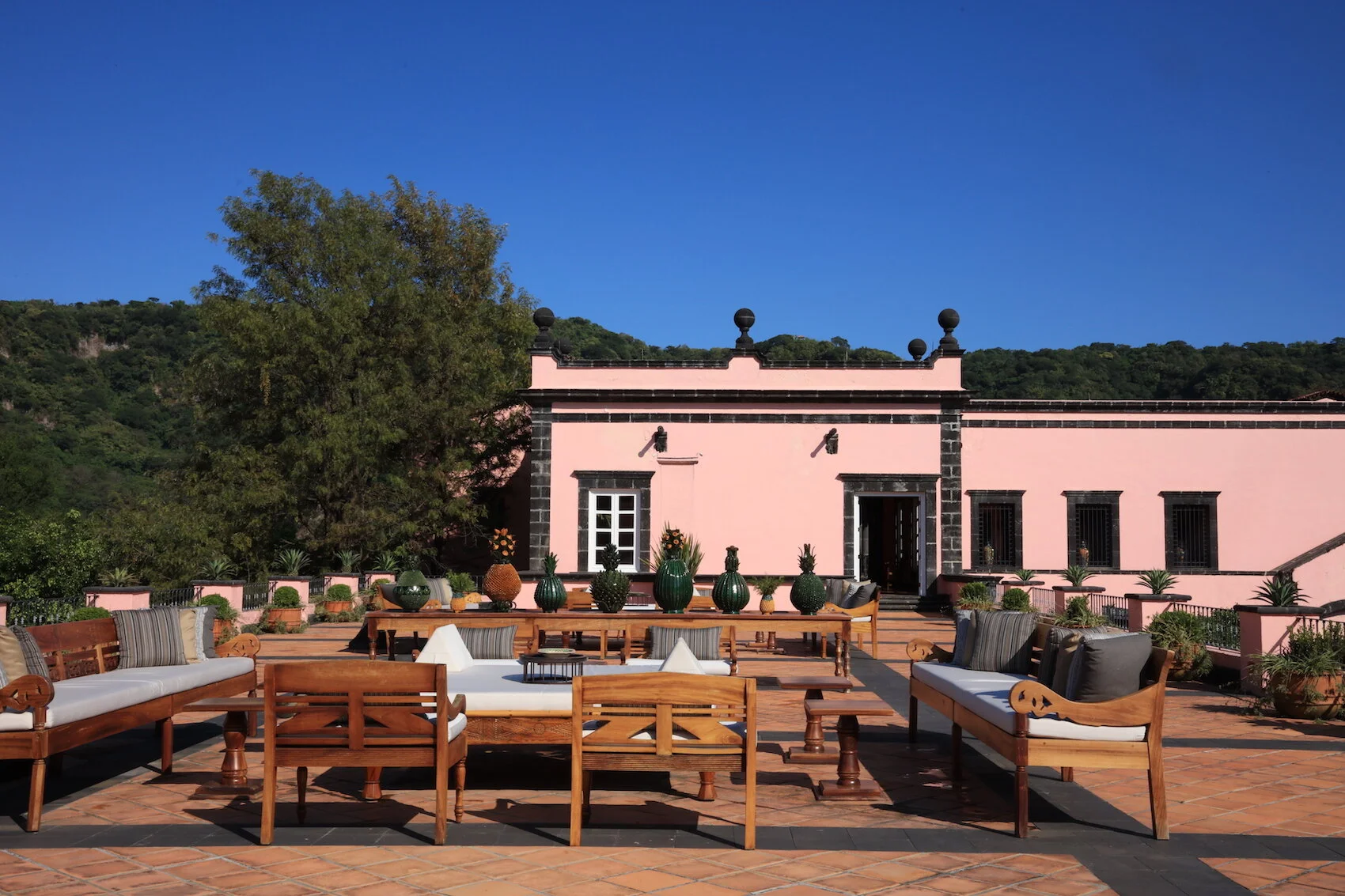
The drama of the landscape is reflected in the homestead’s interiors. The 25 lavish suites feature soothing assortments of terracotta and textiles - carefully curated spaces perfect for volcano-watching and in-room massages. You can spend an evening among lanterns and ceramics on the terrace as Volcán de Colima glows pink in the sunset, daydream in the library, survey the gardens with a hot chocolate and concha, or dine before a roaring fire, so lost in the details - the painted ceilings, chandeliers, murals and antiques - that you almost forget to eat. All around are beaded masks, carved doors, ornate mirrors, black stone aqueducts, fountains and ferns. It is a setting designed to enrapture. Inviting and gallery-esque, Hacienda de San Antonio is a place of luxury and magic, of nature and style, the sanctuary of dreams. Welcome home.
This feature first appeared in our Mexico magazine, which you can order by clicking here.


Sail Away
A different side to Sweden.

Words by Jen Harrison Bunning
Photographs by Tom Bunning
It’s curious that I’d never been curious about Sweden before. My Scottish father was seconded to Stockholm in the 1960s as part of his medical training and my Cotswolds childhood was peppered with Swedish notes: breakfasts of knäckebrot and Kalles kaviar branded smörgåskaviar (crispbread and caviar paste), evening feasts of my Australian mother’s take on svenska fisksoppa (fish soup) and afternoon snacks of Annas Pepparkakor (ginger thins). Aside from the odd delirium-inducing trip to IKEA, a passion for Wallander and late night cook-ups with friends making vats of that same fish soup, Sweden had somehow fallen off my radar.
It was a conversation at dusk over a whisky with my father that ignited a longing to discover the country that had helped shape my taste buds, and the place he had discovered at around the same age I find myself now. He regaled me with stories of the Stockholmers’ easy hospitality, long kitchen suppers, summer days messing around in boats and nights spent wild camping out on the islands of the archipelago, making the most of the Swedes’ law of Allemansrätten (the Right of Public Access). This sort of AAA pass gives any person the right to visit someone else’s land, bathe in and boat on any water and gather wild flowers, mushrooms and berries, amongst other things, from almost anywhere, so long as you’re suitably respectful of the owner’s rights. It sounded blissfully bucolic. But memory can apply a soft filter to the mind’s eye through which the past appears honeyed and mellowed. Added to this, we were finally visiting just on the cusp of winter, so I didn’t know quite what to expect from my first experience of Sweden’s quiet Baltic treasure, the archipelago islands.
Flying into Stockholm gave a tantalising first glimpse of the some 30,000 islands and skerries that make up the archipelago’s Skärgården (garden of skerries) and as we touched down I could hardly wait to get out on the water and start exploring. With a few hours to kill in the city it became apparent that you could ask any Stockholmer about the archipelago and their enthusiasm would have you heading straight down to the port and hopping on one of the many ferries heading east towards the Baltic Sea. Luckily that’s exactly what we were doing. So with bellies full of hip eatery Urban Deli’s recommended special of pea soup and pancakes (apparently the ruminations of the Nobel Prize for Literature Committee are conducted over this very meal) we boarded a Waxholmsbolaget ferry for the first stop on our archipelago adventure: Vaxholm.

You could go by road to Vaxholm, crossing the water at the bridge over Pålsund, but why do that when you can travel by sea? For year-round islanders the trip would be a very ordinary commute home, so naturally they stayed below deck in the warm for the hour-long journey. But as virgin voyagers we couldn’t resist zipping up our coats and venturing to the back deck for a blast of Baltic Sea air.
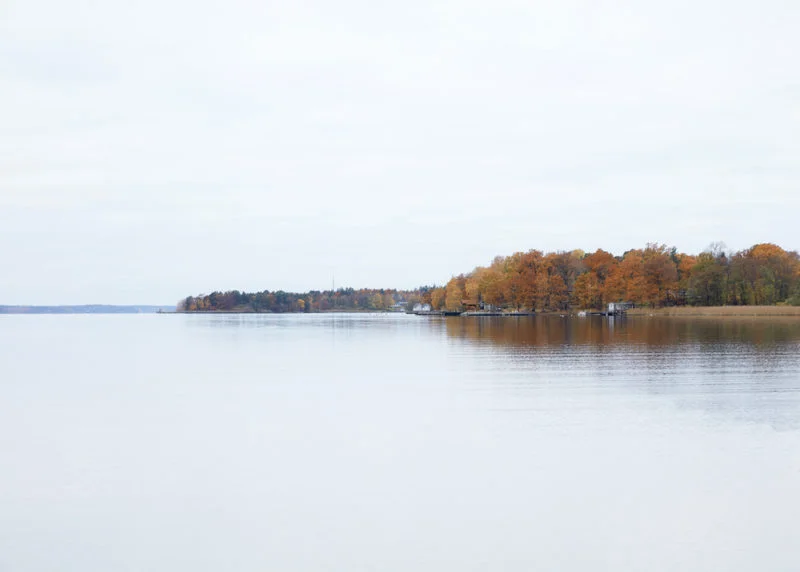
It’s easy to imagine these islands and waterways buzzing come July, filled with sailing enthusiasts, day-trippers and seasonal residents toing and froing from summerhouses. However, on a cold November weekday the water was calm and the air still, and as dusk fell the city’s lights winked and flickered in the distance. I could feel the grime of a London winter seeping from my skin; it felt cleansing, stimulating, a reprieve from the stresses and strains of everyday life. I was hooked already.
Disembarking at Vaxholm Harbour, cries of “Tak” and “Hej-då” rang through the cold air as islanders hurried down the gangplank and across the harbour towards warm homes (and steaming bowls of svenska fisksoppa, no doubt) and we headed towards the welcome sight of the Waxholms Hotell looming out of the dusk.
This splendid old fishing hotel was opened in 1902 by Augusta Karlsson, an extraordinary woman from Sweden’s southern district of Vetlanda. Augusta was a true archipelago entrepreneur who, having been orphaned in her early teens, moved to Stockholm to make a living. She worked as a maid, a seamstress and in catering on the railroads before turning her attention to boats. Here she went into business with the Waxholmsbolaget ferry company to purchase the Waxholms Hotell, becoming the General Manager – no mean feat for a woman at the turn of the century. With one of only three liquor licenses on the island, a thriving music scene and spectacular views across the archipelago, Augusta and her hotel helped put Vaxholm on the map. At the time of our visit the Waxholms Hotell was coming to the end of a refurbishment project, having recently changed hands for the first time in 35 years. After several decades of nautical inspired décor, the new owners were carefully restoring it to its original 1880-1920s glory, complete with a grand bar, fittingly named The Augusta for its pioneering founder.
Vaxholm itself has a rich seafaring past, famous for its role in defending Sweden from marauding would-be conquerors throughout the centuries, as well as its fleet of strömming (Baltic herring) fishermen. History enthusiasts may spend hours exploring its fortifications, citadel, museums and winding lanes, but Vaxholm’s wide-ranging charms include birch and fir woods for balmy walks, beaches for bathers and boutique shops, restaurants and chic B&Bs for pleasure-seekers and foodies. The islanders urged us to come back in the summer to revel in the archipelago party season, but for us hyped-up citydwellers it was the cold, grey skies, the rich autumnal hues, the closed sign of the ice-cream parlour clattering in the breeze and houses shut up for the winter months that signalled paradise.
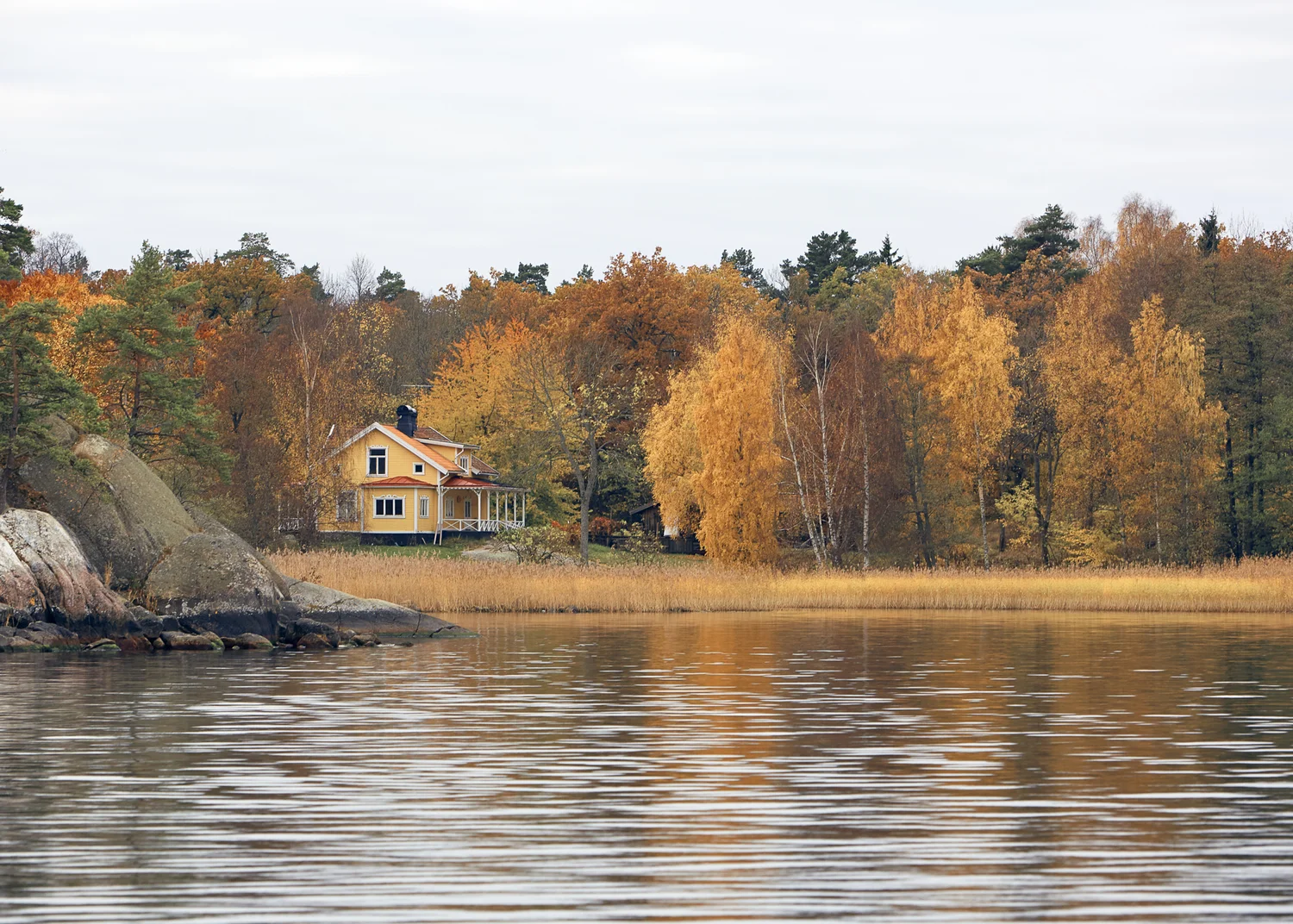
Once filled with fishermen, farmers and sailors eking out a living from the islands and sea, the archipelago’s economy now feasts on summer residents and tourism, but come winter the population shrinks and today’s islanders need to be creative to keep vital lifelines open through the shorter dark days. We heard stories of local entrepreneurs including cheese-makers, craft beer-brewers, boutique B&B owners and even a mobile slaughterhouse that travelled from island to island to service farms and small-holdings. Enter one such creative soul, Captain Anders Borjesson – a charming grocer-cum-skipper who invited us onboard his taxi-boat for a private tour of the local waterways.

Passing along the strait with traditional wooden houses on one side and the imposing citadel on the other, we raced through narrow passages and weaved in and out of spiky skerries before reaching open water, where the real magic of the archipelago’s natural beauty revealed itself. This watery wonderland with its silvered rocks, windswept pines and grass-covered hillocks was breathtaking and we had it all to ourselves. Waterside cabins and summerhouses of all shapes, sizes and hues adorn most of the islands, from modest huts painted in the traditional Falu Rödfärg rust-red paint with their jaunty white-trimmed windows, to elegant pastel-coloured mansions. We came ashore at a white sandy beach on an uninhabited island and, filled with the Swallows & Amazons spirit of young children, raced up a small hill to find the perfect camping spot - the fire would go here, the tent there, we’d bathe in these shallow waters, and we’d forage for berries, if it wasn’t quite so freezing . . .

In summer it’s reputedly difficult to find a Swede in Stockholm as they all flee the city for their holiday homes, and with this natural paradise on their doorstep it’s not hard to see why. The Swedes take their summers very seriously and messing about in boats on the archipelago would be a serious treat under the Scandinavian sun. But for a couple of weary Londoners, puttering about on a very cold, quiet corner of the earth with its expanse of iridescent water, island havens, open skies and rich hues of green, copper and gold, it was the autumn archipelago and its calm beauty that captured our hearts and imaginations. And, just in case we needed any more persuading, as Captain Anders turned about for our return leg to Vaxholm we were offered one last treasure. A giant eagle perched atop its rocky maroon beat its wings once, twice, a third time, and made for the heavens, circling up and up into the low grey skies.
Returning to London, I waxed lyrical about the archipelago to anyone and everyone, including my permanently insouciant and well-travelled father. “Well, yes,” he said, “the Stockholm archipelago is a wonderful part of the world and you certainly should go back in the summer. But if you want a real Swedish midsummer adventure . . .” I poured us another whisky and let the storyteller take me on a road trip up the east coast, round the Gulf of Bothnia, across the Finnish border at Haparanda and on a tiny plane from Kimi to the transient sunshine state of the Arctic Circle where, “it was blazing hot, there were flowers everywhere and we partied all day and night long under a never-setting sun.” Time to get the map out.
Extract from Lodestars Anthology Issue 5: Sweden
Shape of a Boy - My Family & Other Adventures
An extract from Shape of a Boy, My Family & Other Adventures, by Kate Wickers.
The Long Read: In an excerpt from her travel memoir Shape of a Boy, My Family & Other Adventures, Kate Wickers shares an edited version of her chapter on Borneo and what the Malay island taught her family about perseverance.
“You’re going where?” asked my dad.
“Borneo,” I repeated, guessing that he was hoping that he’d heard incorrectly, and I’d said Bournemouth, Bognor, or Barry.
He glanced at his precious grandsons. Josh aged seven, Ben five, and Freddie a whisper off two.
“Is that a good idea?” he wanted to know, images of head-hunting tribes no doubt marauding through his imagination.
“Can’t think of a better one,” I told him.
I didn’t admit it, but I thought that my dad might have a point. Was this such a good idea? This was the first long haul adventure trip we’d taken with three children, and in choosing Borneo we were certainly throwing ourselves in at the deep end. Five was such an awkward number in so many ways. Now we had three curious, and, at times, overly-confidant boys to keep track of in a destination that was unfamiliar and full of potential hazards. For the first time in my life, I didn’t sleep the night before our departure, sick with sudden worry.
The day after Freddie turned two, we flew to Kuala Lumpur, the gateway to our adventures in Sabah, Borneo. Our plan was to let the kids acclimatise and shake off their jet lag. We’d been there just two hours when, while paddling in the shallow end of the roof top swimming pool, Ben suddenly screamed and clutched at his foot. He’d stepped on a diamond stud earring, and it had pierced deep into the sole of his soft skin. Of all the snake-biting; kid-stealing; boat-sinking disasters I’d envisioned over the last few days, this wasn’t one of them and strangely, after pulling out the earring (a trophy, which Ben was reluctant to give up), I relaxed. We were here now, and this was most likely the worst accident we’d encounter. I was determined not to ruin the experience by anticipating danger at every turn.
Kota Kinabalu is the capital of Sabah, Borneo’s most northerly state, and it was shrouded in low brooding cloud the colour of granite when we arrived after a two-and-a-half-hour flight from Kuala Lumpur. Humidity was high and our driver warned that a storm was brewing, and that we should hurry to our transport. Ben, still milking his recent impalement, limped (on the wrong foot) from the surprisingly modern terminal to the old banger of a minibus I’d pre-booked to pick us up. Our destination, Shangri-La’s Rasa Ria Resort, lay between rainforest and sea, an hour’s journey north from here and I watched as the wooden crucifix, that hung from the rear-view mirror, swung at every bump and twist in the pot-holed roads. As our driver had predicted, the heavens opened just ten minutes into the journey.
“I can’t shut the window,” I shouted back to Neil who was at the back of the bus. In fact, none of the windows on the right side of the bus would budge so we all scooted to the left and watched as the raindrops bounced on the seats next to us.
“Nice! Refreshing!” our driver bellowed above the clatter of rain on the roof. No doubt he was hoping the fact we were getting soaked to the skin wouldn’t ruin his chance of a tip.
There were two reasons to bed down at the beach resort I’d chosen for Christmas – its stunning location and its private nature reserve, home to eight young Bornean orangutan orphans. This was to be our first orangutan encounter and the boys were both excited and a little nervous.
“Will the monkey cuddle me?” Josh wanted to know.
“Orangutan,” I corrected him.
“Yes, but will the monkey come into our bedroom?”
“Orangutan. And no, they won’t cuddle you or come into your bedroom.”
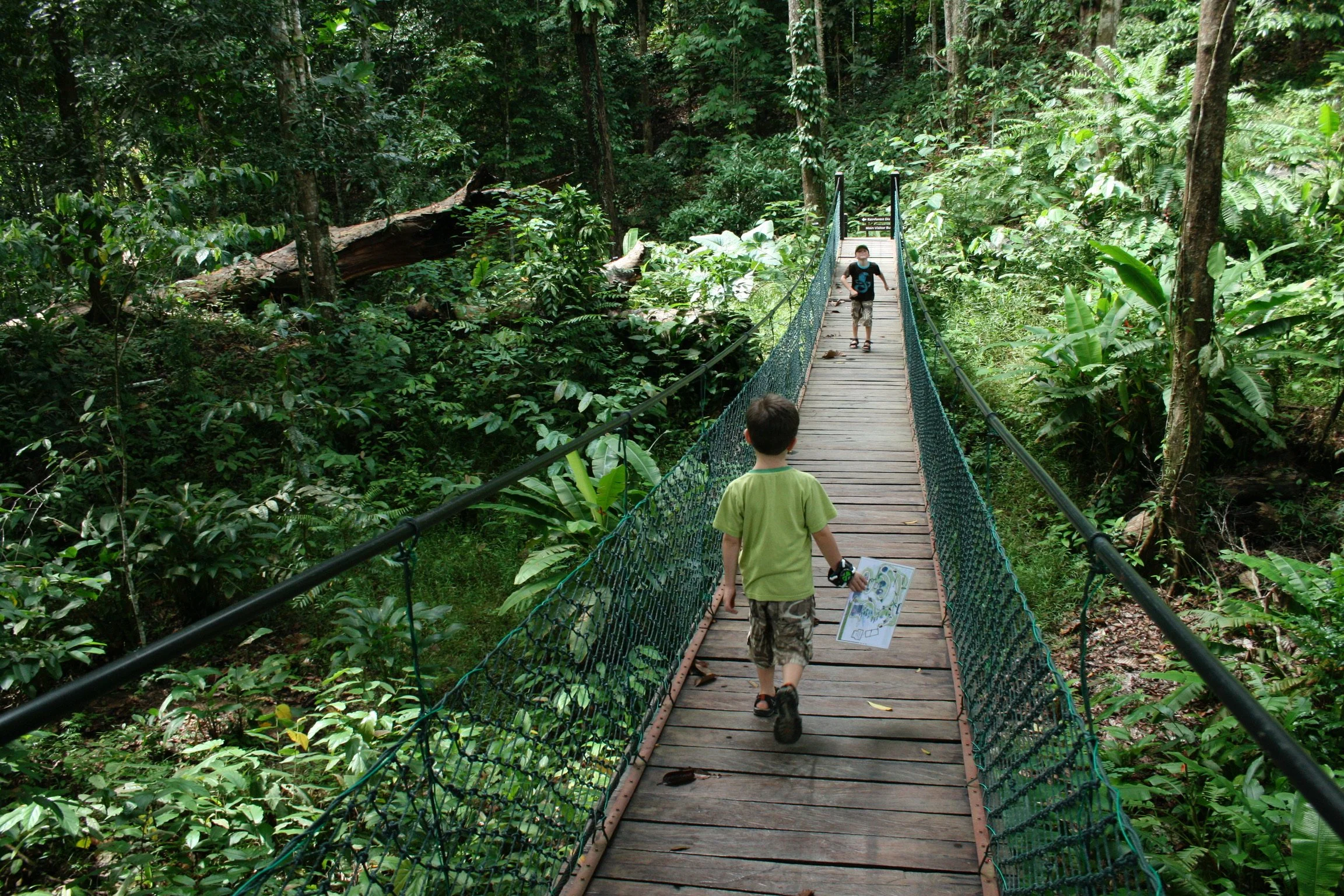
Josh looked relieved. By now the sun was out and we headed for the reserve – more a half-way house for waifs and strays, at liberty to roam during the day and play amongst the vines and vegetation, but by night housed and protected by rangers. Their next residence would be the famous Sepilok Rehabilitation Centre, before ultimately, they would be reintroduced to the wild. I held Freddie monkey-style on my hip to give him a better view, and soon the young orangutans spotted him, and hurried over to check out his mop of scruffy fair hair and cheeky grin. He entertained them with a series of impressive and well-rehearsed “oo ooos”.
“Do it again, Freddie,” instructed Josh, impressed by his baby brother’s linguistic skills. Ever the performer, Freddie obliged and then stuck out his tongue at a five-year old orangutan, named Cute, who stuck his right back out at Freddie. We all squealed with delight.
“Again, Freddie,” begged Ben, jumping up and down. If you were ever looking for a wonderful example of the gift children have in simple communication, then this was it. What fun these two were having without the need of a language, and what a pity we seem to lose this ability as adults. Freddie and Cute had bonded that was clear, and sharing 97 percent of the same DNA why wouldn’t they? They stuck their tongues out at each other a few more times before a piece of sugarcane caught Cute’s eye and he ambled off.
Once Christmas was over, we travelled on to Sandakan on the East coast. The attraction here was the Sepilok Orangutan Rehabilitation Centre, founded in 1964 and home to around eighty orangutans, which sprawls over 43 sq. km of protected land in the Kabili Sepilok Forest Reserve. Our home for the next few days was a basic wooden chalet at the Sepilok Nature Resort, built amongst a rainforest foliage of palms, pitcher plants, giant ferns, and near enough to the rehabilitation centre that we could hear the orang-utan’s soft hooting night-time calls. With their new Christmas binoculars glued to their eyes, Josh and Ben went off to explore gardens alive with croaking toads, over-excited grasshoppers, and rowdy indigo flycatchers, but soon came running back when a frog leapt on to Josh’s shoulder. We were excited to find out if Freddie, the orangutan whisperer, still had the gift and spent the next two days visiting the rehabilitation centre to watch him at work. He chatted away enthusiastically to any orangutan that would listen and of the five of us, it was always Freddie who caught their eye, but he never did find another quite as obligingly responsive as Cute. These were happy hours spent observing the energetic apes as they somersaulted and swung along the jungle vines, and we agonised over which orangutan to adopt, finally agreeing on a young adult male called Sen. 25 pounds would keep him in food and shelter for another year and we were promised a letter every three months from our surrogate primate. “He’s cleverer than you, Freddie,” I heard Ben whisper. “You can’t even write.”
In the evening we left the boys squashed into one bed after they’d clapped eyes on a spider with a body the size of a jammy dodger biscuit (Ben’s rather unique analogy, not mine), while Neil and I sat on the veranda to make plans for the remainder of our stay. To have come all this way and not to have seen an orangutan in the wild seemed ridiculous. And yet, we knew the chances were heartbreakingly slim. Illegal logging; mothers with babies caught for the meat and pet trade; and the slash and burn technique often used to make way for palm oil plantations had rendered the Bornean orangutans as endangered. Perhaps it was already too late. Plus, we’d been told that travelling on from here with young children wasn’t advisable. I’d heard that orangutans were sometimes spotted near to the Kinabatangan River, Malaysia’s longest and rich with wildlife, which was a mere 25 kilometres away, but the road to get there would be rough. Fleetingly, I thought of my dad’s concern over this trip, and then voiced what I knew Neil was already thinking. “Let’s give it a go,” I said. We arranged a car and driver to pick us up a day later.
Our Malay driver and guide, Adam, raised his eyes at the sight of our young sons, then quickly rearranged his face to a broad smile, high fiving each of them as they climbed into his 4WD truck.
“Woo hoo!” whooped the boys. I watched them happily bouncing about; their bums rarely making contact with the seats as we bumped over potholes and through ditches along the dirt-track roads. Oh, the joy of being able to stay that relaxed while being flung about like rag dolls. When we reached the jetty, we transferred to a small motorboat and Adam told us to keep a keen eye out for shy pygmy elephants and also for the proboscis monkey, which with their enormous great hooters, protruding potbellies, and permanently erect penises, was soon providing fodder for school-boy humour.
“And orangutans?” I asked.
“Unlikely,” came his reply.
“But perhaps, if we’re lucky?”
Adam shrugged, reluctant to make promises, pointing to a brilliant blue stork-billed kingfisher that was flitting along on the bank. Pig-tailed macaques gave aerial displays, leaping from tree to tree; and pied hornbills bellowed for attention above the constant shout of, “look at his willy” from the boys, each time a proboscis monkey came into view.
At every rustle in the trees my heart missed a beat as I scoured the treetops for a flash of that distinctive ginger coat, but the orang-utan was either elusive or never actually there. Either way, I resigned myself to the probability that we’d never see one in the wild.
“Do you want to go here on the way back?” Adam asked us, pointing to a crease in a well-worn map when we were back at the jetty.
I gestured at the boys. “Perhaps it’s too much for them.”
He was suggesting a stop at the Gomantong Forest Reserve, famous for its caves where swift’s nests are harvested for the Chinese delicacy of bird’s nest soup.
“Amazing at sunset when the swifts return,” he promised me.
Again, Neil and I reminded each other that we wouldn’t be passing by here any time soon and so we agreed. The caves weren’t much to look at from the outside, and even before we’d set foot in, we could smell the toxic stench from the accumulated excrement of swifts and bats, known as guano. We ventured to the mouth of the cavern, and I looked at Neil. “What do you think?” I asked.
“I don’t like it,” Ben said. “Please can we go back?”
“It stinks,” sated Josh, who wasn’t known for mincing words.
Neil shrugged and picked up Freddie to carry. “We’re here now,” he said, taking his first step in on to slippery guano splattered floor. “Come on, boys! We can do this!”
Adam assured us that we would be through the cave and out the other side in just ten minutes. Fetid and gloomy, but unfortunately not quite dark enough so we couldn’t see cockroaches and giant millipedes scurrying around, I had to stop myself shrieking.
“You’re doing great,” I told them, just as Ben slipped and put his hand down to save himself.
“My hand’s got poo on it,” he wailed. “I want to go back to the car.”
“Oh God, this was a terrible idea,” I conceded, trying to wipe the odious substance off Ben’s hand with a tissue. Neil handed Freddie to me and scooped Ben up. Josh, as the oldest, had to fend for himself and we soldiered on.
“Peg your noses,” I barked, breathing through my mouth.
After ten minutes of picking our way through the cave, a large shaft of light came into view and we hurried towards it. “Sorry, boys. Never again. We’ll take you to the Isle of Wight next year,” I promised.
Adam had gone ahead to clear the path by kicking as much debris out of our way as he could. “Nearly there,” he called back to us. Up ahead I could see daylight (our exit from, what I was secretly calling in my head, ‘this God forsaken shithole’). As we stumbled out of the cave, into a clearing in the forest, I couldn’t have felt guiltier at having put my young sons through such an unpleasant ordeal.
“Oh, boys. I’m so sorry. That was awful,” I said. “We made a bad decision, but I’ll make it up to you…”
Adam gripped my arm. “There, look there,” he whispered.
I gazed up to where he pointed, a sudden movement catching my eye. My breath caught and my heart seemed to thud to a stop as I realised what was before us. “Look boys. Oh, my goodness, just look.”
Up in the bamboo, right before us, was the world’s largest tree climbing mammal - a female orang-utan reaching up for newest, sweetest bamboo leaves with her long grasping fingers. No one said a word. Even Freddie was silent, lost for his usual “oo ooos”. Her shaggy reddish fur was aflame in the setting sun. Intent on feeding, she wasn’t disturbed by our arrival and so we crept a little closer. Close enough to smell her musky odour, and to see how her feet gripped the bamboo stem, while she stretched her seemingly elastic arms up through the canopy. Then with a sudden movement she disappeared into the forest, leaving the trees quaking in her wake.
“Did you know she would be here?” Josh asked me.
I shook my head. “No idea. Aren’t we lucky?”
Adam agreed. “I’ve only ever seen one other so near to the cave.”
I was close to tears as what we’d witnessed sank in. “We almost gave up,” I reminded the boys. “See how it was worth it? We would have missed seeing her if we’d turned back.”
Ben sniffed suspiciously at his hands, and yet even he nodded.
To have seen the original wild man of Borneo not on a feeding platform but in a tree, feral and free, remains one of the rarest privileges I’ve had while travelling, made even more special by experiencing it with our young sons.
Kate Wickers’ travel memoir Shape of a Boy, My Family & Other Adventures (Aurum, £9.99) is available at Amazon and all good books shops in the UK, US, Canada, Australia, & New Zealand. Order a copy here.
Follow Kate @wickers.kate

Devouring Dubrovnik
A culinary odyssey with Hotel Excelsior.
Words & Photographs by Daisy Wingate-Saul
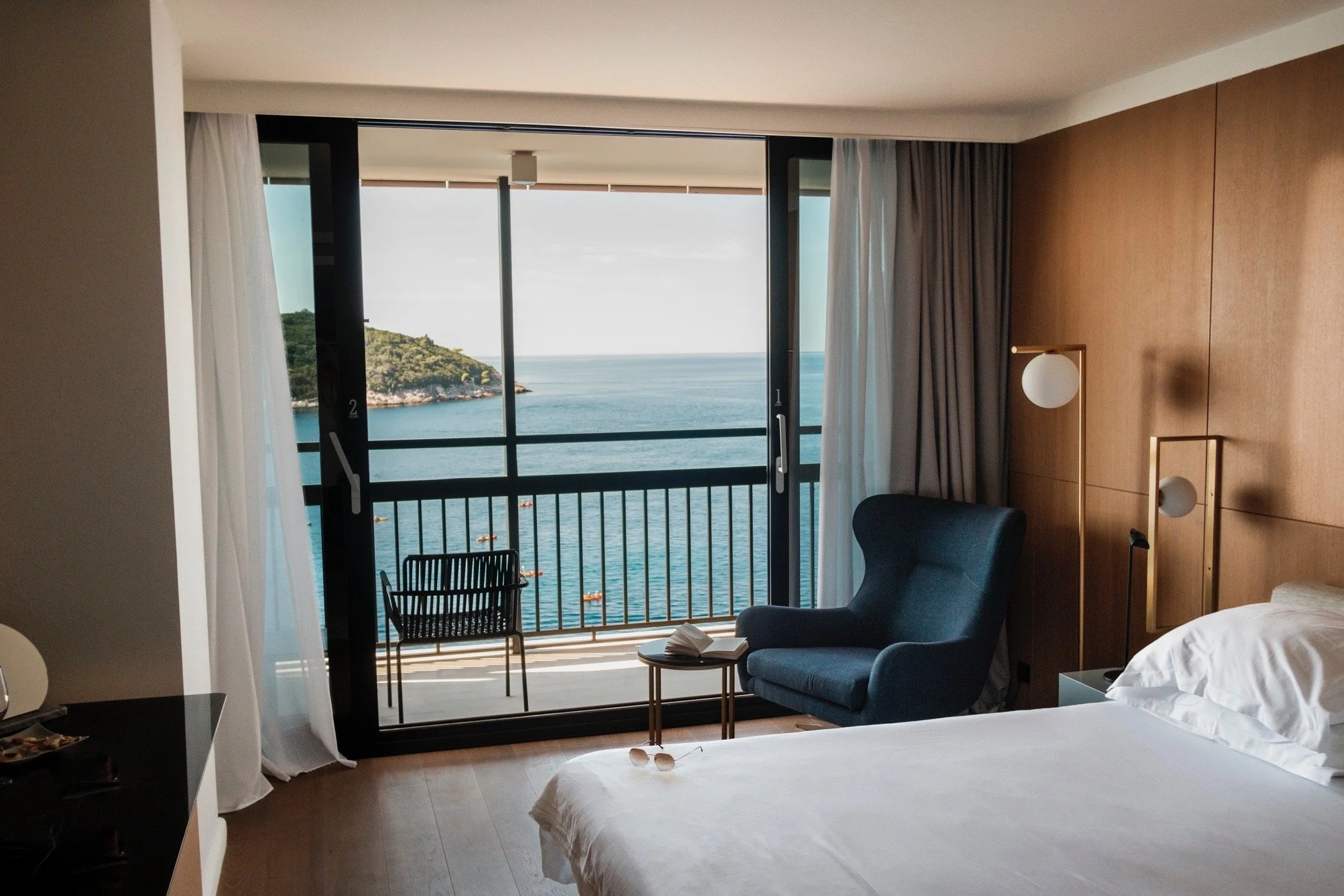
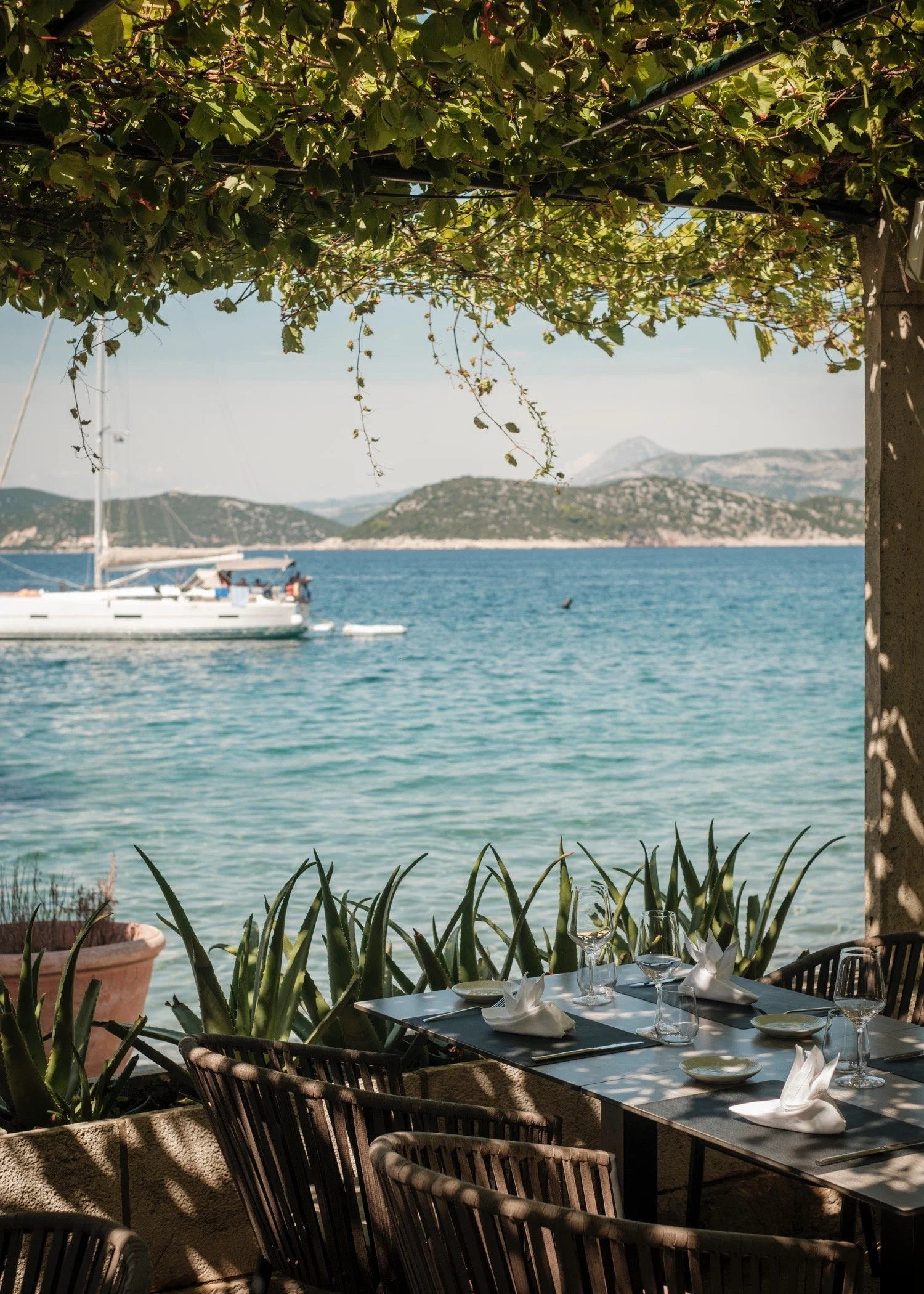
As the dawn light percolates through the curtains, I step onto my fifth-floor balcony, perched above the Adriatic sea. The warm breeze with its salty scent enfolds me like an old friend, dimming memories of a lacklustre London summer. The rich early light bathes the mythical island of Lokrum that lies across the bay, while to the west the city walls rise from the sea, ready to reveal Dubrovnik’s treasures.
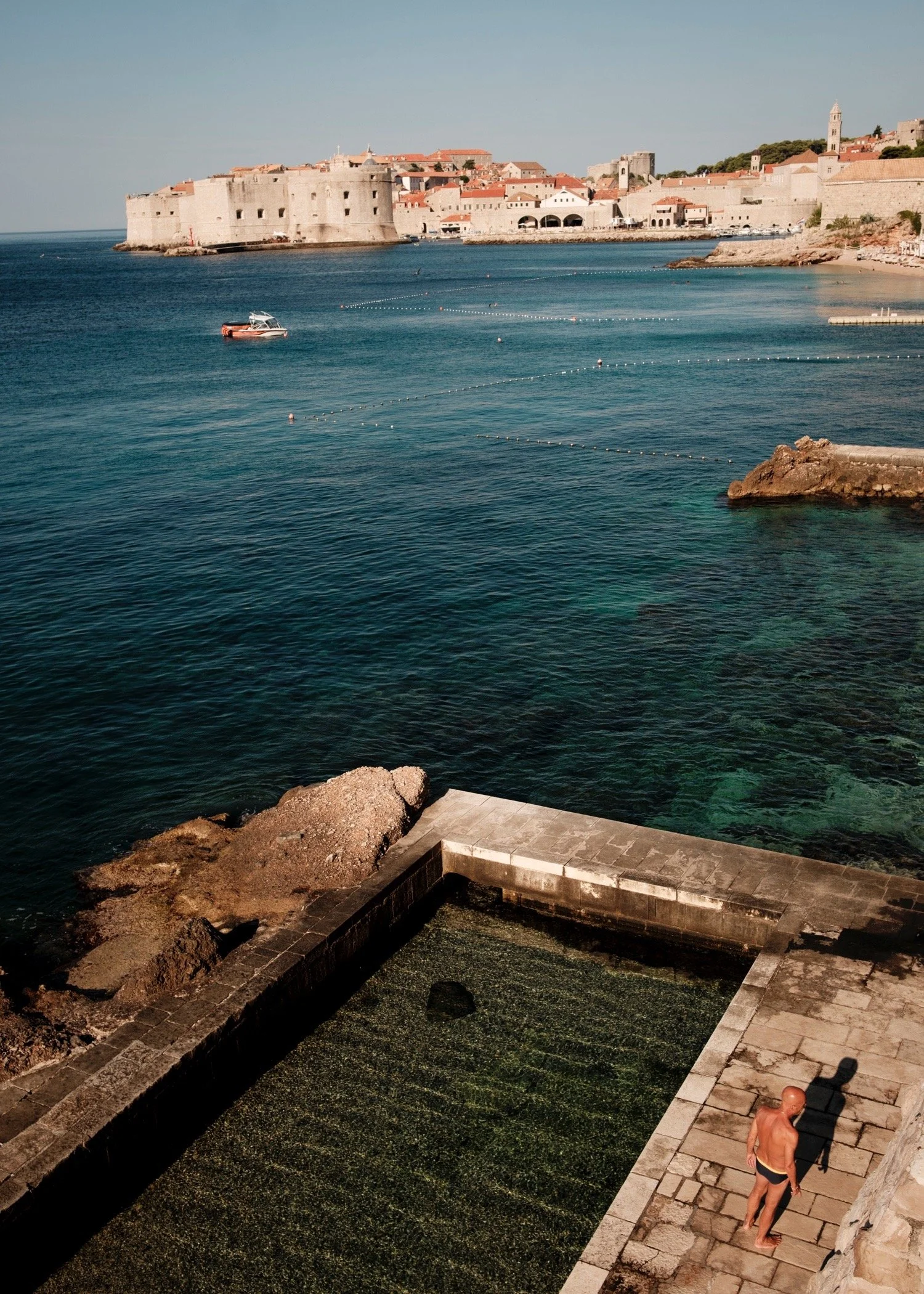
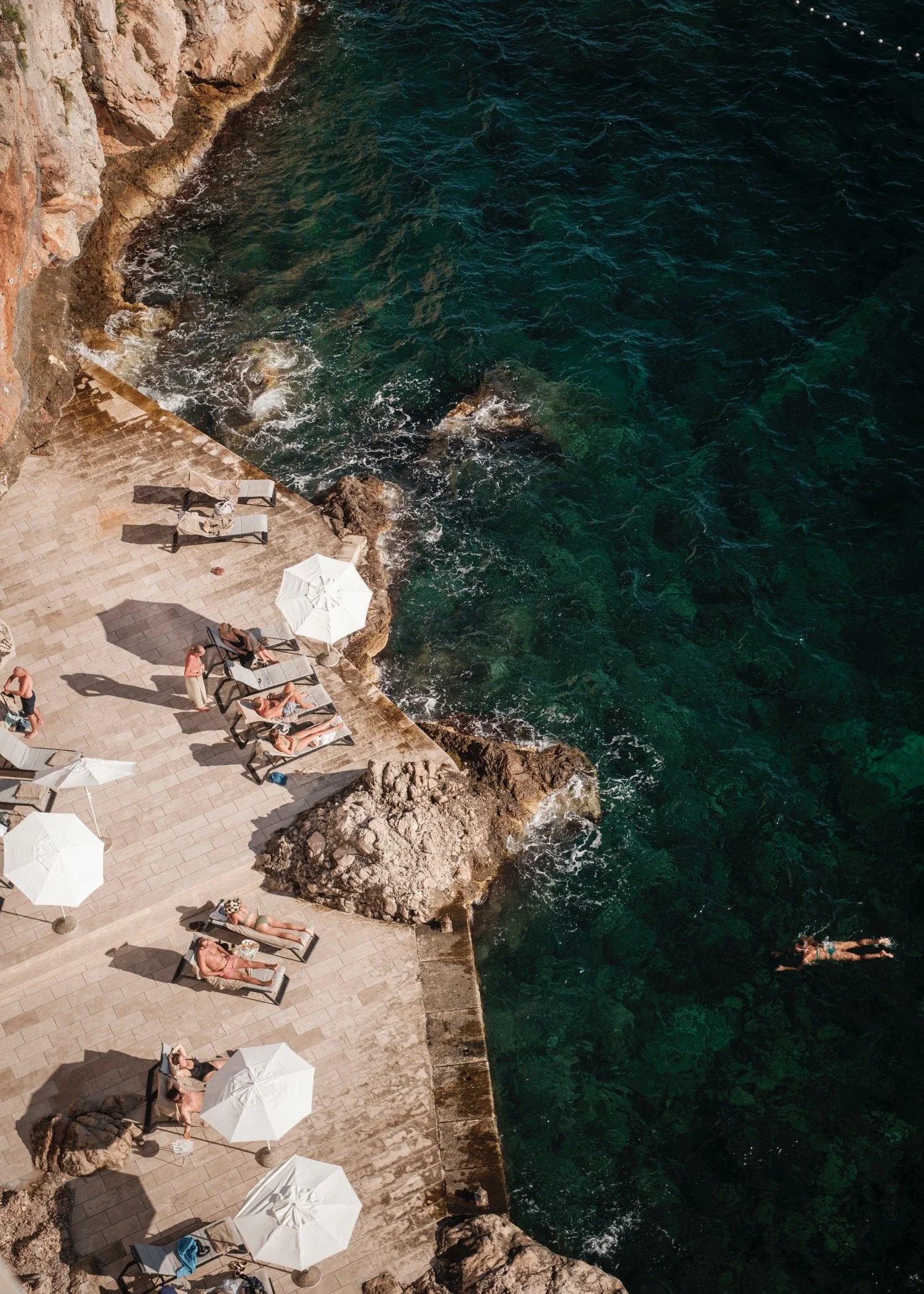
At the heart of my journey lies the 5-star seafront Hotel Excelsior, seamlessly blending historic villa charm with a modern six-story glass-fronted tower. Its contemporary interiors, seafront terraces, spa, indoor pool, secluded beach and three restaurants create an alluring oasis, yet its proximity to the old town calls for adventure.
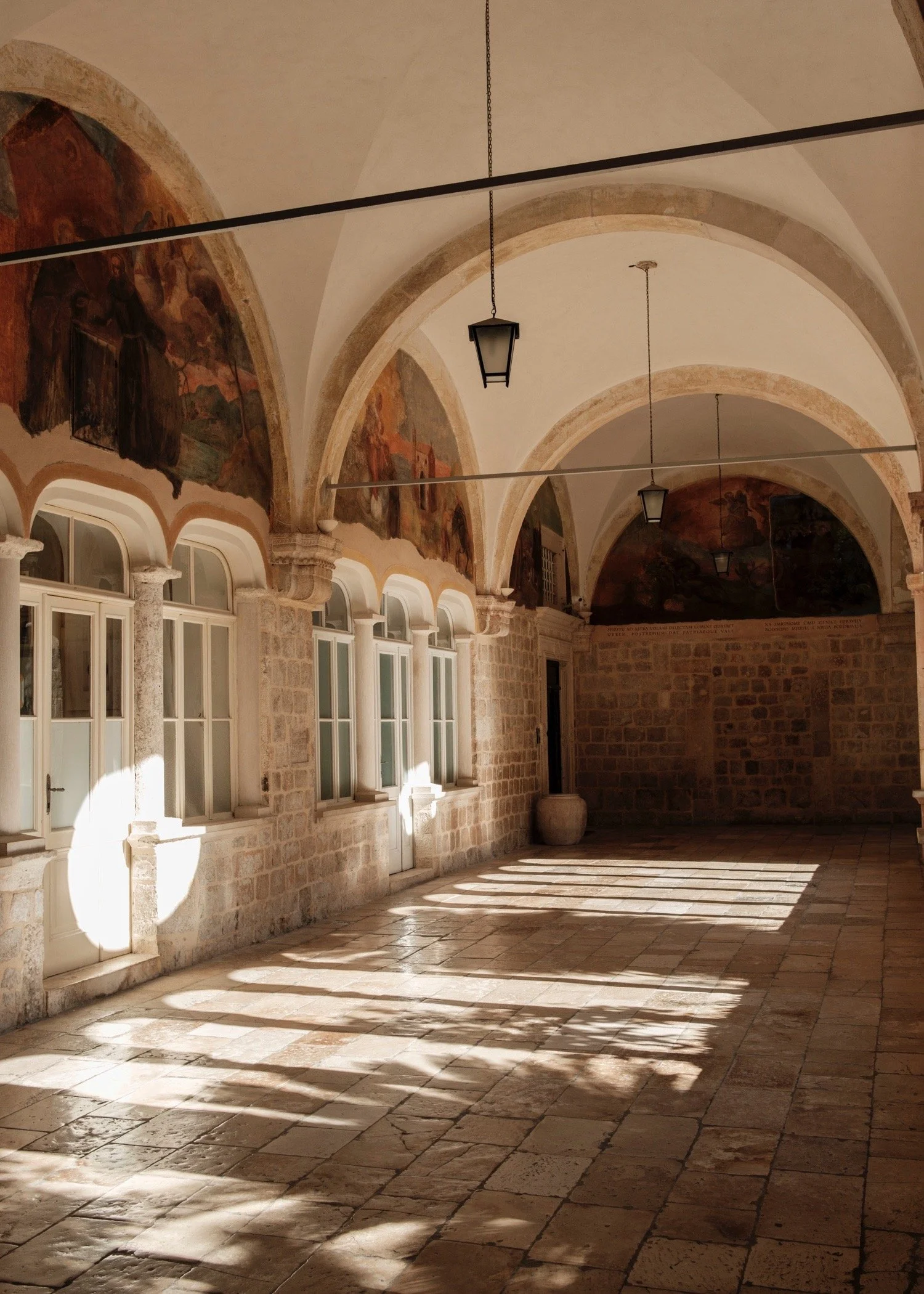
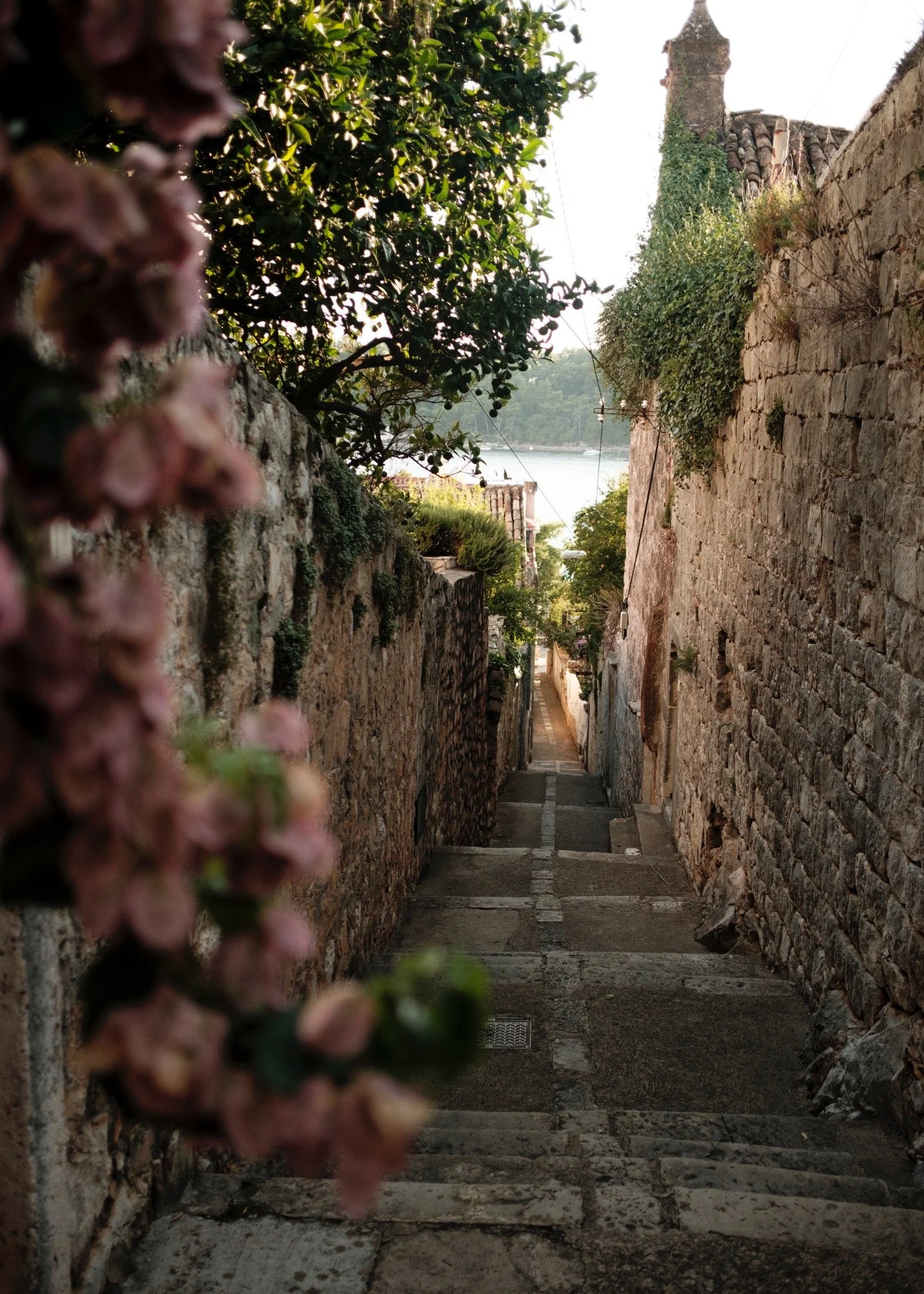
The Old Town unveils its true charm in the early morning. As I stroll through cobbled streets, soft buttery light bathes the sandstone buildings and their iconic Dubrovnik-green shutters. From the city walls, sweeping views of Gothic, Renaissance and Baroque facades frame the Dalmatian coast. In the Franciscan friary and church on Placa, adorned with ancient frescoes, a nun shops at one of Europe's oldest pharmacies as swifts dart through the cloisters above.
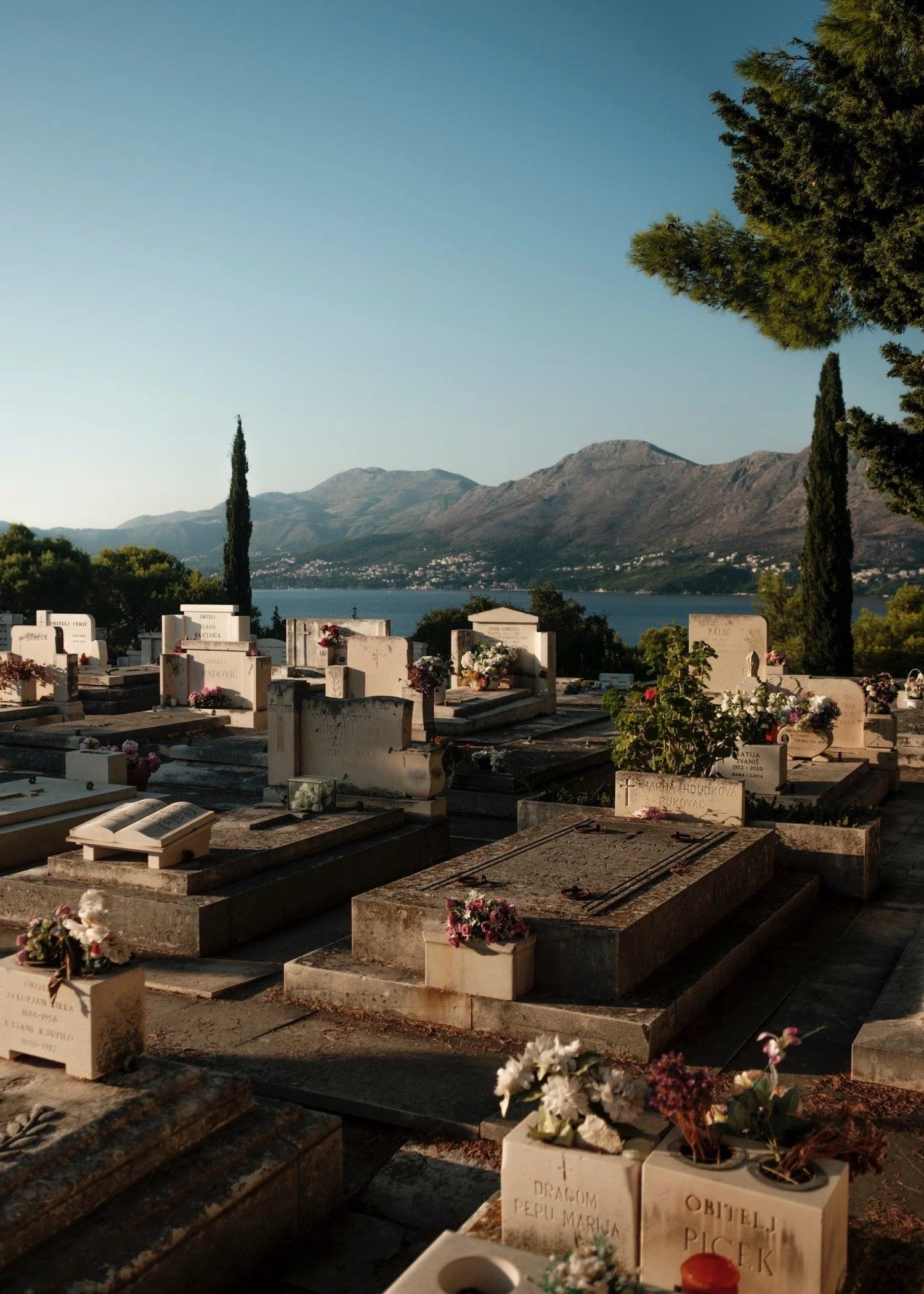
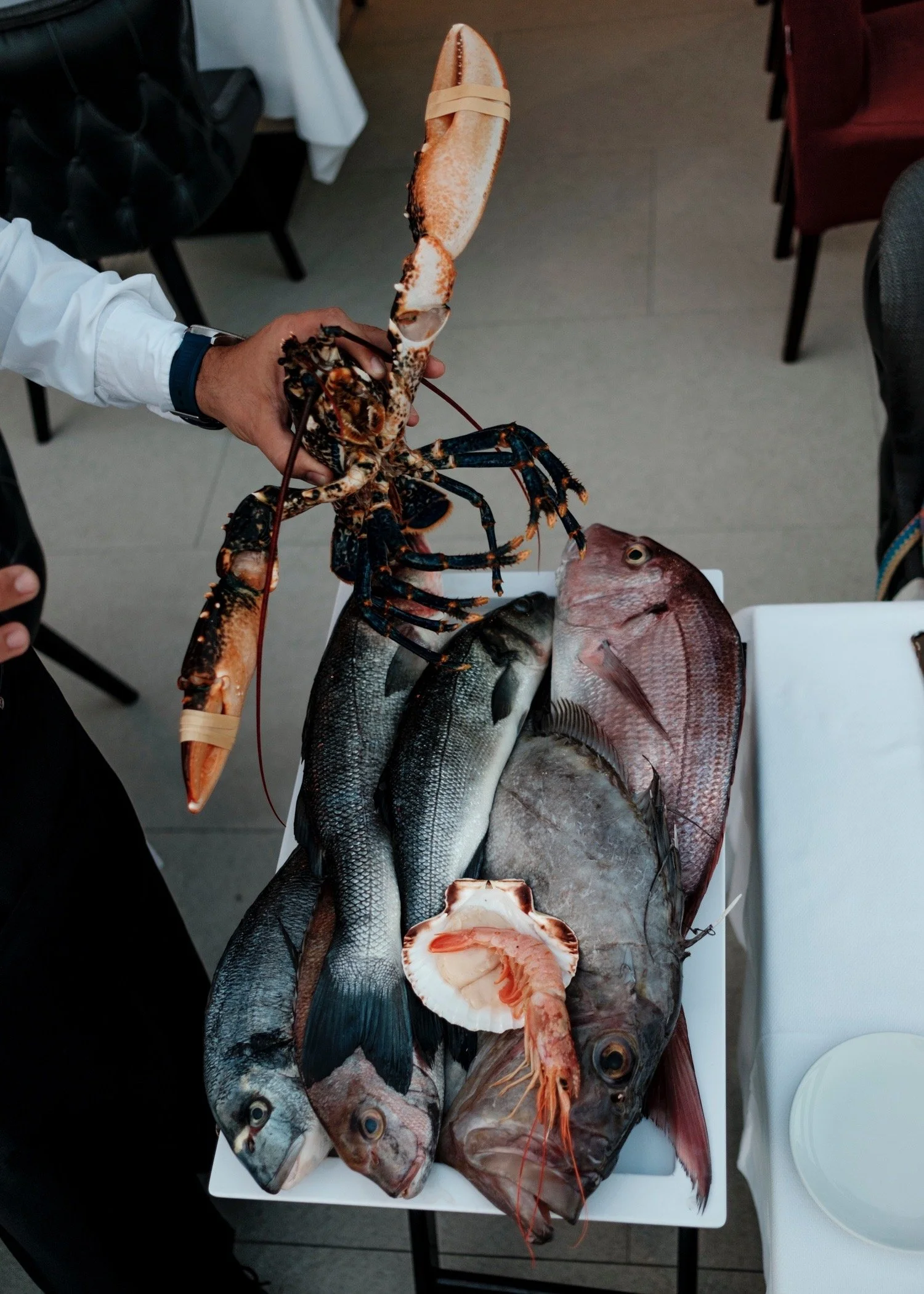
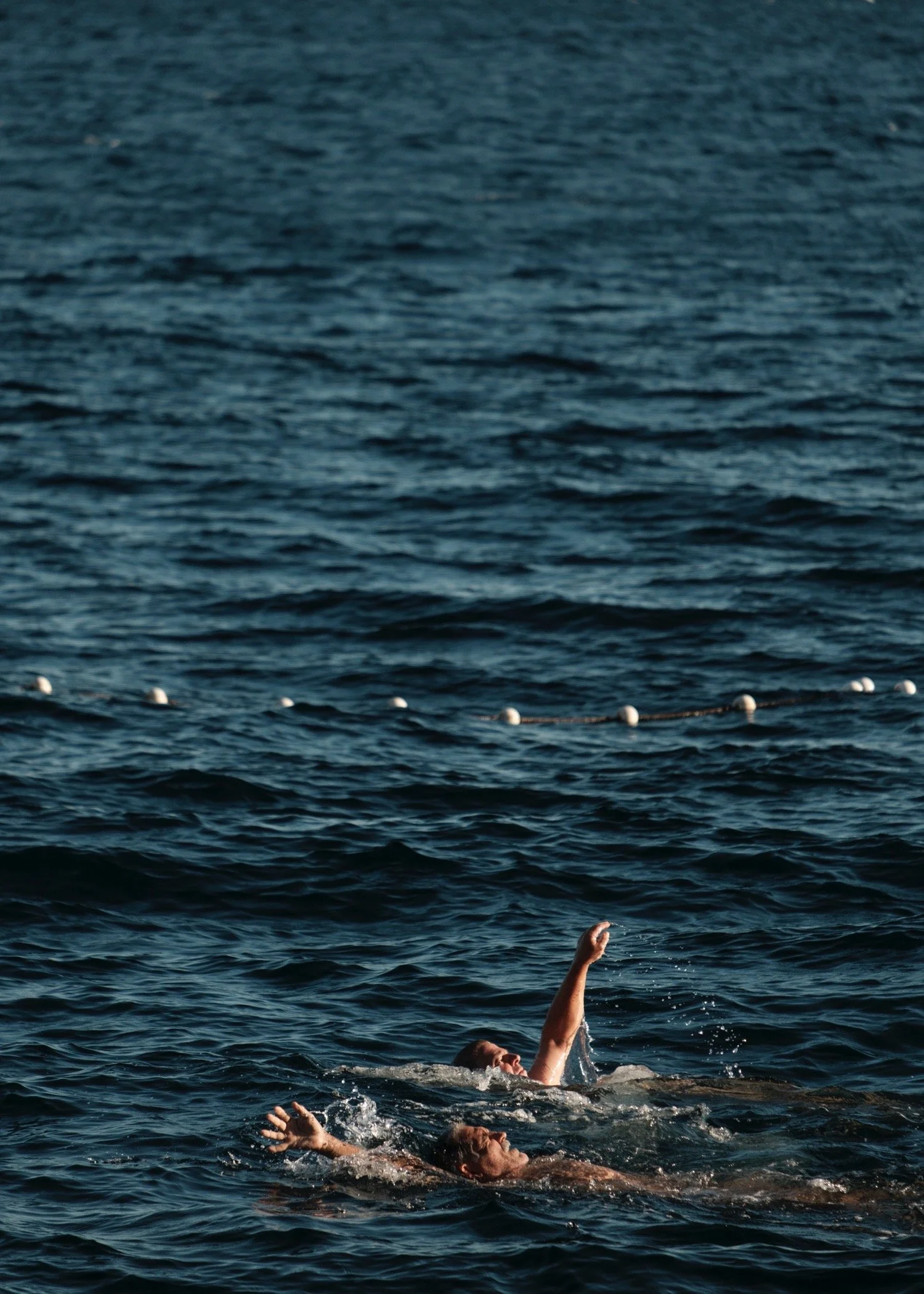
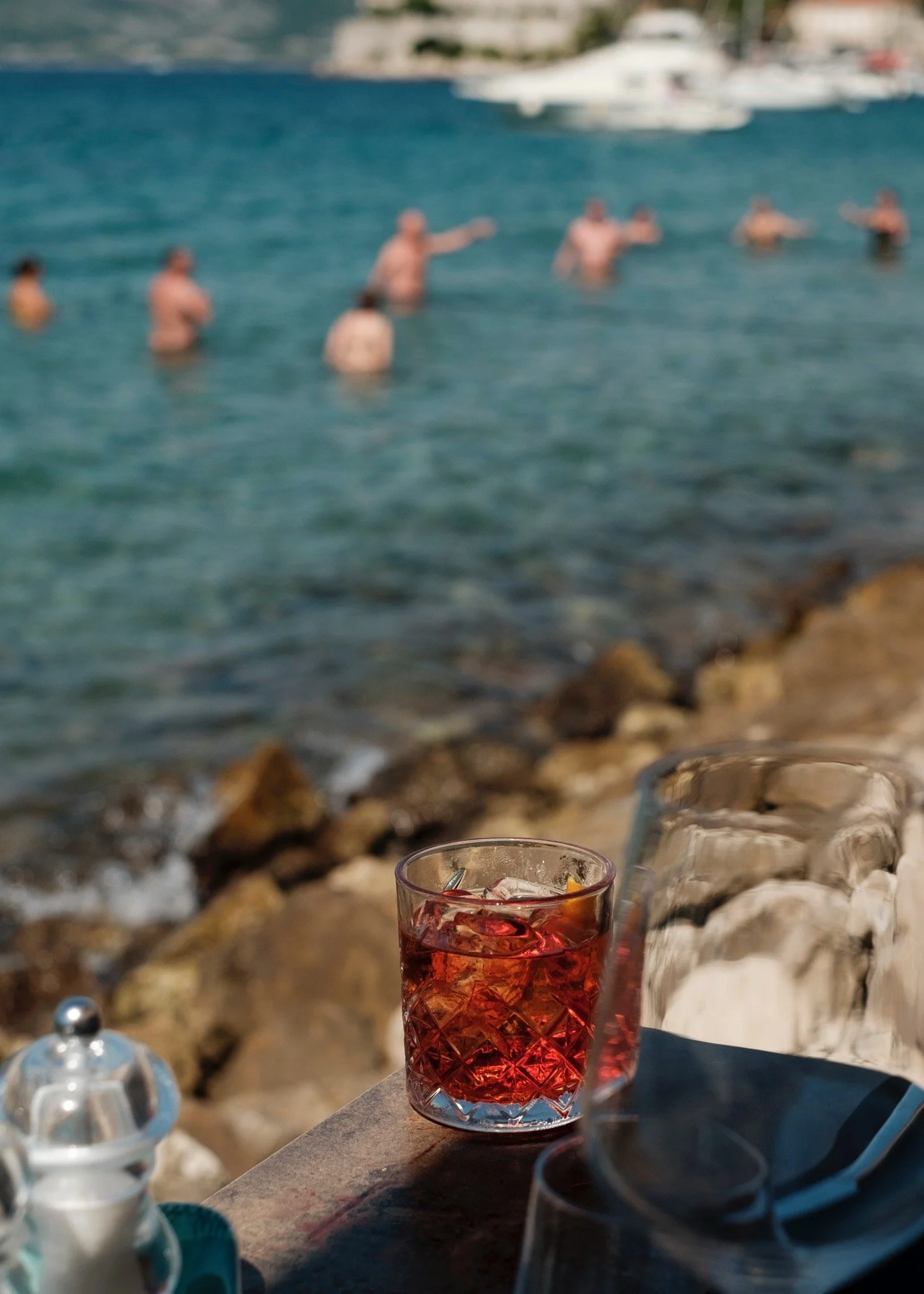
At dusk, Dubrovnik transforms once again. The cruise ship tourists depart and locals gather by the waterside. Leather-skinned beach veterans swim backstroke and the city wears its finest peachy hues. Just outside the city walls, theatrical waiters at restaurant Posat present guests with live lobsters and large slippery fish as they set the stage for an extraordinary night of feasting.
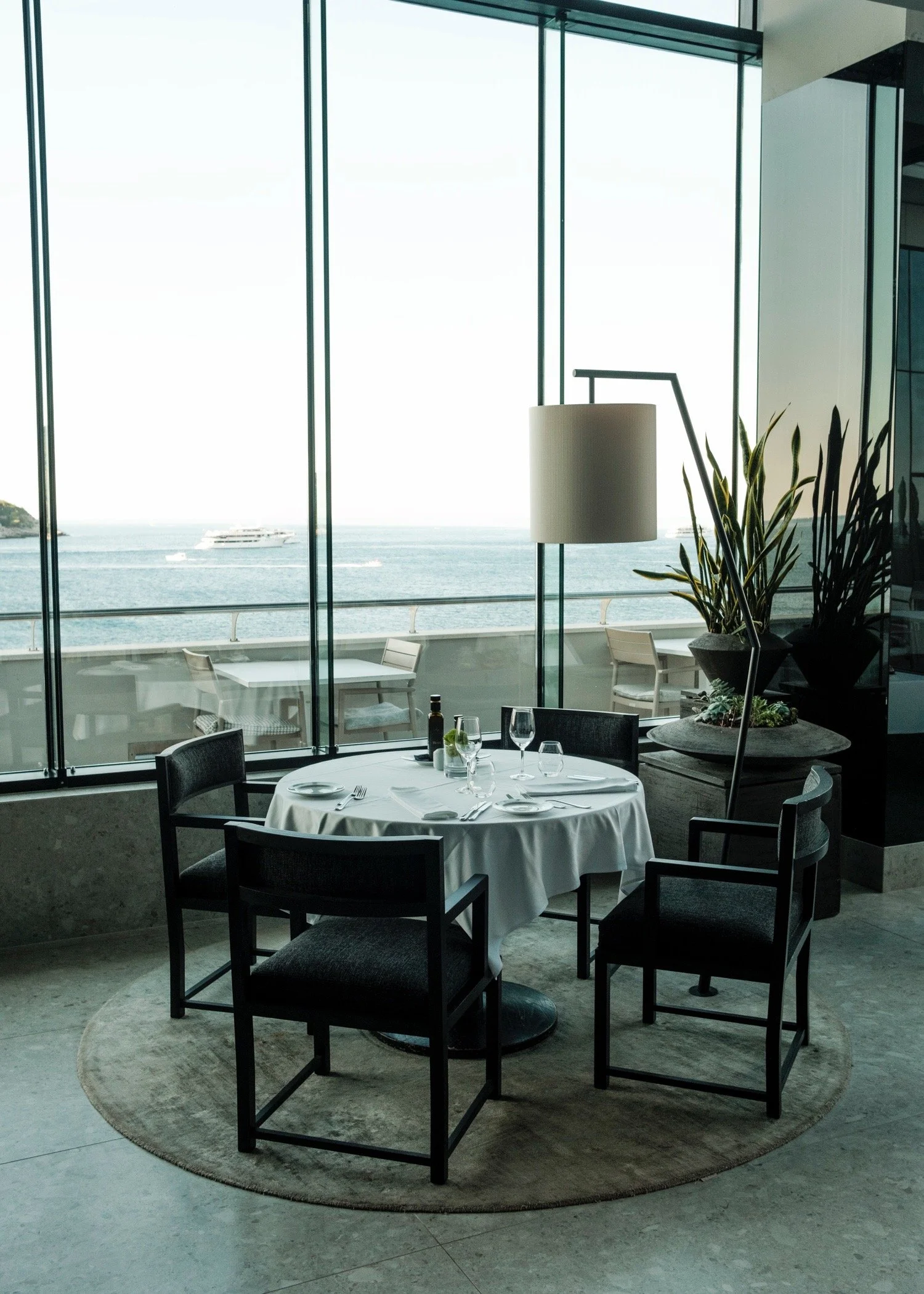
We dine on the terrace of Hotel Supetar, the charming boutique sibling of Excelsior, in the picturesque town of Cavtat nestled amid the majestic Dinaric Alps. We eat rabbit ragu that transcends the ordinary, while artist-in-residence Iva Laterza Obuljen shares the inspirations behind her expansive architectural abstract pieces. Her formative years within the city walls during the 1991 battle for independence infuse her art with even deeper meaning.
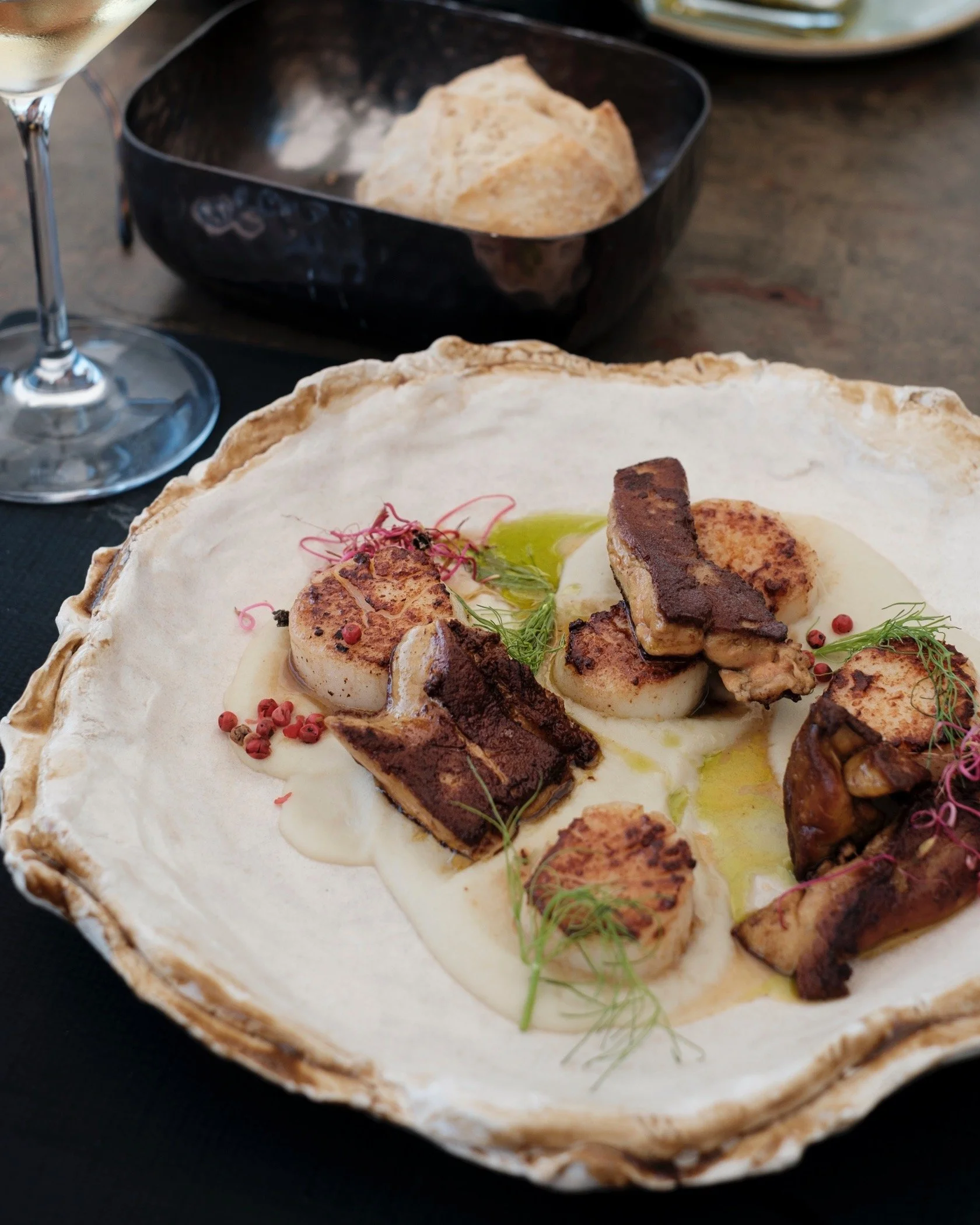
The hotel arranges private yacht rides that unveil secluded beaches and azure caves along the stunning coastline. After morning aquatic adventures we dock at Lopud Island's eatery, La Villa and with the clear water as our backdrop we indulge in luxurious seafood and meat dishes including highlights like local truffle risotto, scallops with foie gras and spiny lobster tail. Dubrovnik's cuisine blends Mediterranean traditions with Balkan and Italian influences; a gastronomic paradise rich in seafood, olive oil and fresh vegetables.
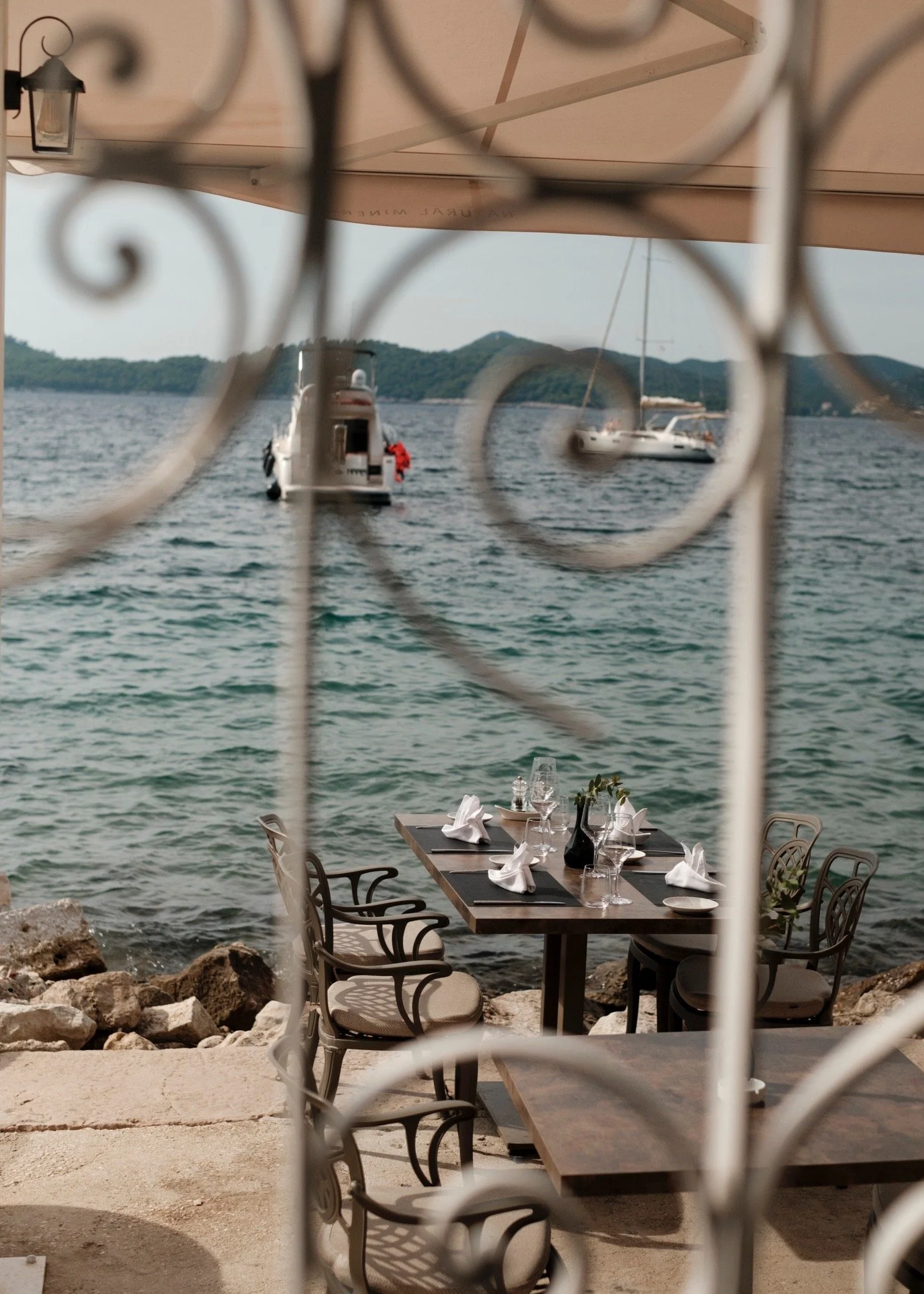
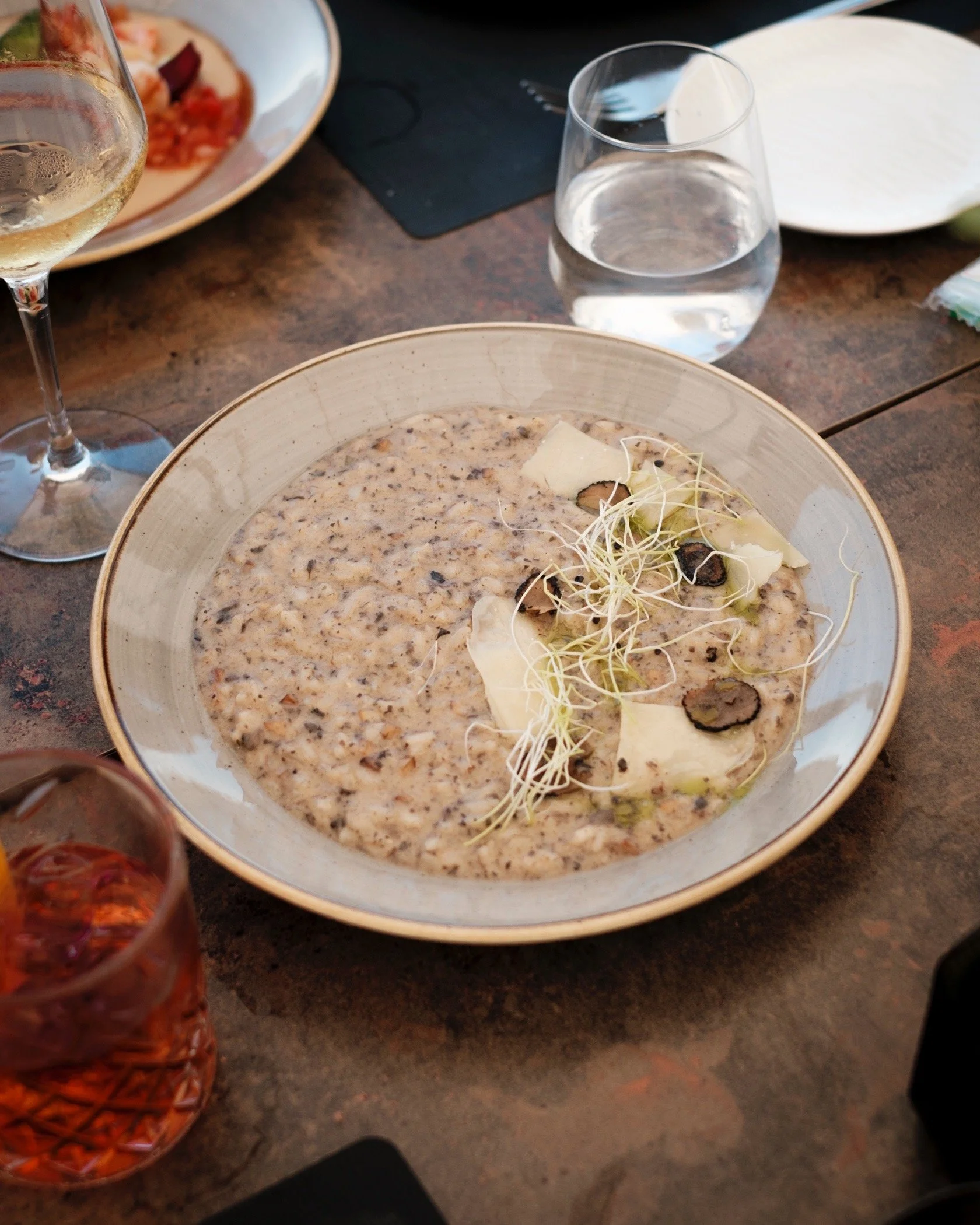
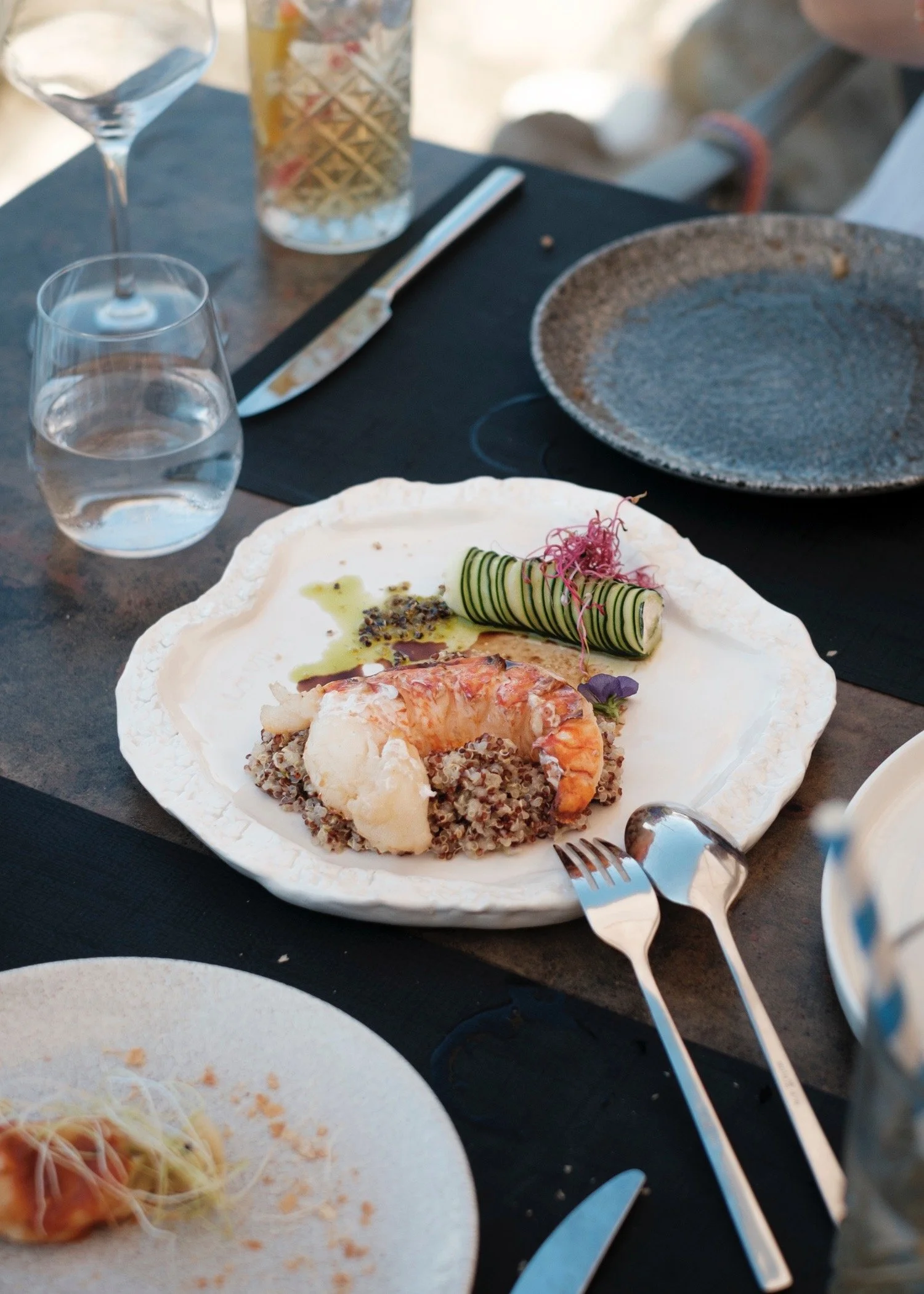
Back at Hotel Excelsior, Sensus restaurant skillfully blends contemporary and traditional flavours, while Salin offers a lavish breakfast buffet with yet another captivating view. Yet, my heart truly belongs to Prora, the hotel’s waterside gem, set on a stone terrace framed by graceful arches. Prora's menu is a poetic masterpiece, where sea bream tartare dances on the palate. We are serenaded by local musicians as we sip Istrian whites, while the city lights twinkle on the water, napkins drift from tables in the evening breeze and waves gently caress the feet of unsuspecting diners. Prora doesn't merely epitomise romance; it writes the love story and I'm hooked.
As Monday morning dawns, I say goodbye to Hotel Excelsior, having condensed an entire summer of coastal and culinary adventures into one exquisite weekend. With a final plunge into the Adriatic, I devour every last delicious second before the flight back to London. Next week, I'll be wrestling with my local lido's archaic booking system for a dip in chillier water of a less vivid shade of blue.
To learn more about the hotel, or book a room, click here.
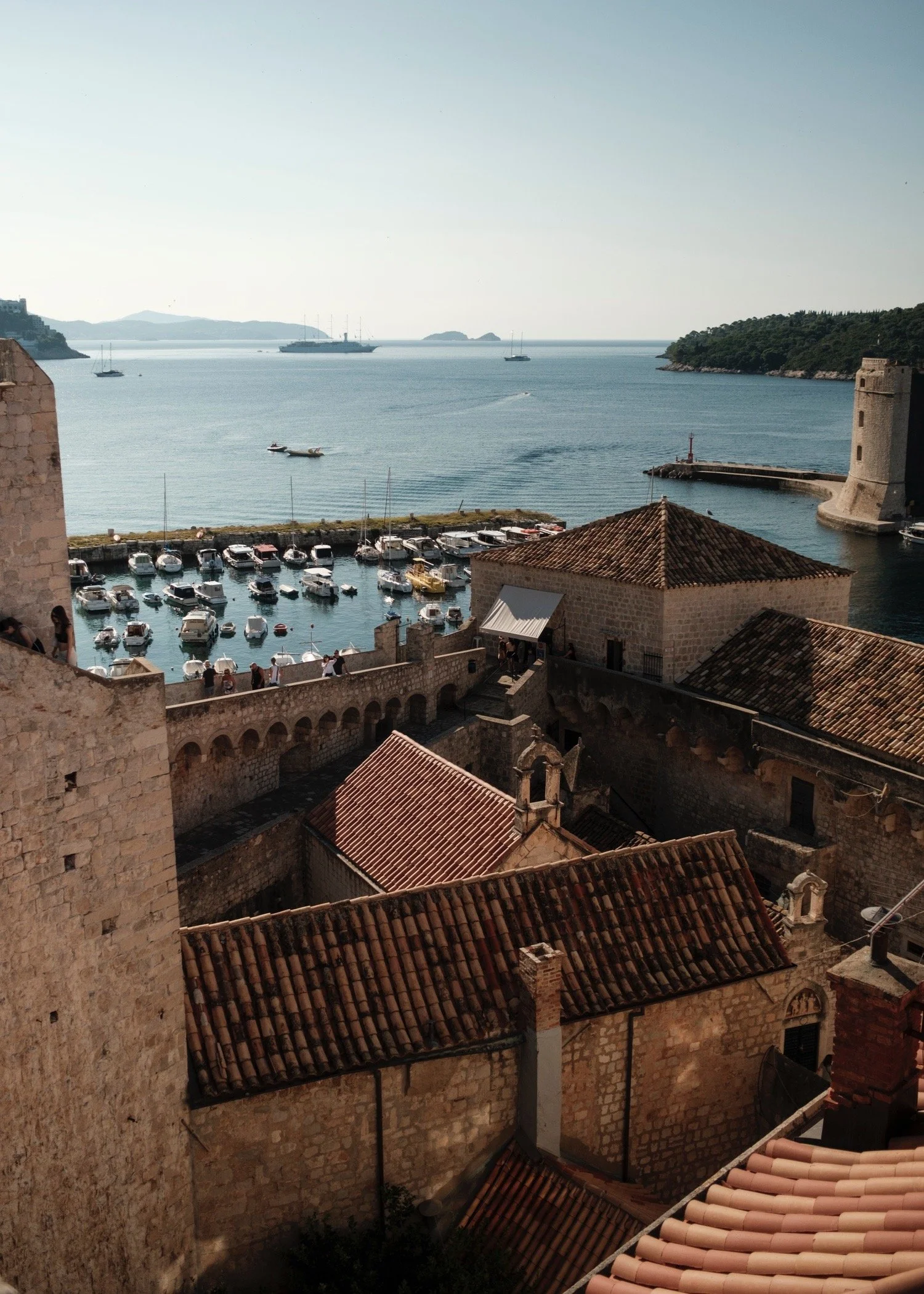
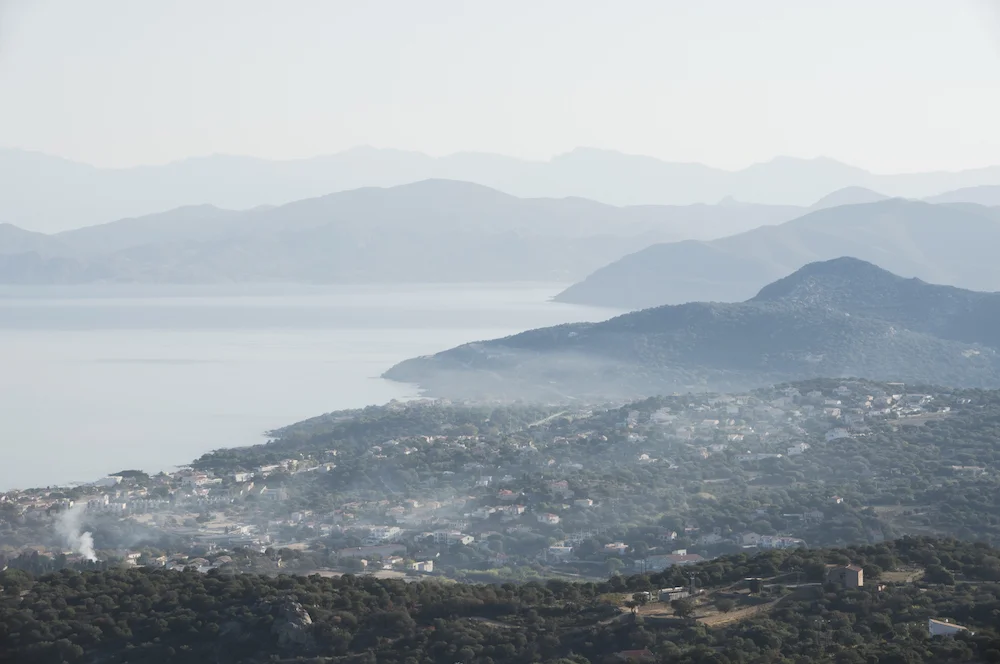
Corsican Craft
Conversations with the artisans and creatives safeguarding tradition and island life.
Words by Kieren Toscan & Photographs by Renae Smith
It was October when we arrived in Bastia, Corsica’s northernmost city. The summer had already left on its annual journey south, taking with it the best of the heat and the bulk of the tourists; a draw I would argue was a win, allowing us to have the still-sun- kissed island all to ourselves. Alas, as a result there are fewer flights to and from Corsica at this time of year and this, combined with vagaries of airline delays, meant it had taken the best part of the day to fly from London. Nevertheless, rest and Napoleonic history were on my mind - even if they required further travel - so my wife and I left the airport to chase the softening glow of the sun west towards La Balagne.
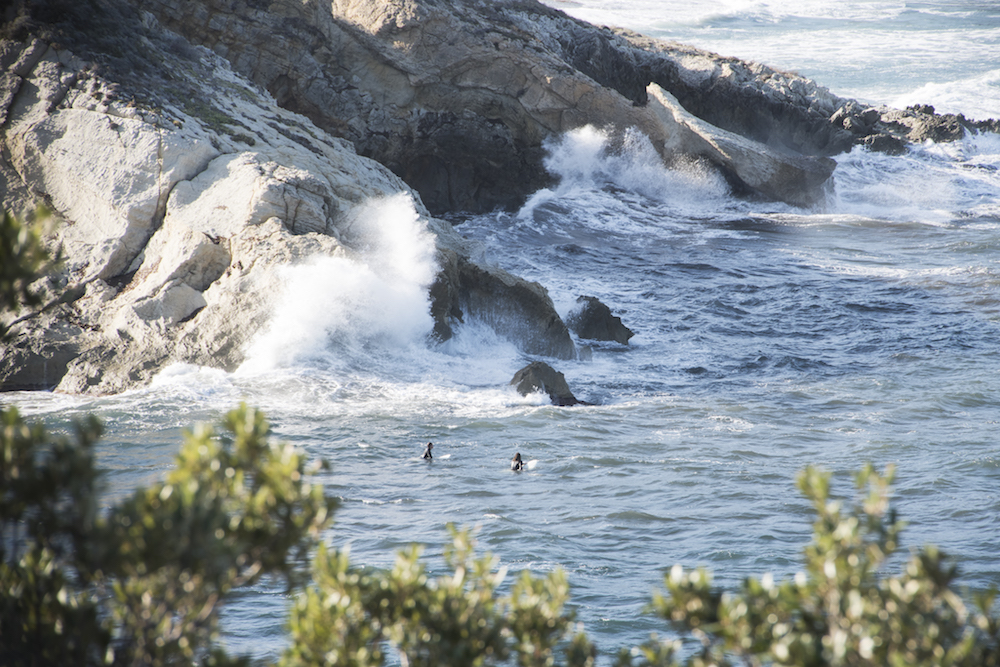
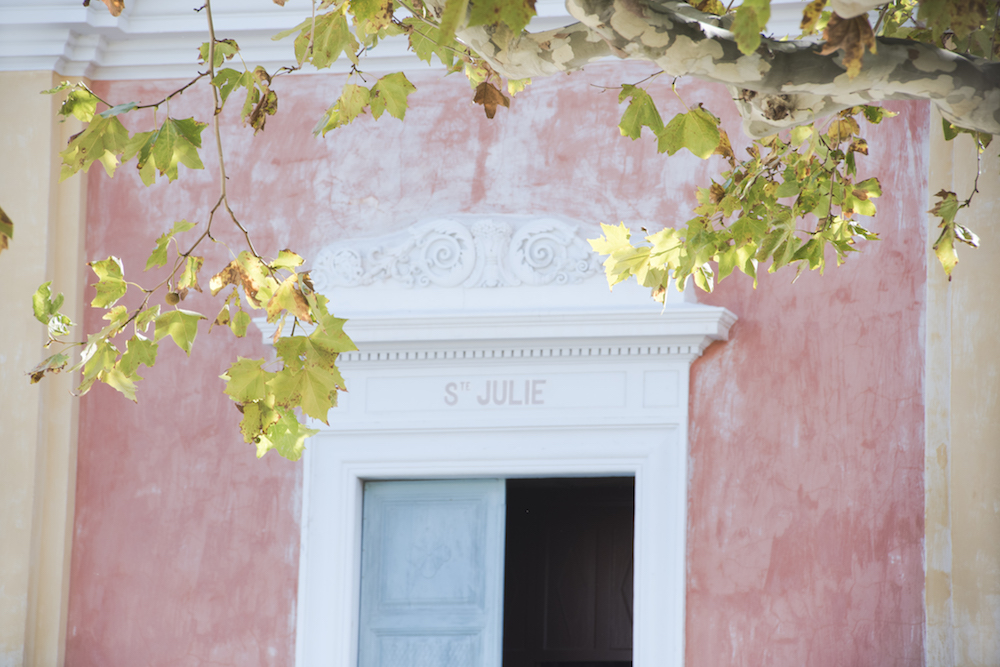
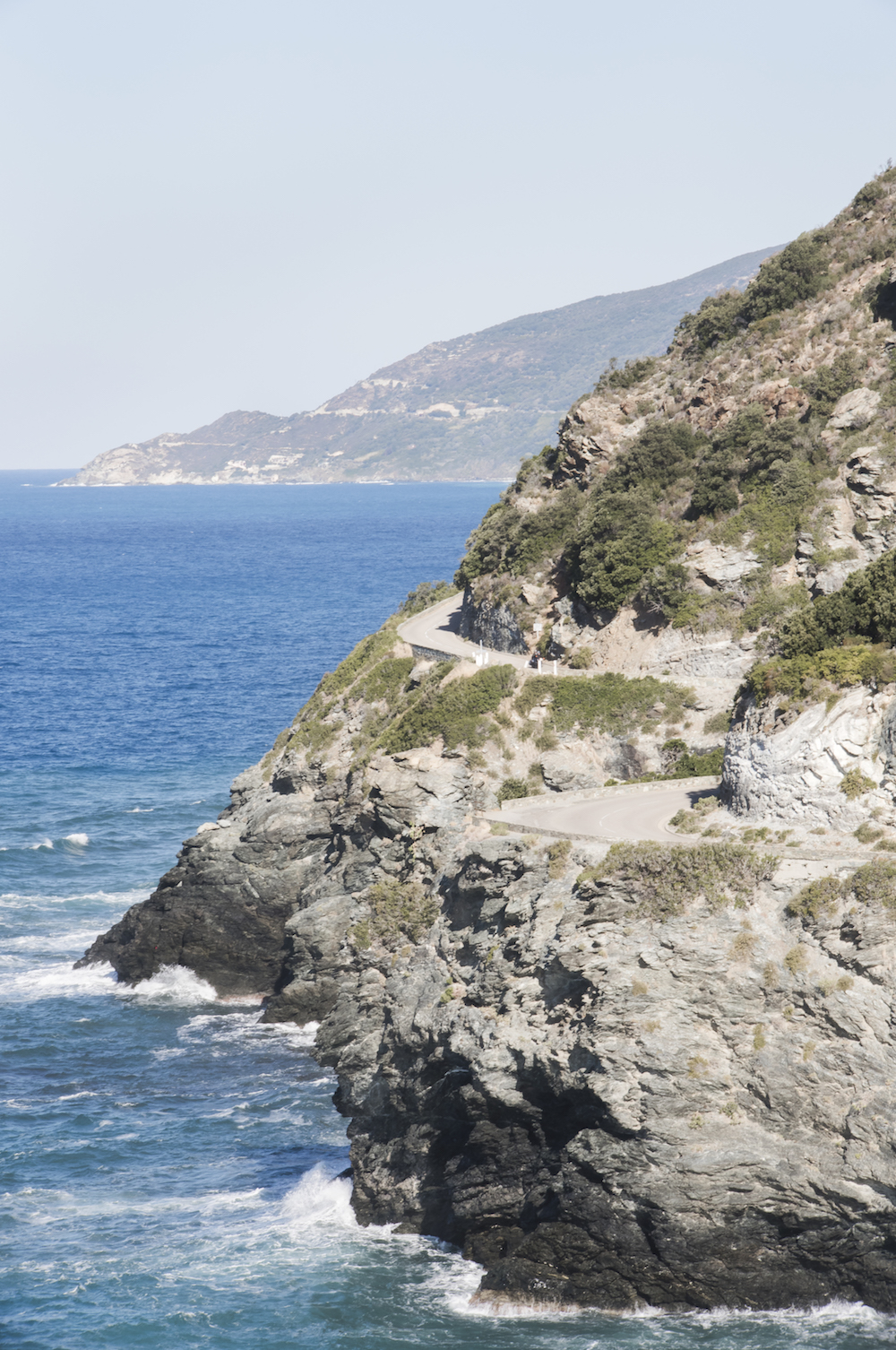
Bastia to La Balagne is not far as the crow flies and, even accounting for the narrow roads that wind and unwind along the way, it should have taken little more than an hour to drive the distance, yet we found ourselves arriving well on the wrong side of two. Traversing the tip of the high granite backbone that runs almost the length of the island proved to be more than we bargained for. But this wasn’t a challenge of conditions, rather one of attention.
No sooner had we started our journey than the landscape began to show us glimpses of its harsh beauty, beckoning us to stop at every turn and marvel at its offerings. Partially covered in dark green, fragrant scrub - which makes up a biome known as maquis - the ranges and peaks seemed to fold over and into themselves, again and again off into the horizon, and grew more indiscernible as the sun receded, almost to the point of confusion. Was that another range? An angry bank of dark clouds making its way towards us? Or something else entirely?

It was harder still to keep moving once the ranges had parted and dropped away to reveal the deep blue of the Ligurian Sea, still sparkling in the early evening light. Bordered in parts by golden sand, topped with the occasional white cap, and finished with gusts of clean, salty air, the scene was one we had known would be bountiful, but was unexpected nonetheless - worlds away from the wintery London we had so recently departed. By the time we reached La Balagne we were wholly enlivened and rendered utterly refreshed, retiring with the travails of travels past a faint memory.
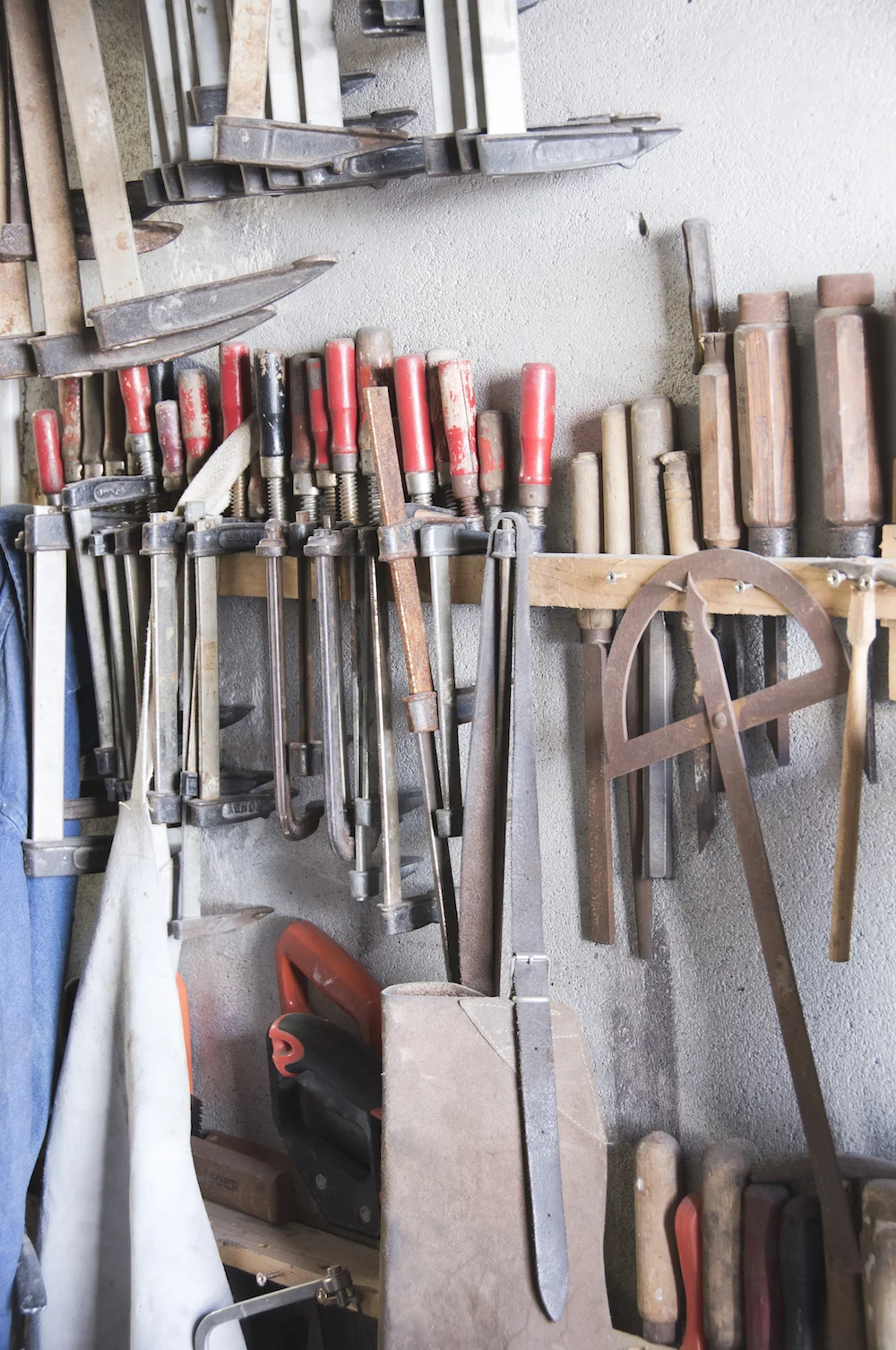
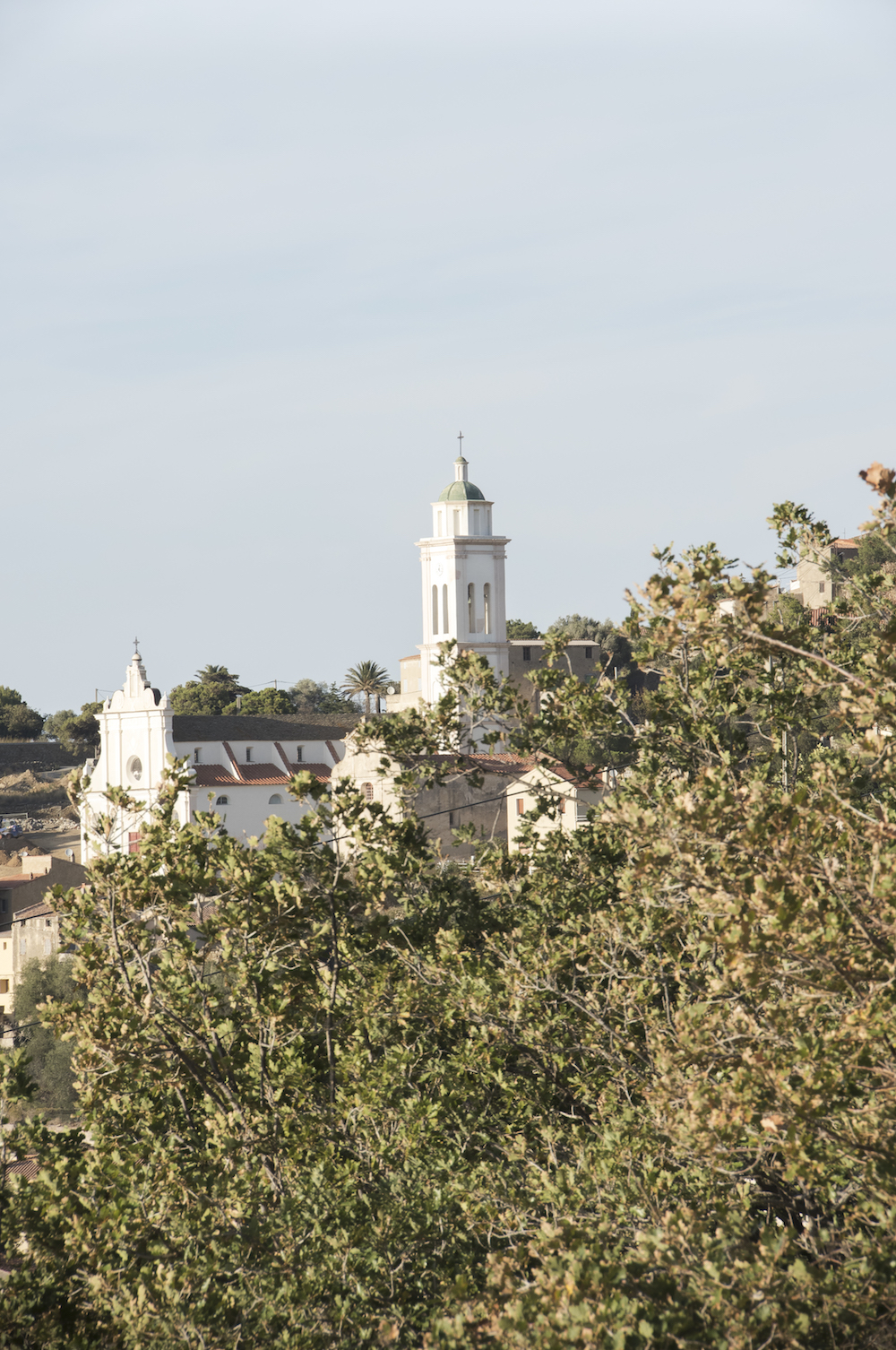
Given our glorious introduction to Corsica, we awoke the next morning greedily wondering what more it would gift us. The answer revealed itself as we arrived in Pigna, a small medieval village of sand-coloured buildings, blue shutters and cobbled alleys, perched on a hillside with expansive views towards the coast. It was here that we had the good fortune to meet some of the artisans of Strada di l’Artigiani - the Artisans’ Road - a serpentine, scenic drive between the villages of La Balagne, conceived in 1993 to help regenerate the region and promote Corsican heritage. Along this route one can find craftsmen and women creating everything from sculptures, ceramics, honey and wine, to leather goods, music boxes, wooden flutes and guitars. Part of the joy of journeying along Strada di l’Artigiani is found not just in the creations encountered but in the time spent with the artisans themselves after you’re welcomed into their workshops, where they reveal just how keen they are for visitors to understand a little more about them, their art and their island home.
Renae and Kieren's full article appears in the Lodestars Anthology France magazine. You can order a copy here.



The Good Life
Going back to Summer School.
Photos by Daisy Wingate-Saul
In July, feeling the pressure of deadlines and the subsequent need for escape, I decided to put adult life on hold and spend a deliciously drizzly weekend at The Good Life Society’s Summer Camp - a micro-festival full of workshops, feasting and wellness experiences in Hawarden Estate, which is found just over the Welsh border. For three days I woke to yoga classes among castle ruins and wild swimming sessions in a lily-pad-strewn pond. My days would then be split between listening to writers muse on life and creativity, and trying my hand at a range of crafts. Under the patient and playful guidance of illustrator and stamp-maker Laurie Avon and sign writerRobert Walker, I discovered that I didn’t need to be particularly good at the artistic task at hand. I just needed to give it a go. Because the magic happens simply by being there, ensconced in a walled garden, doing something with your hands and mind. The hours float away - as do grown-up worries - your thoughts focused entirely on the fabulous here and now.
With fires burning, wine flowing and vintage French vinyl spinning, evenings would feature a communal feast, the fare prepared by The Good Life team or the guest chef - a different foodie icon headlines each of the weekends, and nature-besotted Valentine Warner cooked over the fire for us.
Summer Camp made me appreciate the joys of conversations with strangers, and just how freeing it is to get creative, swim in the rain, watch the sunset from a castle wall, or whittle a mug from a fallen branch. The moment I entered Hawarden’s walled garden, the world slowed and inspiration flowed. I cannot wait to pitch my tent again next year.


Hotel Review: The Lanesborough
A decadent London escape.
London has always held a special place in my heart. As a child, I lived there while my father, a Qantas pilot, flew to exotic locations on the Kangaroo Route (the early flight path that linked Australia and the UK). I backpacked there in the 80s, was a young parent in the 90s, and have found the city’s mesmeric, chaotic brilliance impossible to ignore over the ensuing decades. Yet it wasn’t until I sojourned at The Lanesborough that I understood just how marvellous London is when you fully embrace its decadence.
Situated on the corner of Knightsbridge Road and overlooking Hyde Park and Buckingham Palace Gardens, The Lanesborough is perfectly located for exploring London’s glitzy centre, being only a short saunter from Harrods, Harvey Nichols and the fabulous people-watching of Sloane Square and Knightsbridge. Yet while the sartorially-savvy heart of London is literally on your doorstep, The Lanesborough is a haven of peace - a hotel to meet with friends, read in The Library Bar, chat over a Bridgerton-themed afternoon tea, or simply absorb the beauty of a time-gone-by. In fact, when you stay here, you'll be forgiven if you forget London’s wonders altogether.
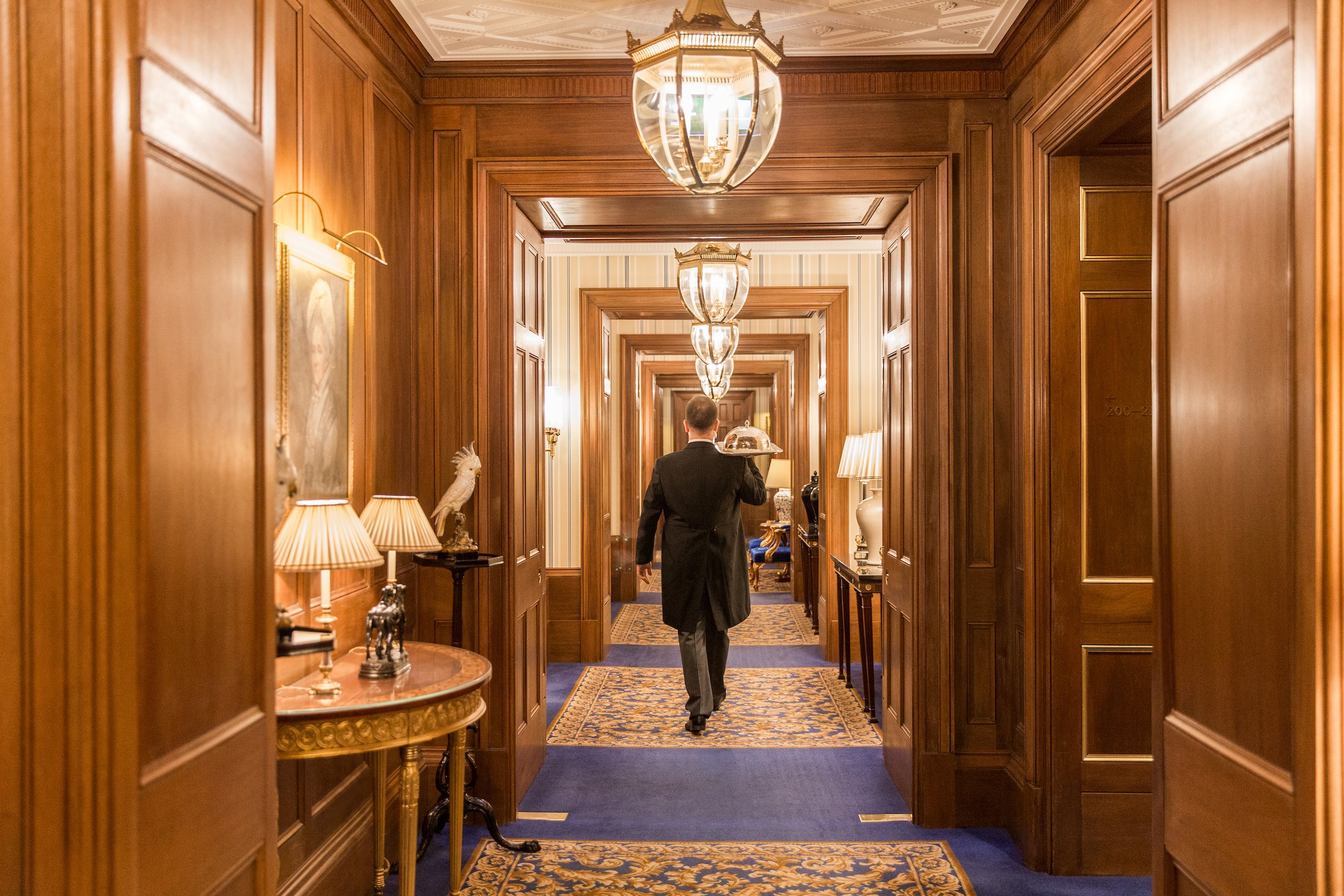

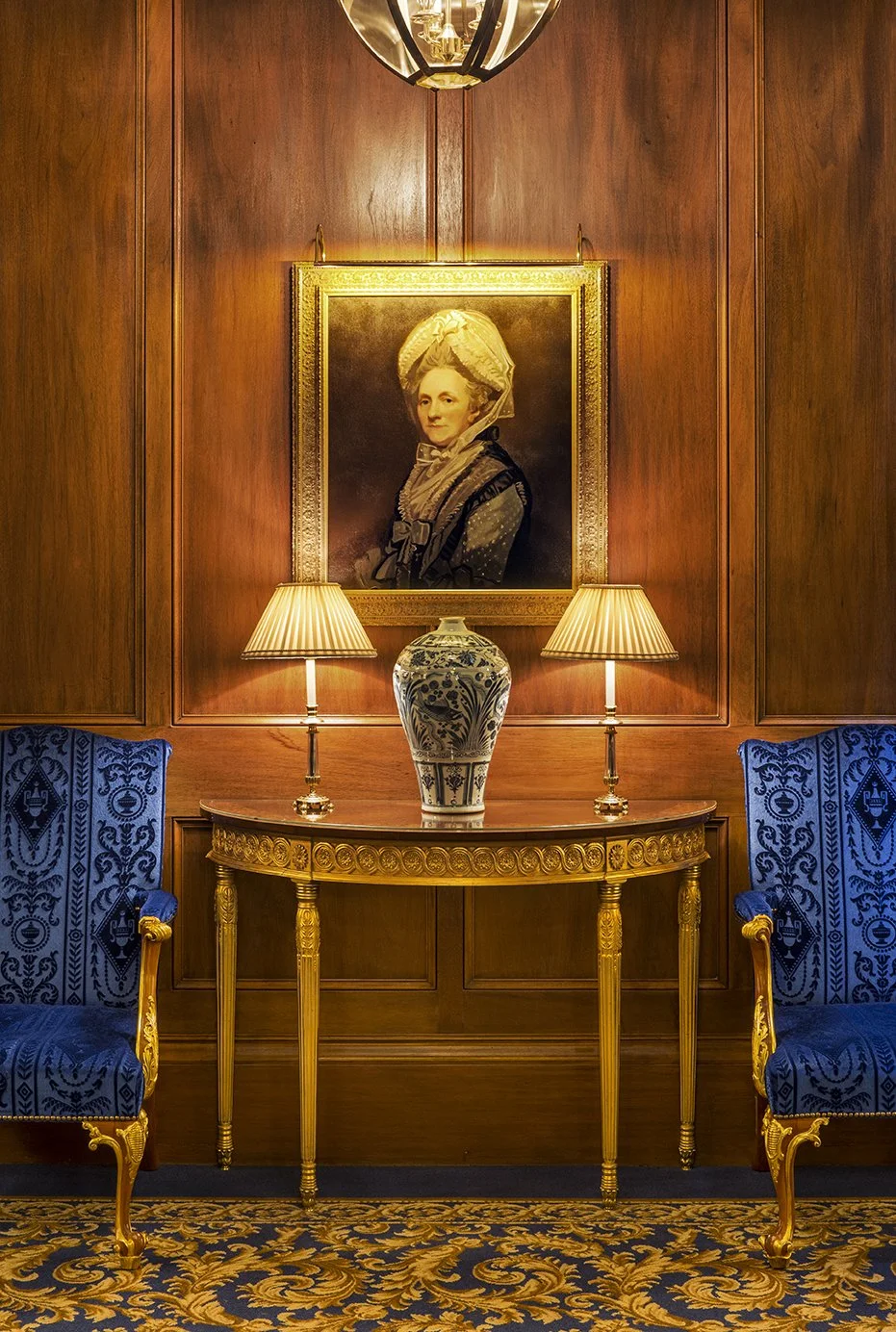
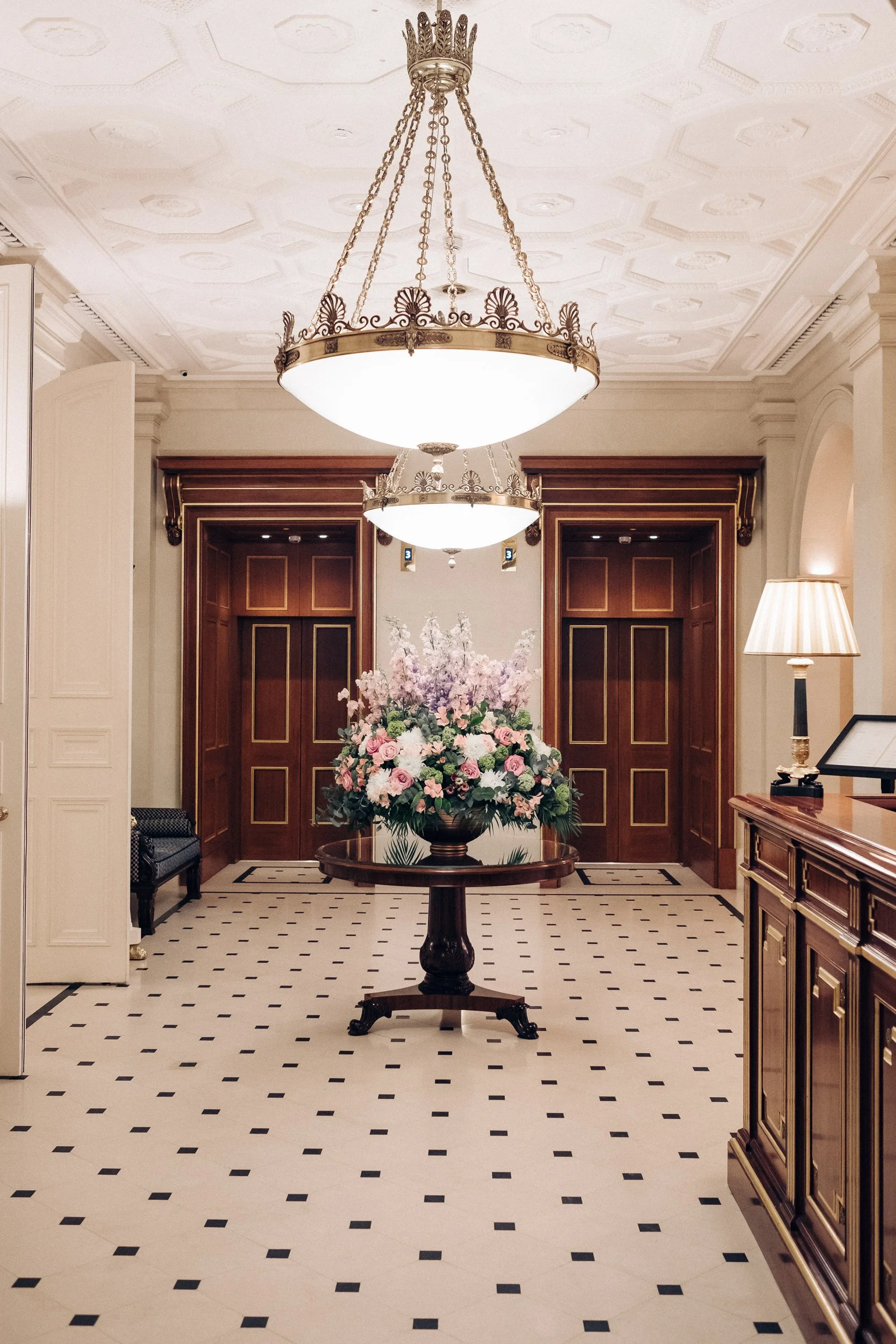
The attention to detail is astounding, and guests are offered every luxury imaginable. When you enter the flower-filled foyer (inevitably spotting Lilibet, the hotel’s resident cat), you sense that this Regency-styled gem (once a Viscount’s house, a hospital for 150 years and a luxury hotel since 1991) has tales to tell. Today, it’s still creating stories, having emerged from an 18-month renovation to become one of London’s most lavish boltholes. Over 6,000 books of hand-painted gold leaf were used in the process, and the 54 crystal chandeliers, sumptuous textiles, and 5,500 restored stencils are the embodiment of design magnificence. But what's truly wonderful is the atmosphere that this vision and artistry has created.
Naturally, you never want to leave - so you’ll be pleased to know that rooms and suites are sumptuous. Marble and jewel-tones abound, and there’s a butler service to help fulfil every whim (and deliver tea and cake with your wake up call). Everything is designed to make you feel right at home, even if a 19th century mansion isn’t your usual abode.


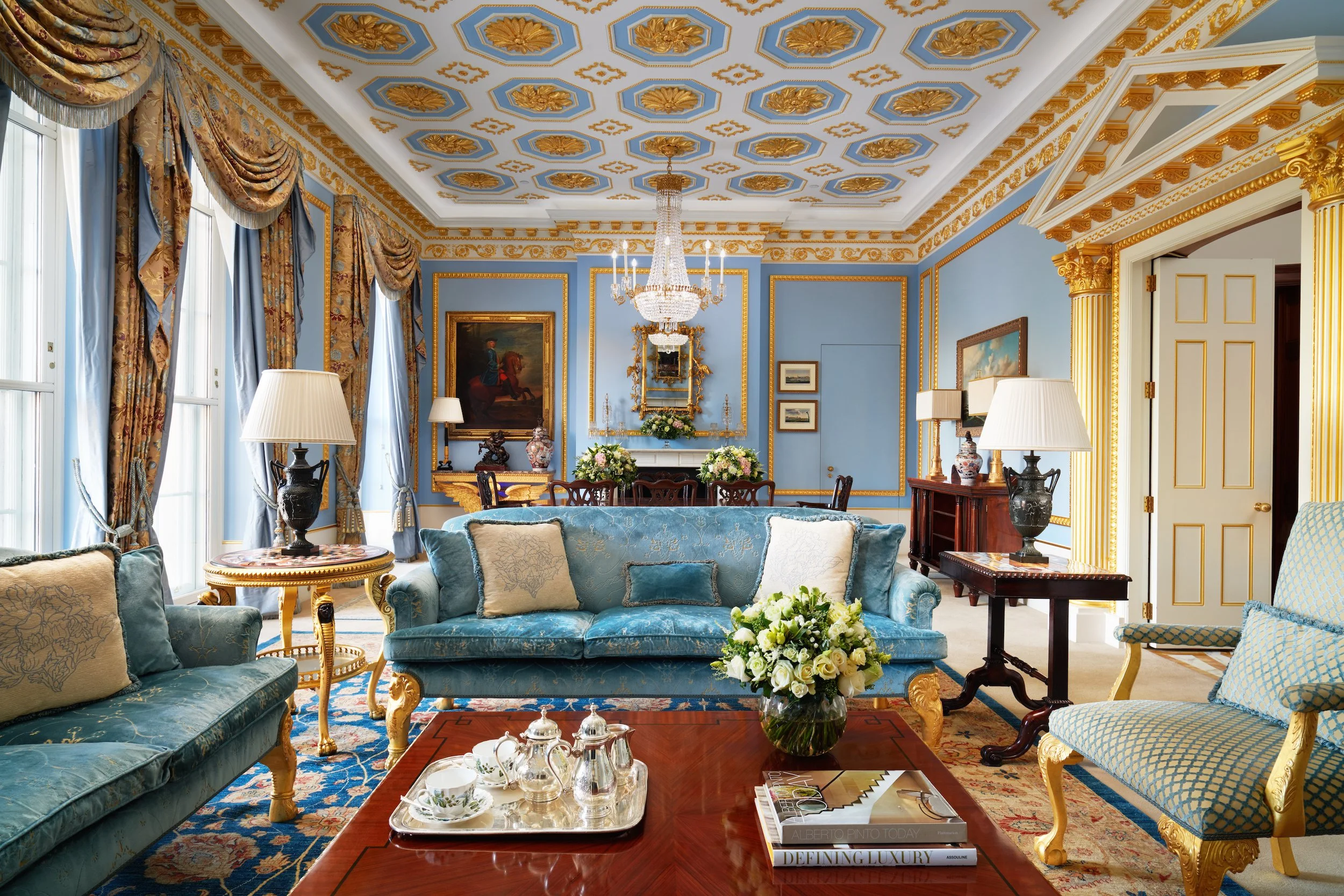
When it comes to dining, The Lanesborough Grill is unmissable. Flooded with natural light by day, breakfast is a scrumptious multi-course affair (be sure to savour the pastries - absolute perfection), while the deliciousness served up at lunch and afternoon tea looks almost too beautiful to eat. By night, the rotating array of art on the restaurant’s pastel walls (most of which is for sale), become an elegant backdrop to Executive Chef Shay Cooper’s seasonal creations, which reflect the best of British produce.
My escape to The Lanesborough was certainly an exceptional experience, and I clearly wasn’t the only besotted guest basking in the hotel’s aura and choosing to only see London in bursts - one outing simply taking me to M&S for a swimming costume so I could spend the afternoon luxuriating by the spa’s hydro-pool. Of course, if a Hermès cossie is preferred, that’s just around the corner too! Wherever you choose to do your shopping, The Lanesborough is a hotel to admire and adore - even if you have to keep it for very, very special occasions.
To book a room, click here.
Words by Angela Terrell.



Country Life
Going off grid in Wales with Old-Lands.
An extract from the Wales magazine.
Words by Shannon Connellan & Photographs by Andy Fraser
If you’d told me I’d be spending a crisp autumn Saturday morning surrounded by Victorian stone and bee-heavy flowers, studying emerald-winged moths and watching white swans corral their cygnets, rather than gorging on yet another must-stream TV show, I’d have eaten my proverbial hat before I visited Old-Lands. Yet here I was doing just that - feeling windswept and renewed.

Located in Monmouthshire, Old-Lands is run by Sam and Clare Bosanquet and has been in the family since 1801. It was revitalised by Sam’s parents in the 70s and started a new chapter in the last decade. An ecologist and photographer respectively, the pair now inspire a small, like-minded team to help rewild the estate’s ancient grasslands and worn-out guests, encouraging them to rethink their relationship to biodiversity and good ol’ fashioned muddy fun.
Centred around the elegant Dingestow Court, three unique, self-catering lodgings provide guests with a bewitching base from which to align themselves with Welsh country life. We ushered our books, boots and wolfhound into the cosy Wood Barn, the beautifully revitalised old workspace of the Gwent Wildlife Trust, which still has its headquarters at Old-Lands, working with the Bosanquets to reverse some of the wildflower species loss that happened in the 20th century. There’s also Stable Court, part of the west wing of the main house, and Horseshoes, the former stables.


You’ll better understand the property’s biodiversity during one of Sam’s nature walks. An expert on moss, lichen, liverworts, fungi, plants and birds - and friend to moths - Sam grew up in Dingestow Court, roaming its 200 acres of rolling meadows, studying the enormous variety of life here for 25 years. “I learnt my flowers and birds and butterflies wandering around the fields. So, to me, each field corner has memories: of whinchats on the edge of Cae Issa, the stonechats wintering near Caewern Triangle, finding adder’s-tongue fern in the bottom of the Lawn Meadow, sweeping for insects in Gramdîr’s swampy areas.”
If you’re inspired to begin your newfound career as a wildlife seeker, you’ll find a kit in your cottage with everything budding naturalists could desire: white-meshed nets for pond dipping, black-meshed nets for insect-catching, a magnifying glass, reference cards and plastic pots “for putting insects and other minibeasts in” for study. Should you get hungry during one of these missions, you’re encouraged to scrump apples from trees heaving with fruit. But don’t fill up too much, for there are spoils to be enjoyed from Old-Lands’ honesty shop, where shelves are filled with local produce amid a Dutch still life of a wooden table heaped with fruit and vegetables grown in the walled garden just metres away.


The Bosanquets have designed a clever way to draw guests to the property’s far reaches with a delightful activity known as letterboxing. Like a form of offline geocaching, it began on Dartmoor in 1854 when participants would leave visiting cards in bleak, lonely spots - of which Old-Lands is neither, but it’s still a treat. The puzzle trail involves following clues (with an illustrated map and compass) to track down ten hidden boxes containing pads of ink to plunge a triumphant stamp into and mark your victory on the map. One requires you to grab oars and make for the lake’s boathouse. Avoid the swans.


Apart from all this treasure hunting, slow living is everything at Old-Lands, which offers a chance to break from the frenetic norm and our impatient, results-driven tendencies. It’s also a reminder that life, like rewilding, is all about balance. While guests here have ample sprawling patches of lush lawn to laze about on, corridors of ancient grassland are left to thrive as a hiding place for insects, who in turn pollinate the wildflowers and attract hungry birds. Rewilding is a lengthy, meticulous process for fields, meadows and forests, but at Old-Lands you can easily achieve it for yourself in a few days. The rest, well, that’s underway too.
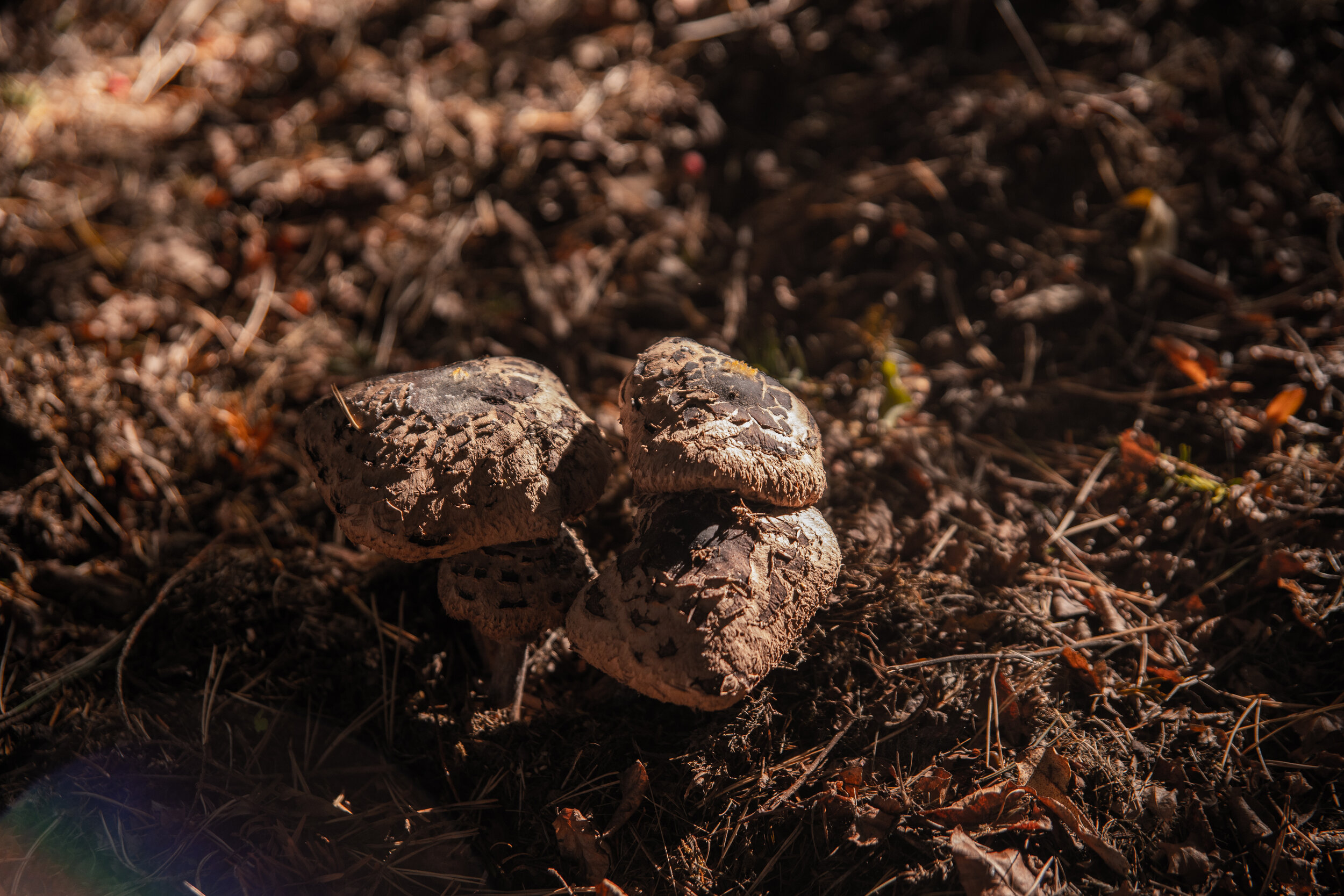


Postcards From Crete
Falling for a Greek island.
Brooks Plummer takes us on a photographic tour across the Greek island of Crete. His dreamy, sun-drenched images are paired with musings from SteMajourneys, who featured in our 2021 Greece magazine. As Emma Latham Phillips wrote for the issue: ‘based between Athens and Crete, Stefanos Gogos and Maria Passarivaki (together, SteMa) combine their experience in journalism and passion for anthropology to craft unique itineraries for travellers who want to dive into the heart of a destination.’
“Crete is my ancestral land. My roots lie in the south of Chania. There’s an old proverb saying you should cherish the land that brought you up. Crete is my homeland, but it revealed itself to me only after I wanted to leave it. Diving into it again as a tourist, I learnt to respect my heritage and childhood. I re-travelled the route to my grandmother’s village, where she had goats, a blue and whitewashed house, and piles of foraged herbs.”


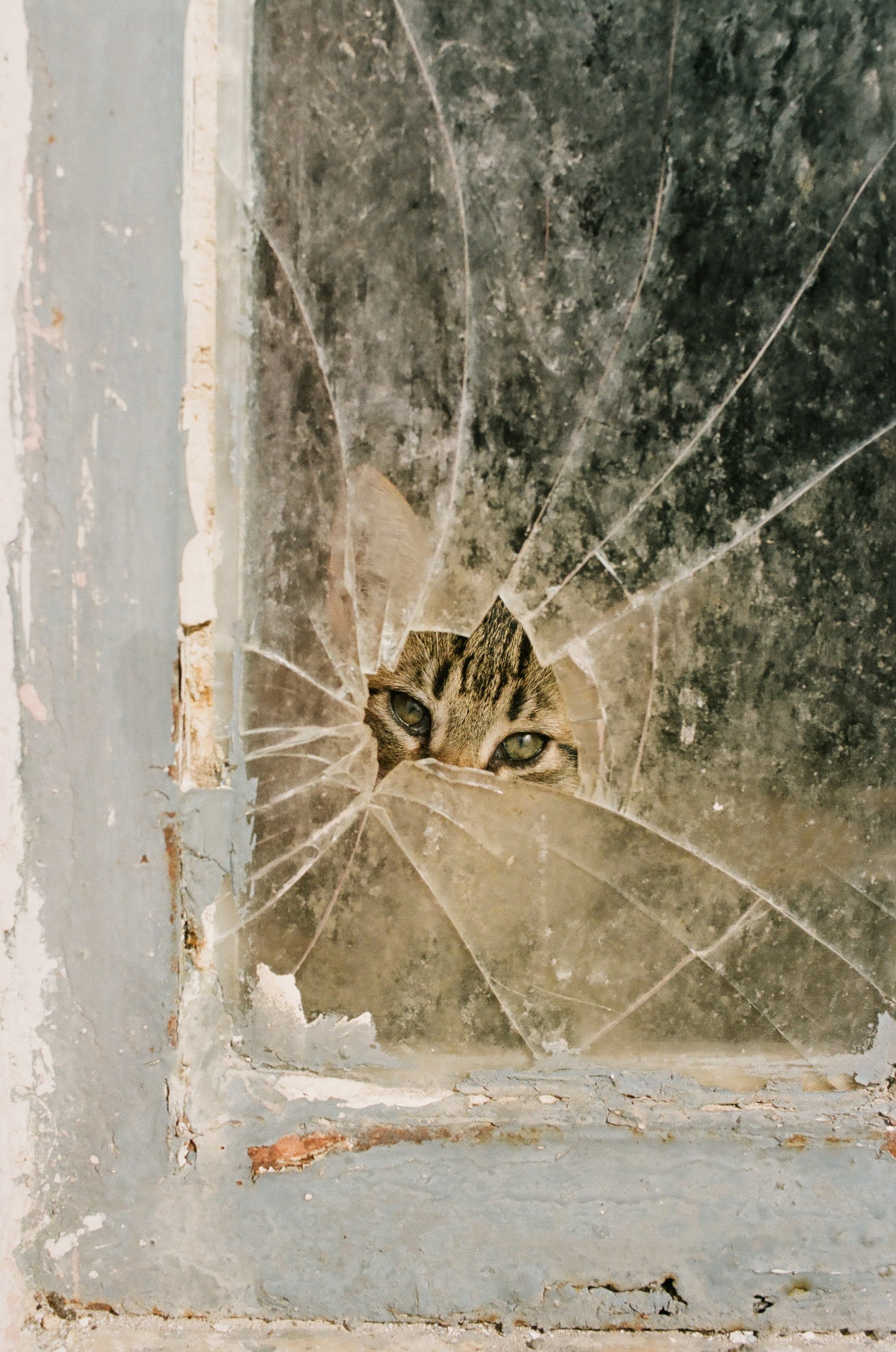
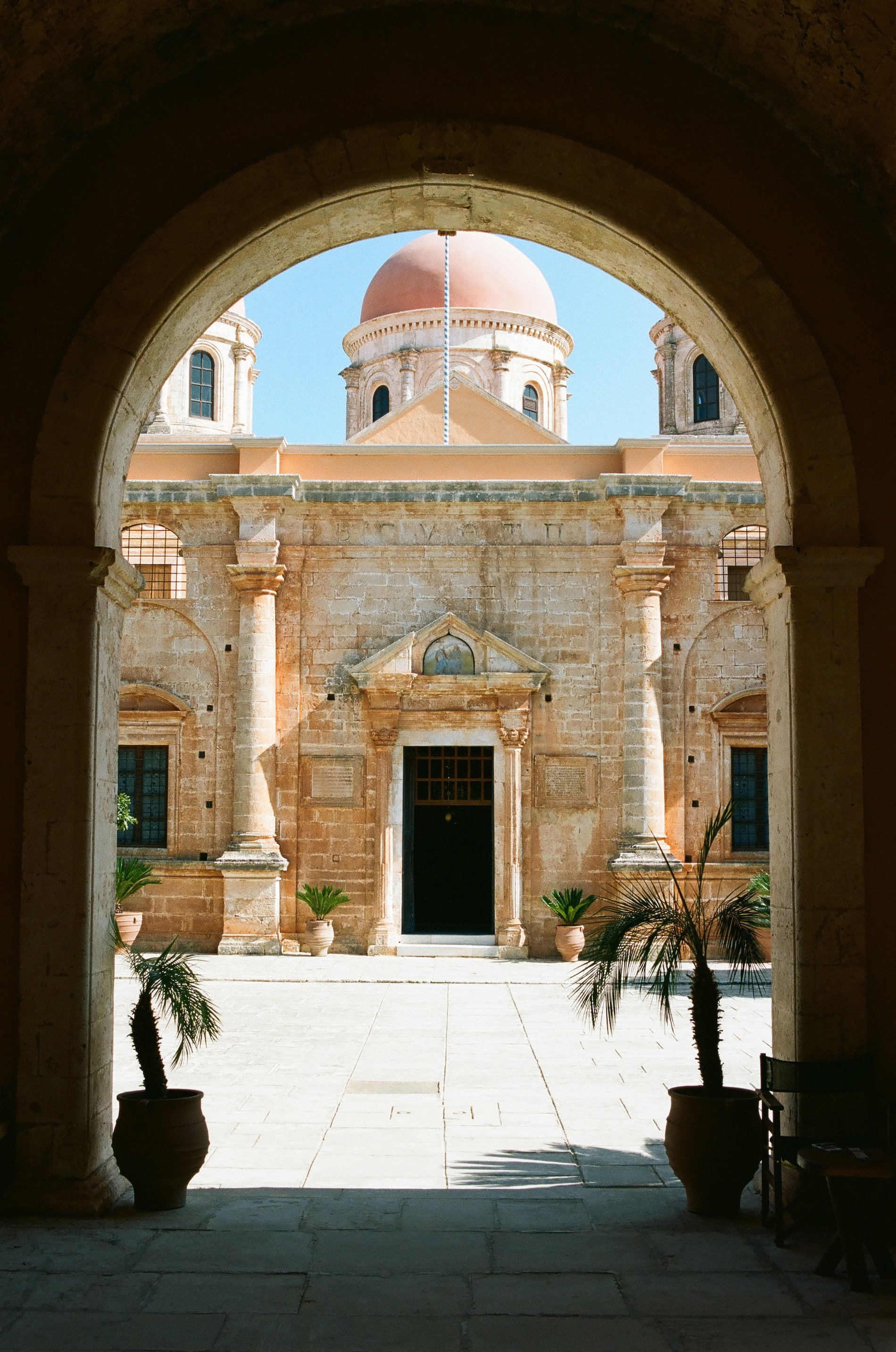

“Crete is the mother of all Greek islands, offering a self-sufficient living and economic independence to its inhabitants - and at the same time feeding the rest of Greece. Cretans live by age-old traditions that have survived and shaped the identities of generations.
It is found at the southernmost tip of Europe, facing across to Africa, and is a land of contrasts, from nature-filled landscapes to desolate ones. This is a magical place, where you will find snowy mountains and dive in unspoiled tropical waters, all within a few hours drive.”

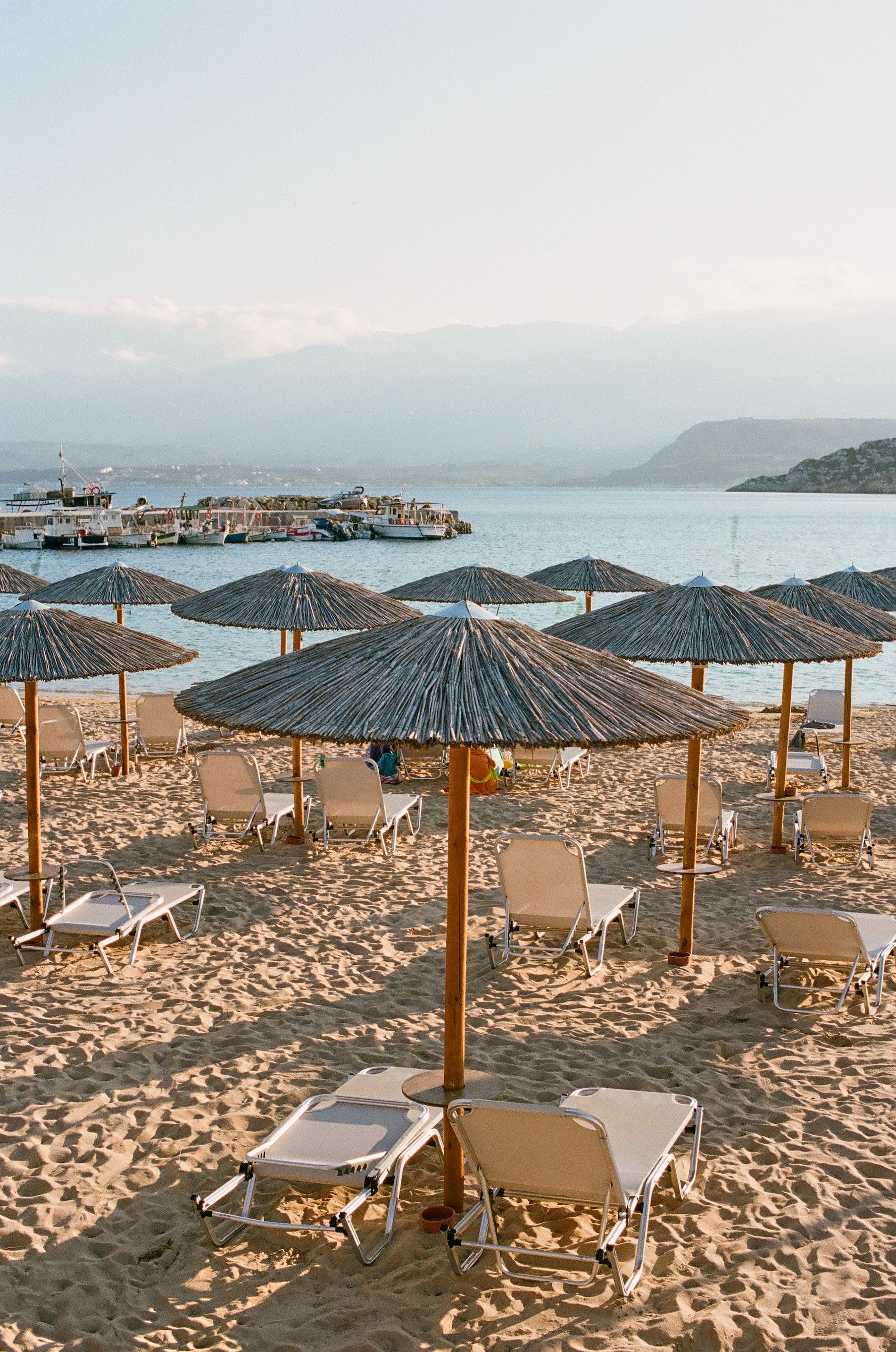
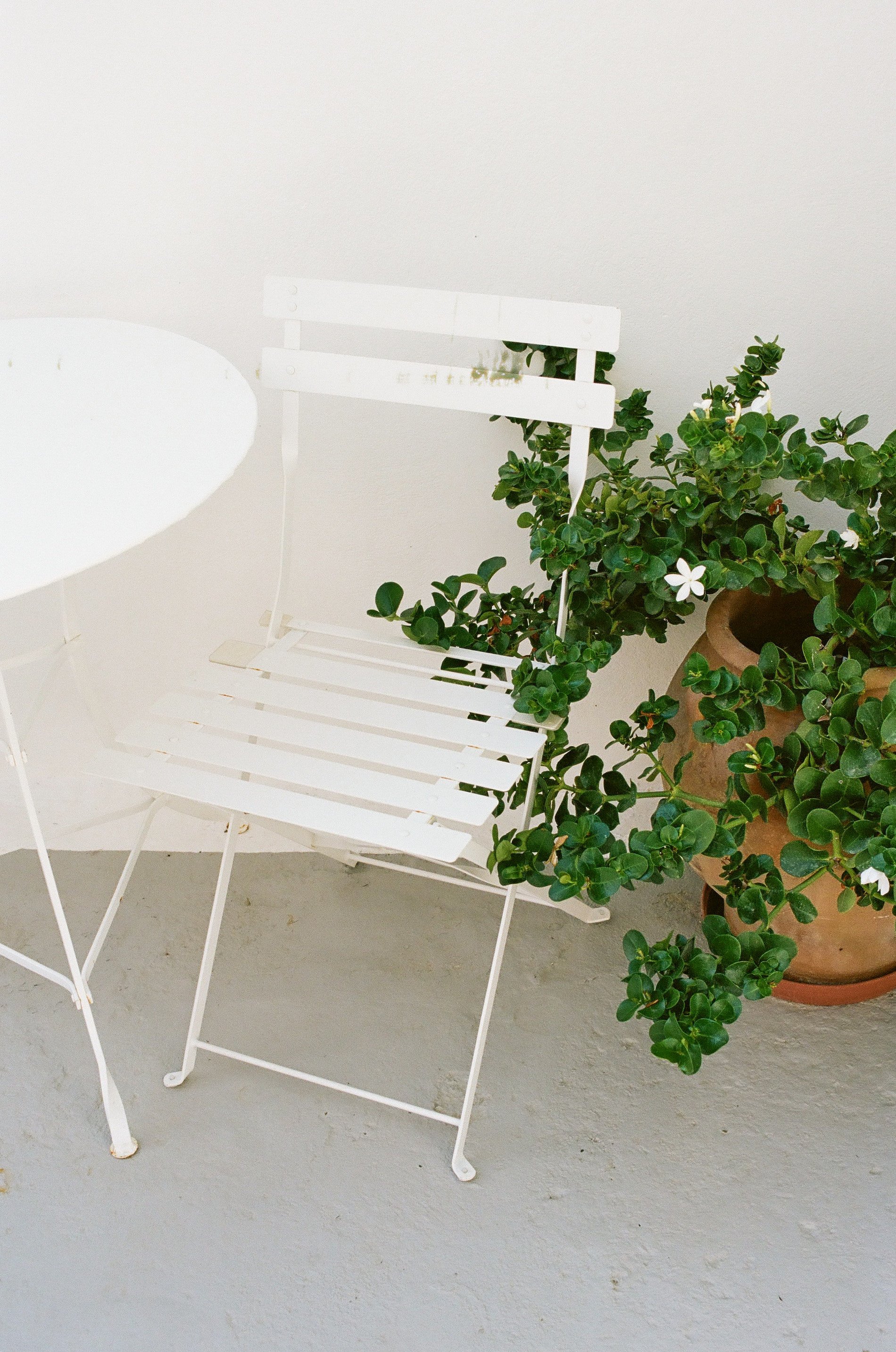


“Surrounded by olive and fig trees, Crete feels miles away from everything else. If you are wanting a slower travel experience, you can certainly adopt a less-stressed pace of life here and be more attuned to nature’s rhythms.
This lifestyle can be found in the tucked-away villages of the wild south, where locals cure and produce their own olive oil, and make their own honey and wine. In autumn, they distil raki in the old-fashioned way. In spring, the island sheds the sparkles for a more subdued richness - perennial wildflowers and blossoming citrus trees.”
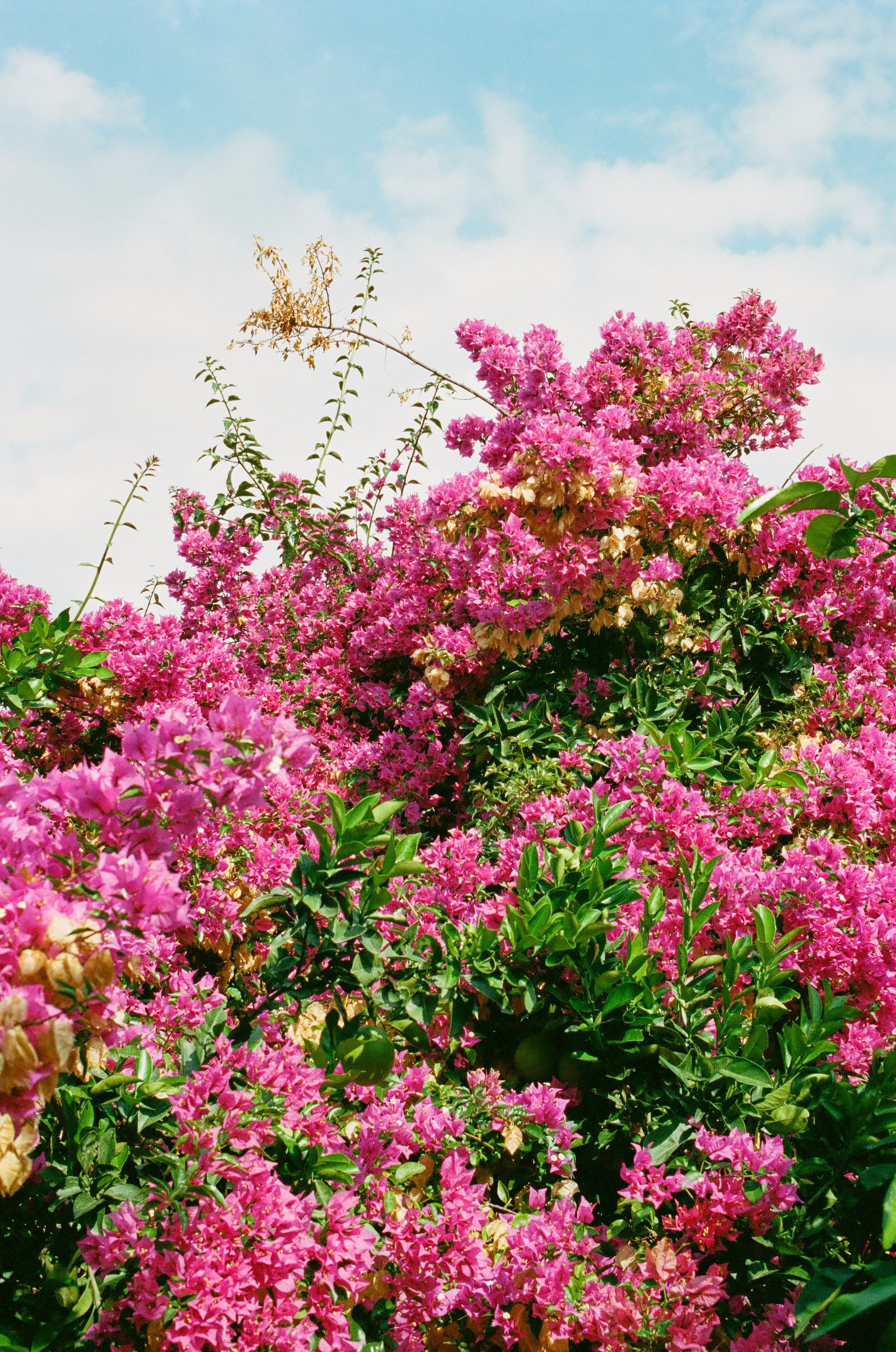
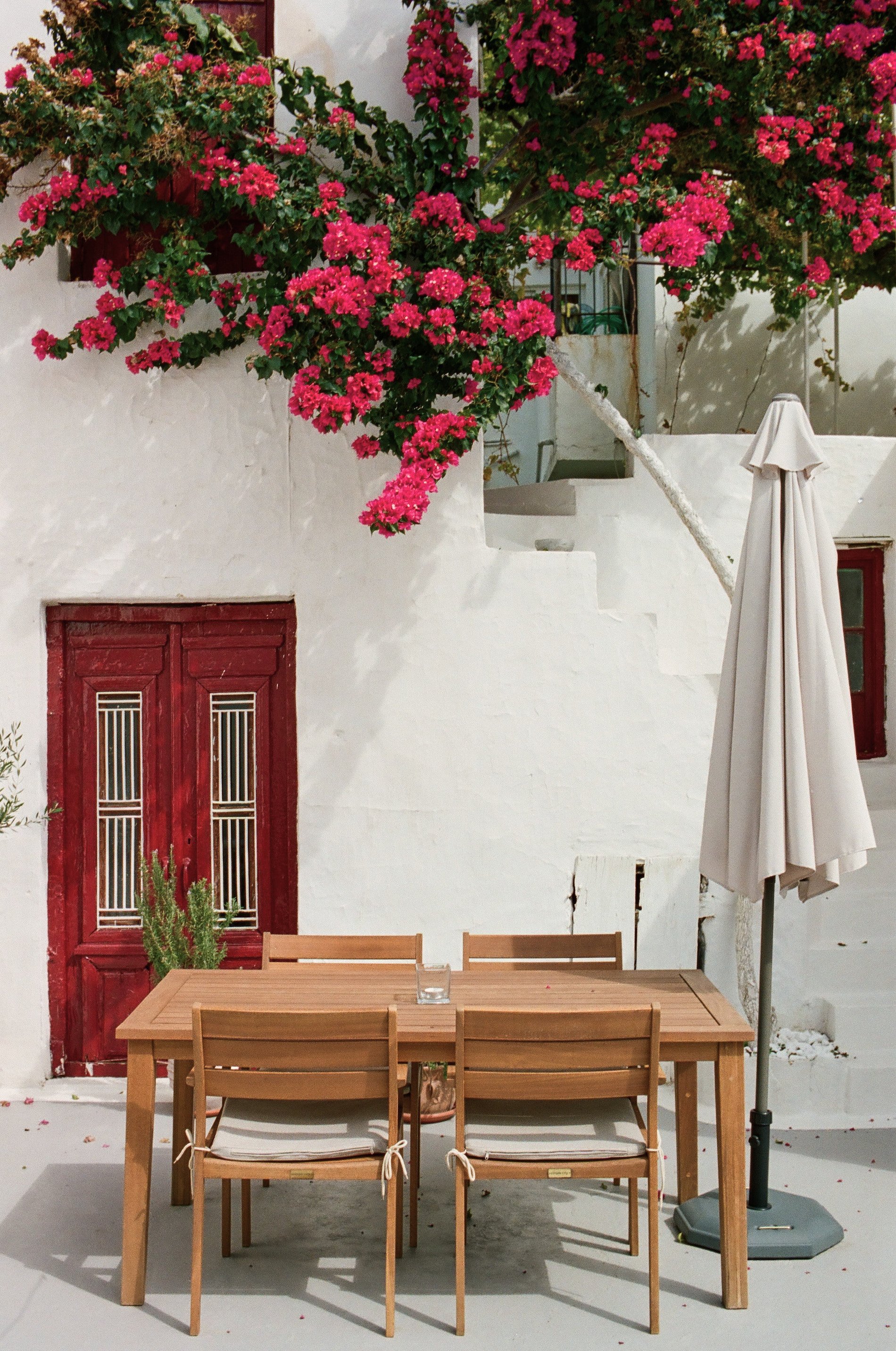
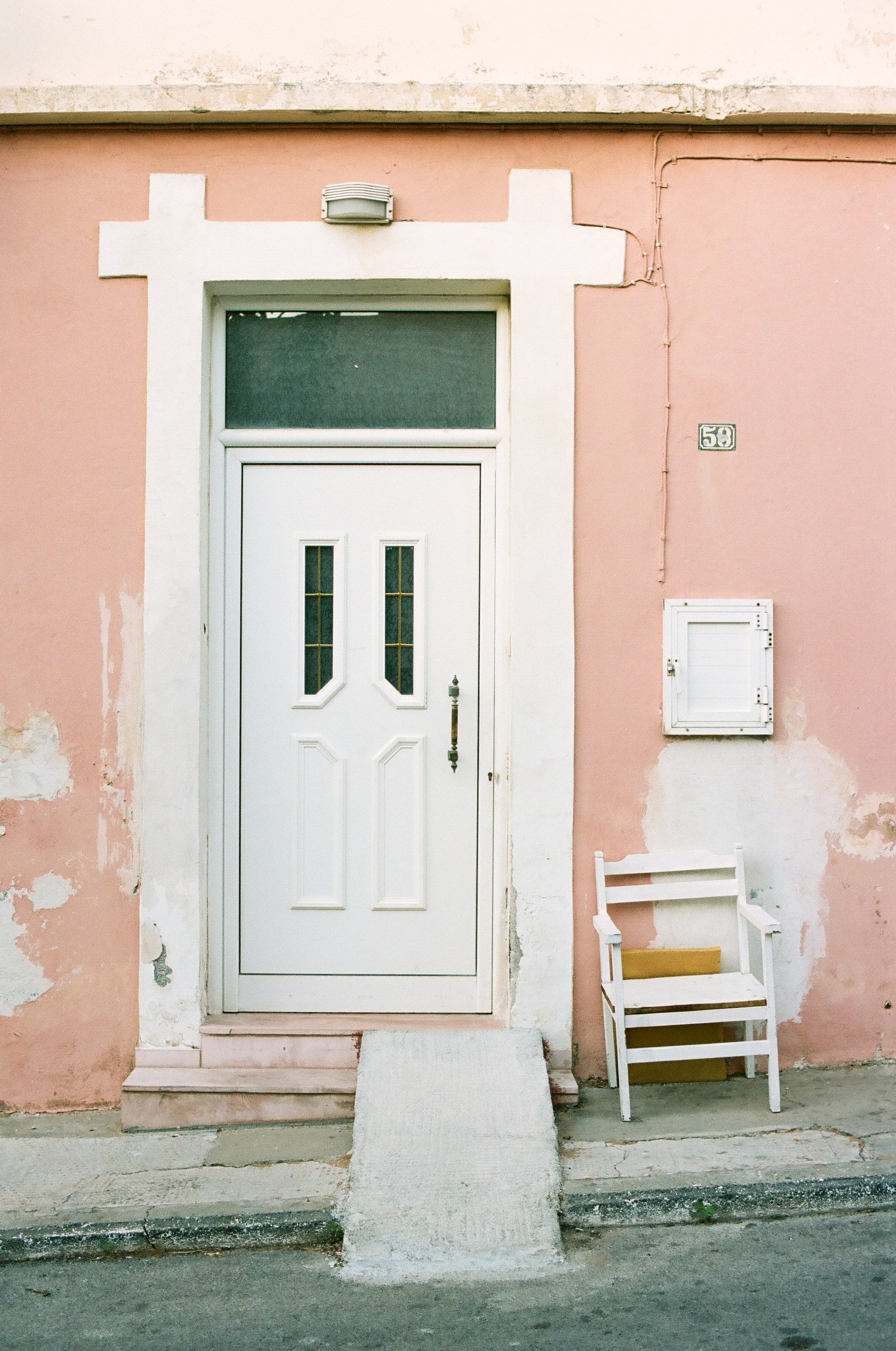


“Unplanned road trips are the best kind of journeys in Crete. For instance, the Chania to Sitia Highway (a journey of about five hours) is one of the most scenic routes to travel, with continuous landscape changes. Throughout this trip you can stop for a dip at 30 to 40 different beaches and visit charming chapels by the side of the road.
If you are looking for romance and solitude, the south coast of Crete remains untouched, offering some of the most impressive landscapes and solitary beaches on the island, with wild sub-tropical waters.”

“We want people to take fewer trips, but longer and more mindful ones - personalised travel experiences that champion a profound interaction with local communities. We need to offer something in return to the places we visit.”

Another Scotland
Off grid cooking in the Isle of Skye
Photos by Lisa Paarvio and Words and Recipes by Kieran Creevy
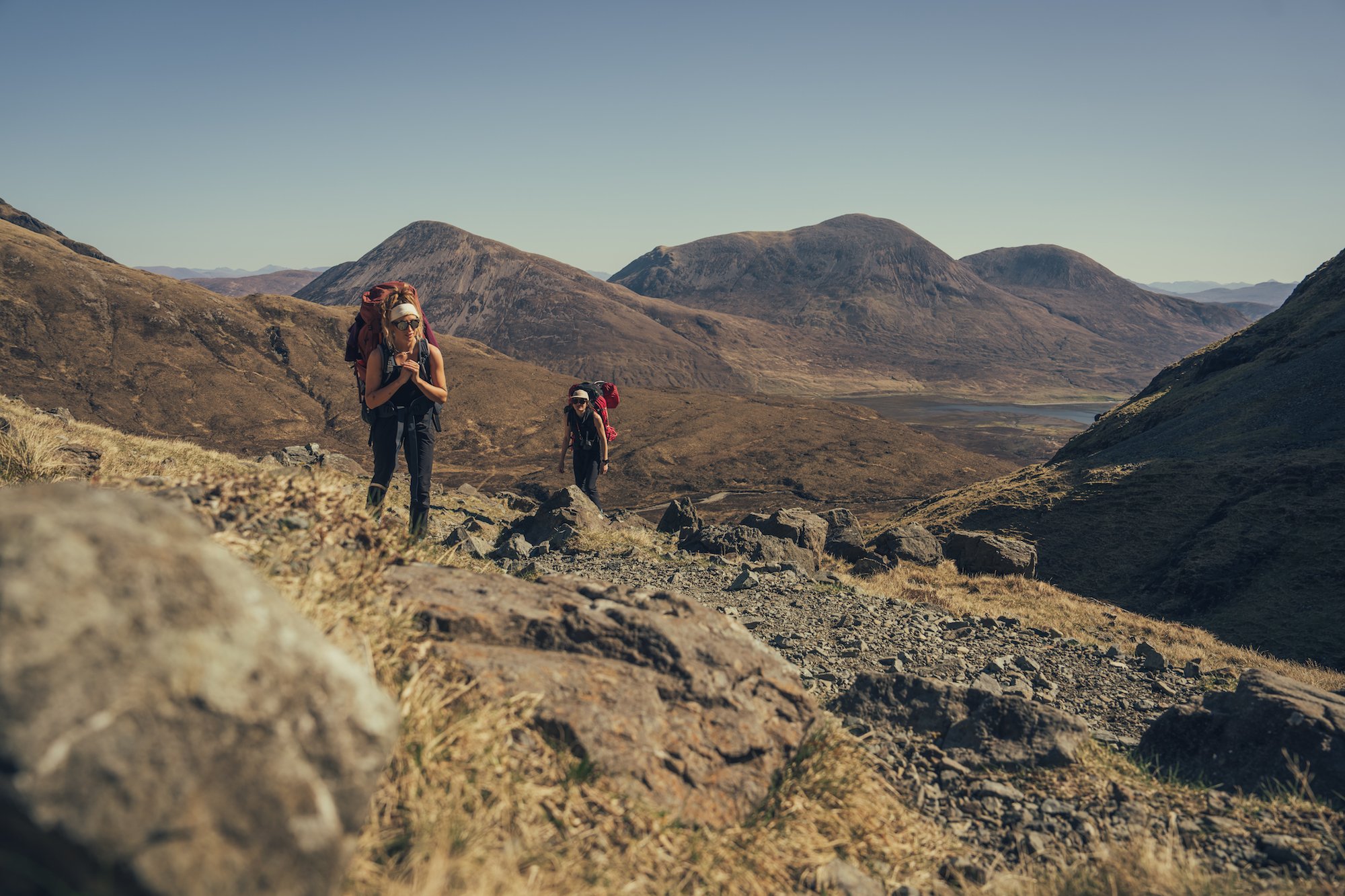
The green walls of our tunnel tent glow, light shimmering and flowing in waves, the dawn chorus ebbing, reminding us that time is a wasting. Waking slowly in cocoons of silk, down and nylon, there's a delicious sense of lethargy, we’re slow to get moving.
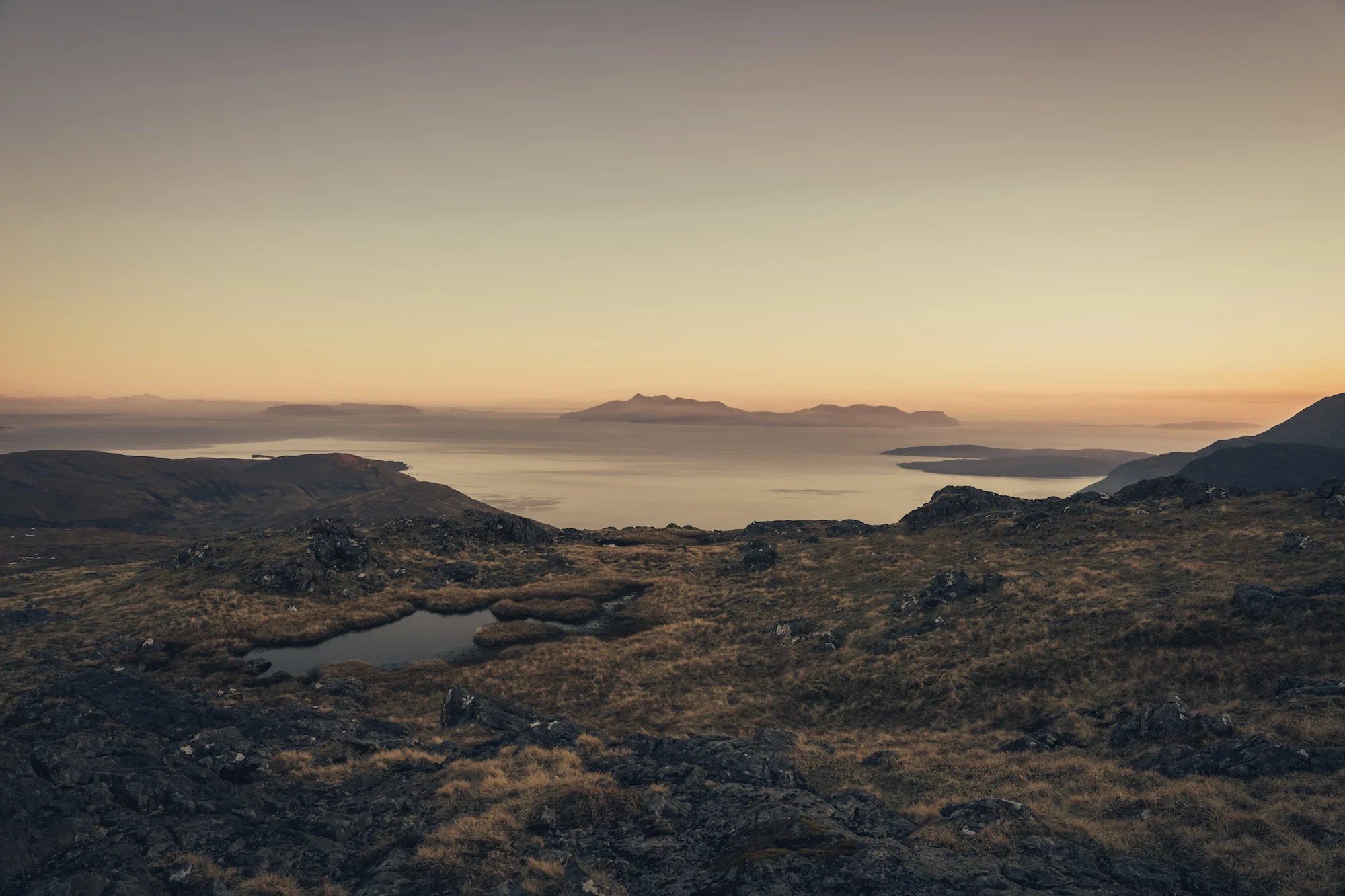
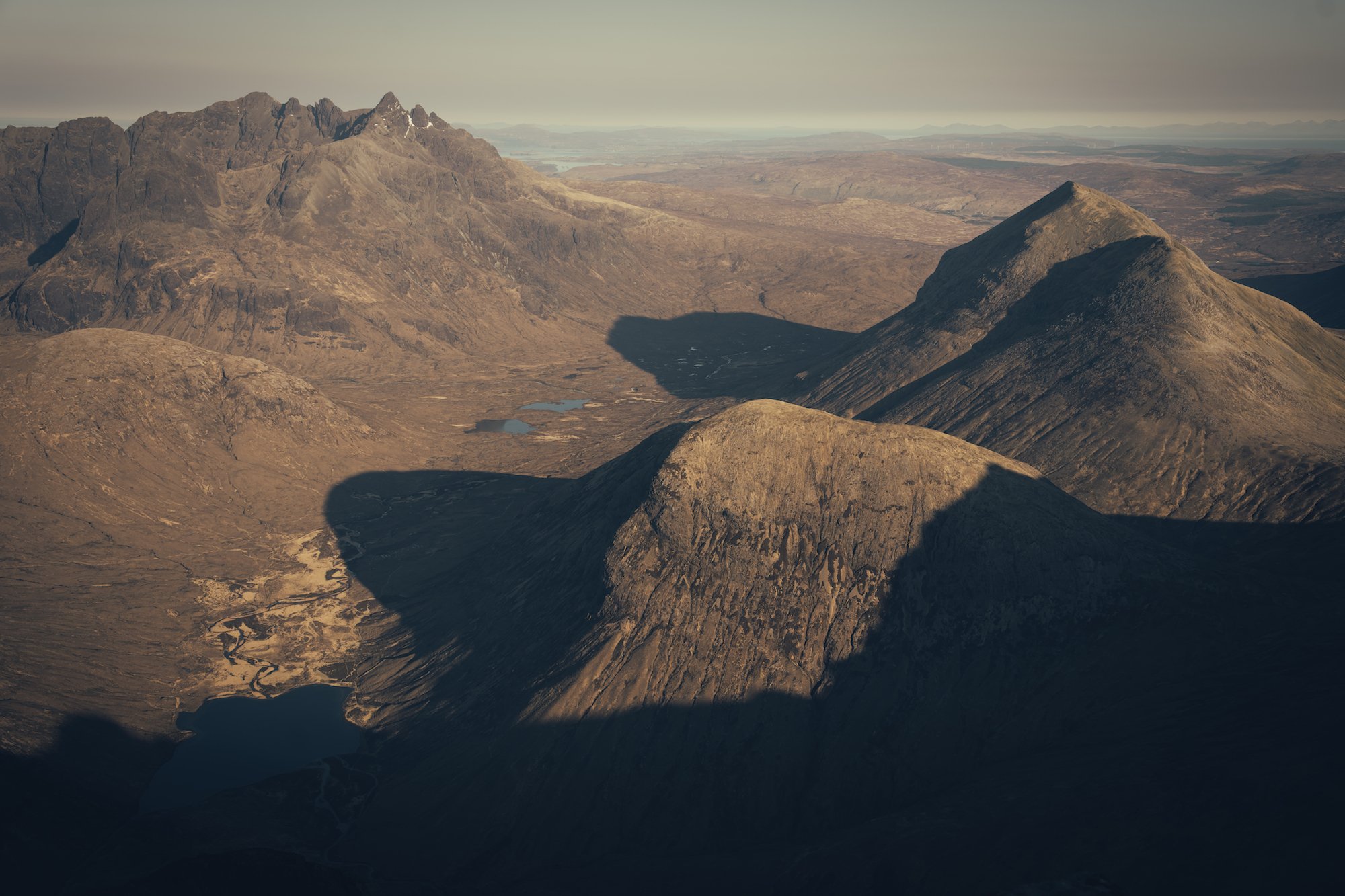
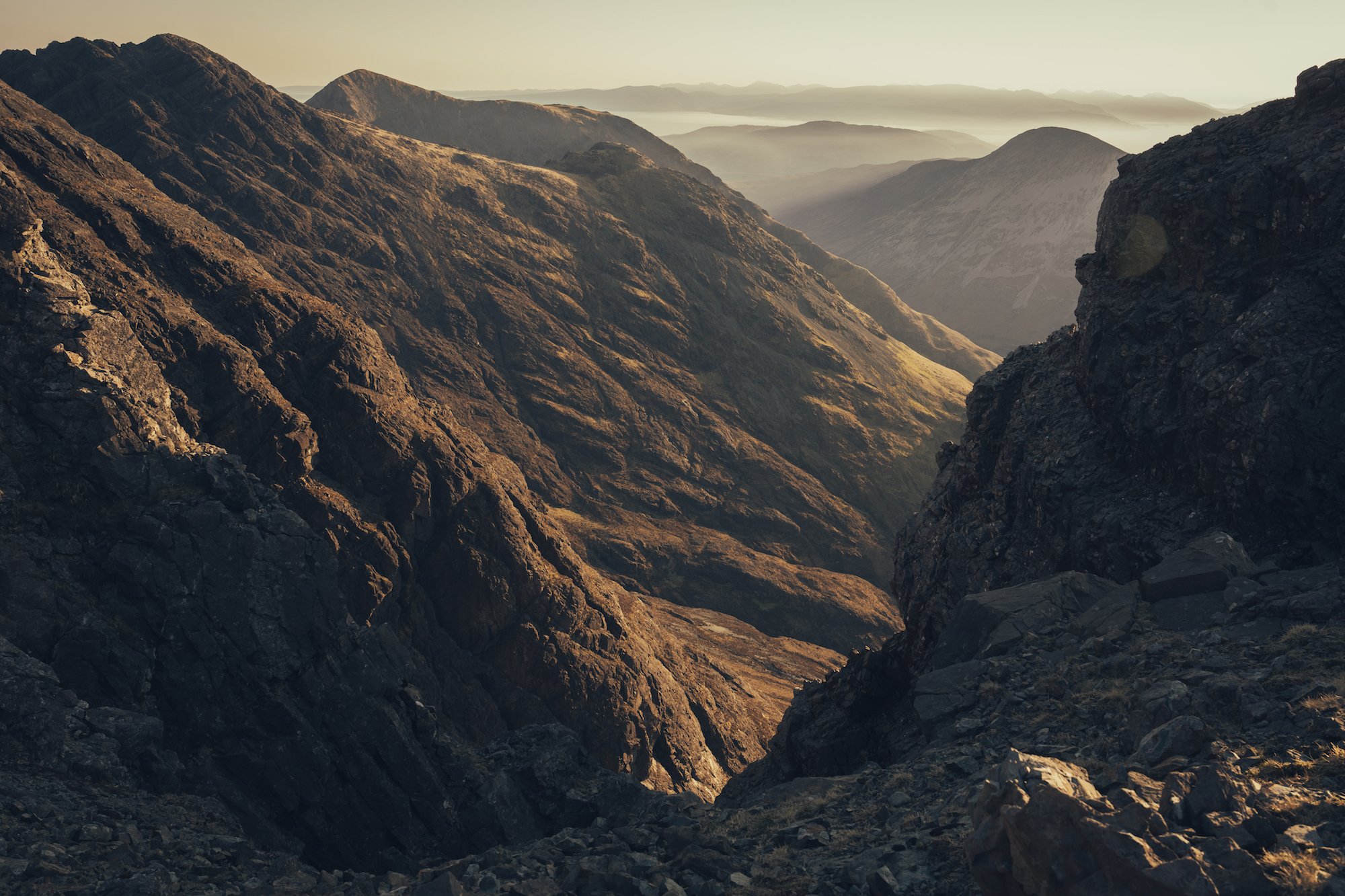
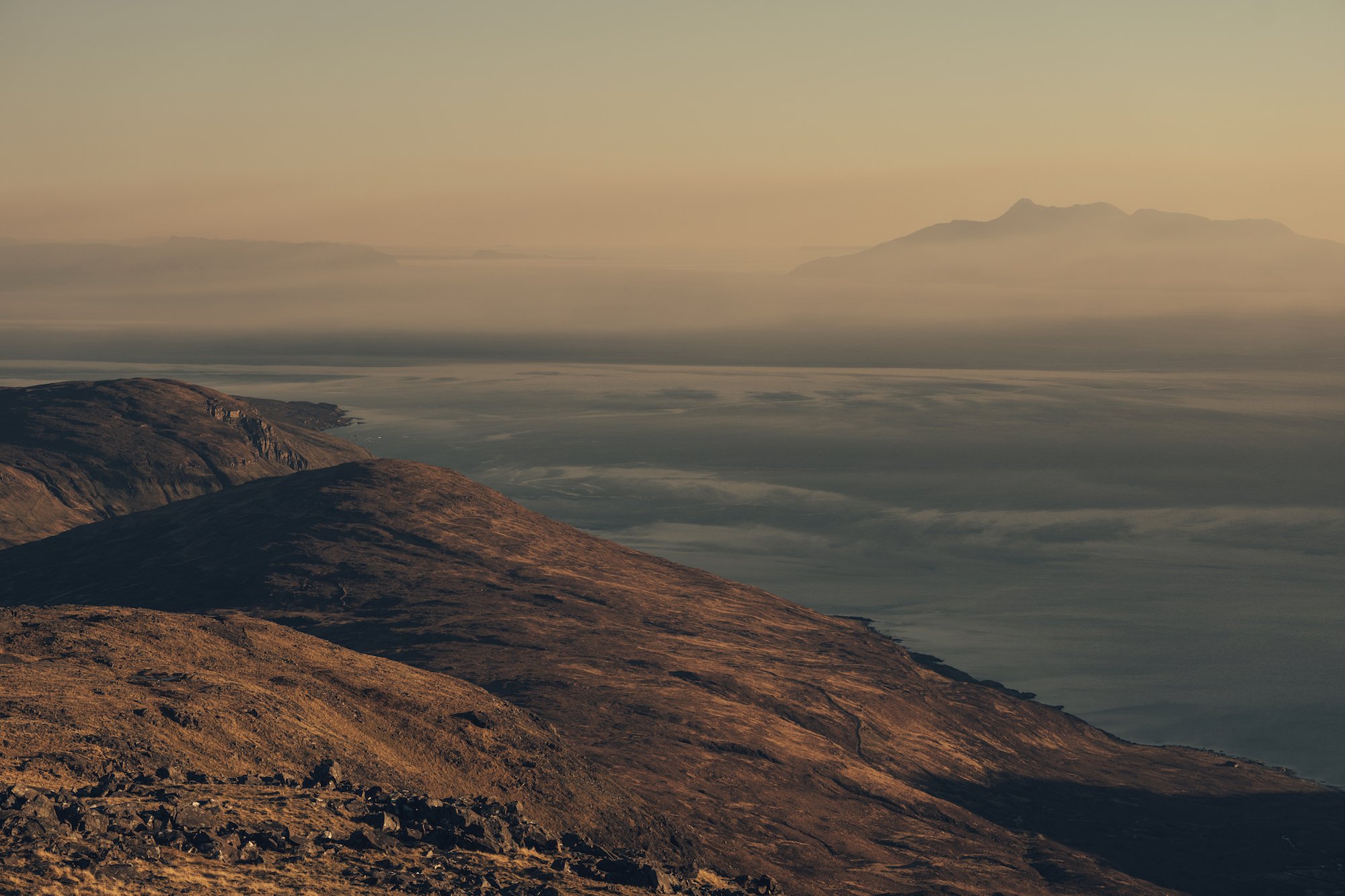
Here, beneath stark basalt mountains on the Isle of Skye, the scent of sun warmed earth and heather flows into the tent. Still in our bags, there's good natured banter as to who has to leave the comfort of a warm bag to light our stove and get breakfast going.
Grumbling slightly, one of the team wriggles out of the tent, the fly taut with the heat from a cloudless sky. A rare and unexpected joy here in the far North West of Scotland, where one day of sunshine is a thing to be celebrated.
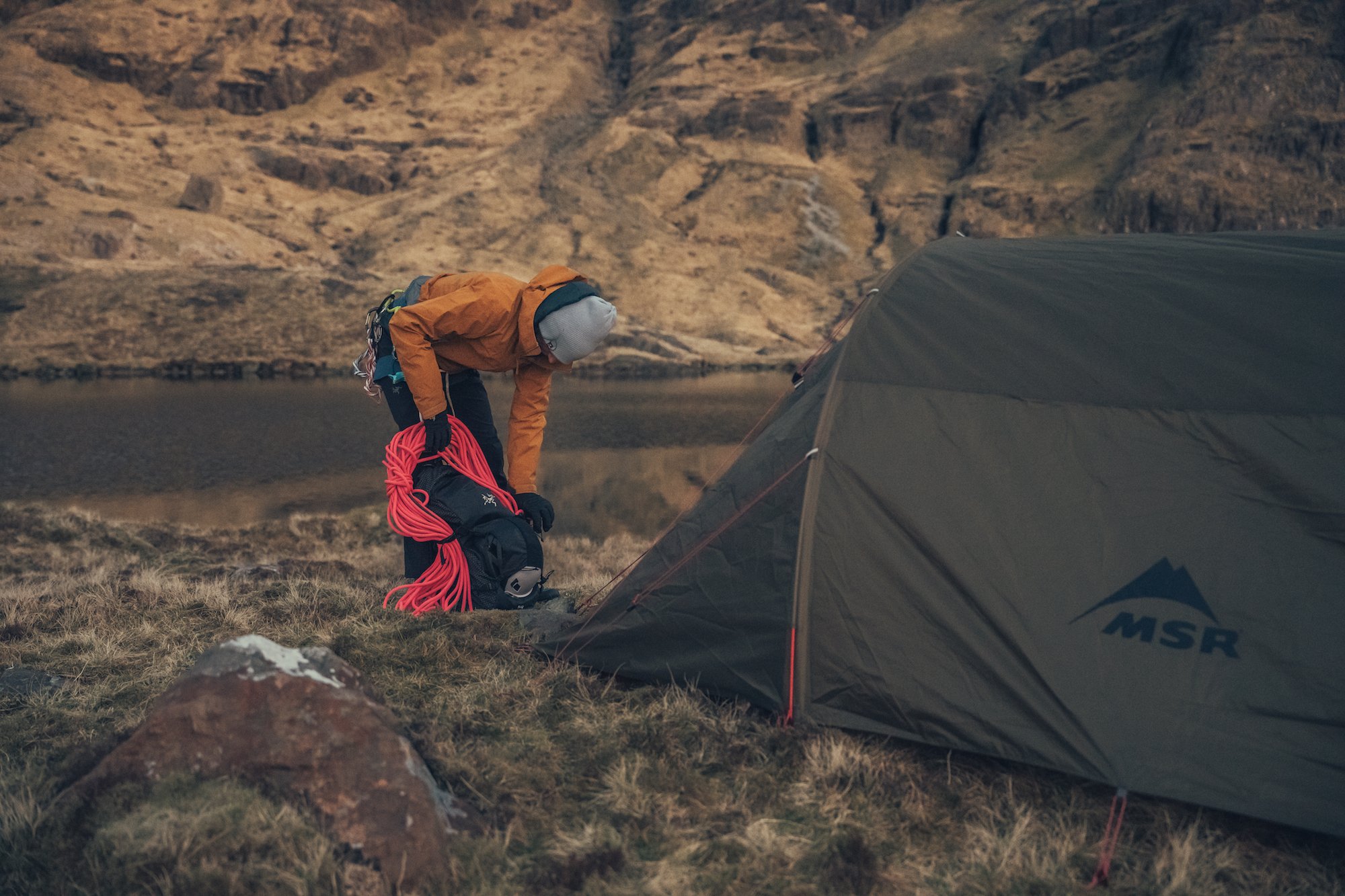
The contrast in this landscape bewitches, and pulls us into its embrace. Packs lie in the lee of the tent, the pink loops of our climbing rope wedged underneath a lid, ready for todays scramble along beautiful ridges, the beams of sunlight shading the rock formations, calling to mind a Jacobs Ladder of sorts, ascending to the heavens.
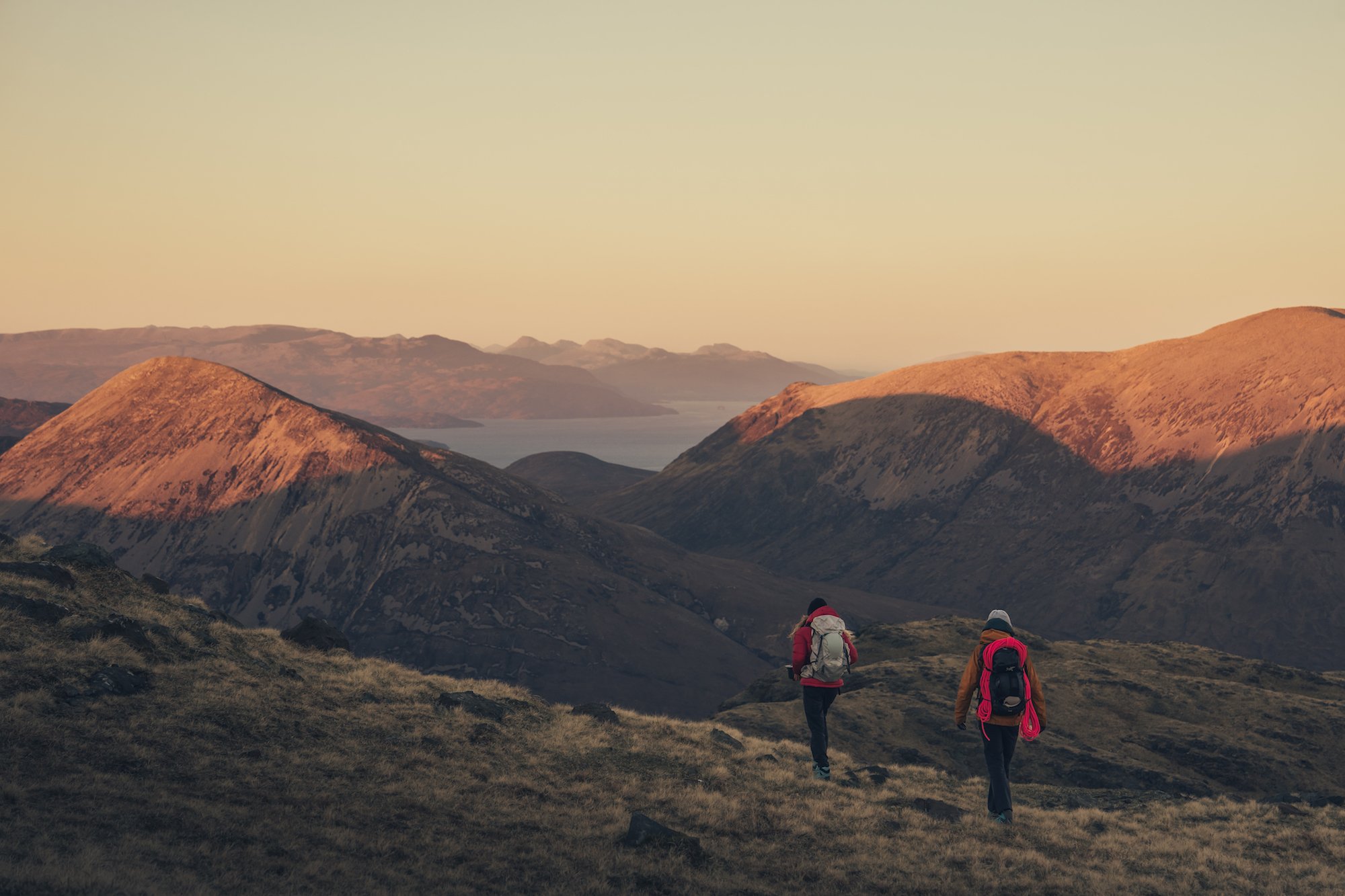
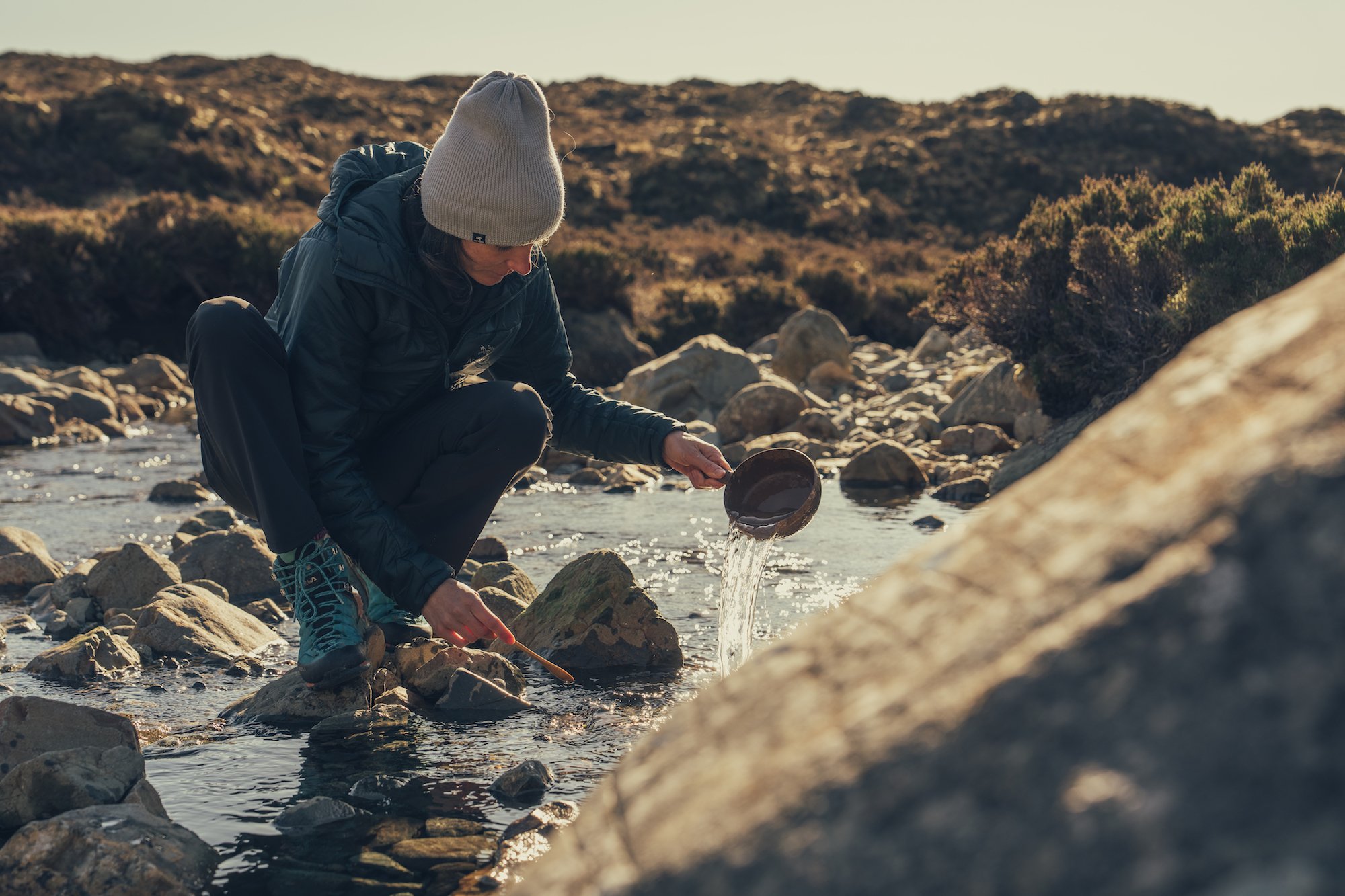
Descending to the stream, we fish out a dry bag wedged between boulders. Inside, chilled in this makeshift fridge, are wild salmon fillets and hard boiled eggs, cooked the night before. When I’d purchased the eggs - handing over cash, crumpled in a ball, to the farmer who raised the animals - I felt that the exchange came with a greater sense of human interaction than any chip and pin transaction in a supermarket. These type of encounters are still an everyday occurrence in the area from which we get the other elements of our meal.

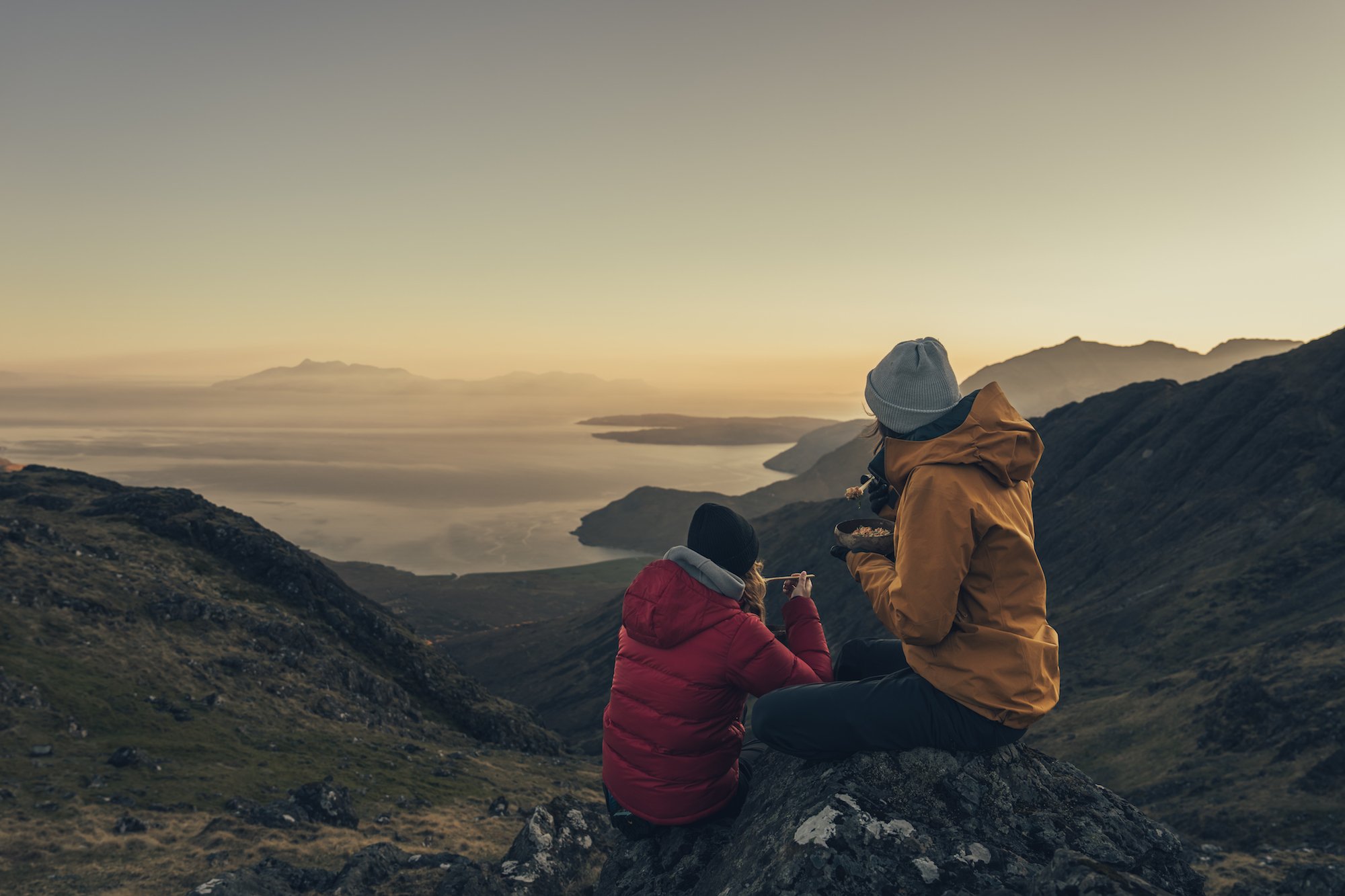
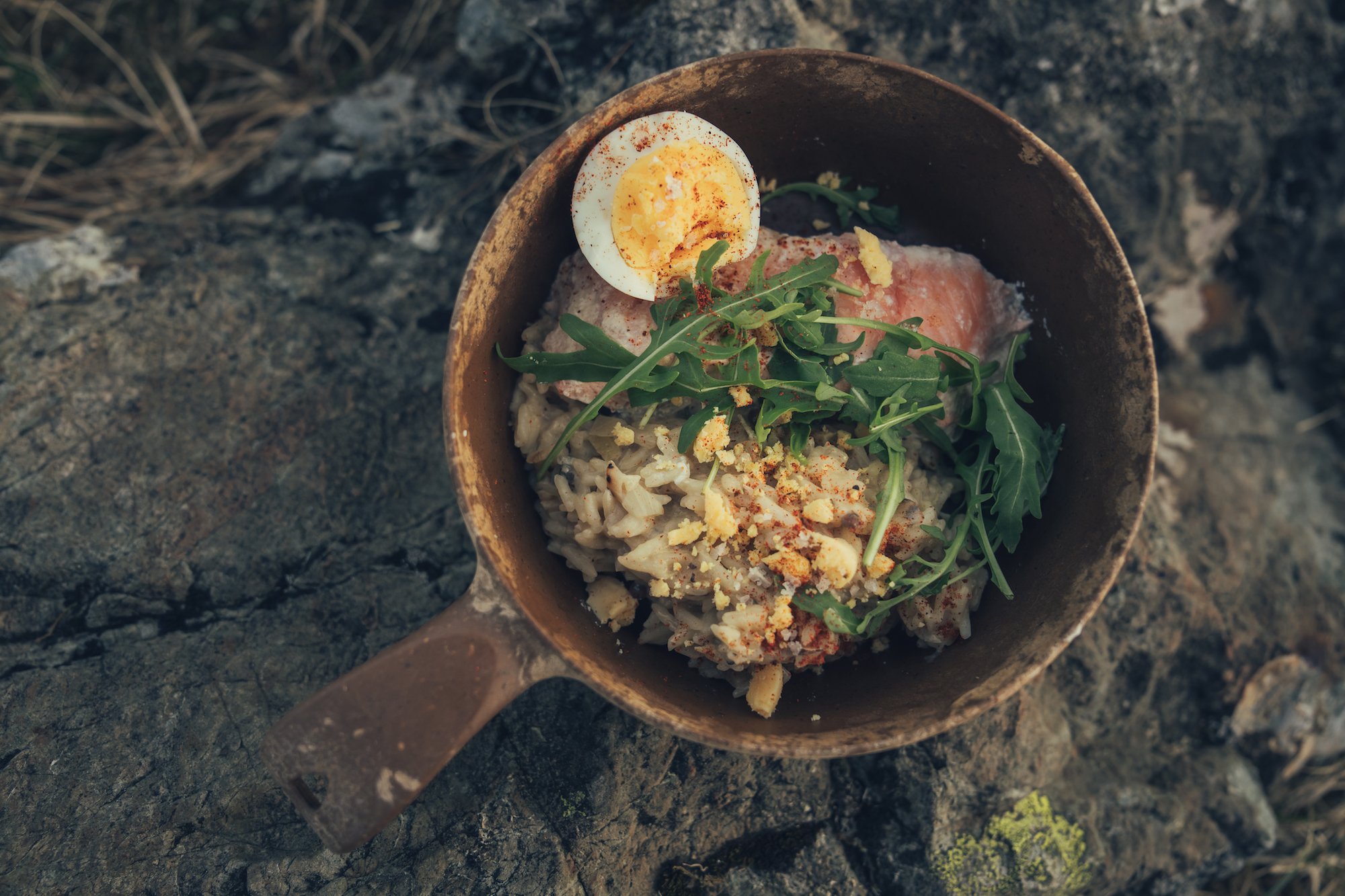
Rice and spices from Indian markets mingled with the European addition of fish and eggs, transforming the traditional dish of kichirī into todays kedgeree. Though some kedgeree recipes include curry powder, no self respecting Indian cook would ever resort to the vaguely brown powder sitting in a jar at the back of the cupboard. Use the mix below, or add to it as you will, the flavour will be far better than any pre-made combination.
Dried whole spices weigh little, changing the quantities below can greatly alter the flavour of the recipe, so we encourage you to experiment.

Ingredients:
2 cups long grain rice or a mix of long grained and wild rice
500ml water
2 tbsp garam masala powder, or use the mix below
1 tsp tumeric
1 tbsp curry leaves
1 tsp mustard seeds
1 tsp black onion seeds
1 tsp rock salt or sea salt
1 tsp pepper
2 organic duck or chicken eggs, hard boiled the night before and kept fresh in the drybag fridge.
2 fillets wild salmon or trout.
Chervil and coriander leaves
1 tbsp olive oil, butter, or ghee
Method:
Heat the ghee in a pan, when hot, add the spices and salt
Cook the fish fillets, skin side down first until crisp then flip and cook for 1-2 minutes more, remove and leave to rest.
Rinse the rise in clean water, drain the excess starch and add clean water to the top of the rice, then one knuckle deep extra.
Bring to the boil, with lid on until fluffy, season.
Peel and chop the eggs.
Flake the trout fillets into the rice, add the eggs, tear the chervil and coriander leaves and mix well.

Cranachan, deconstructed
Ingredients:
150g oats
400ml water
2 tbsp wild heather honey
3 tbsp butter
4 tbsp raspberries
4 tbsp strained yoghurt.
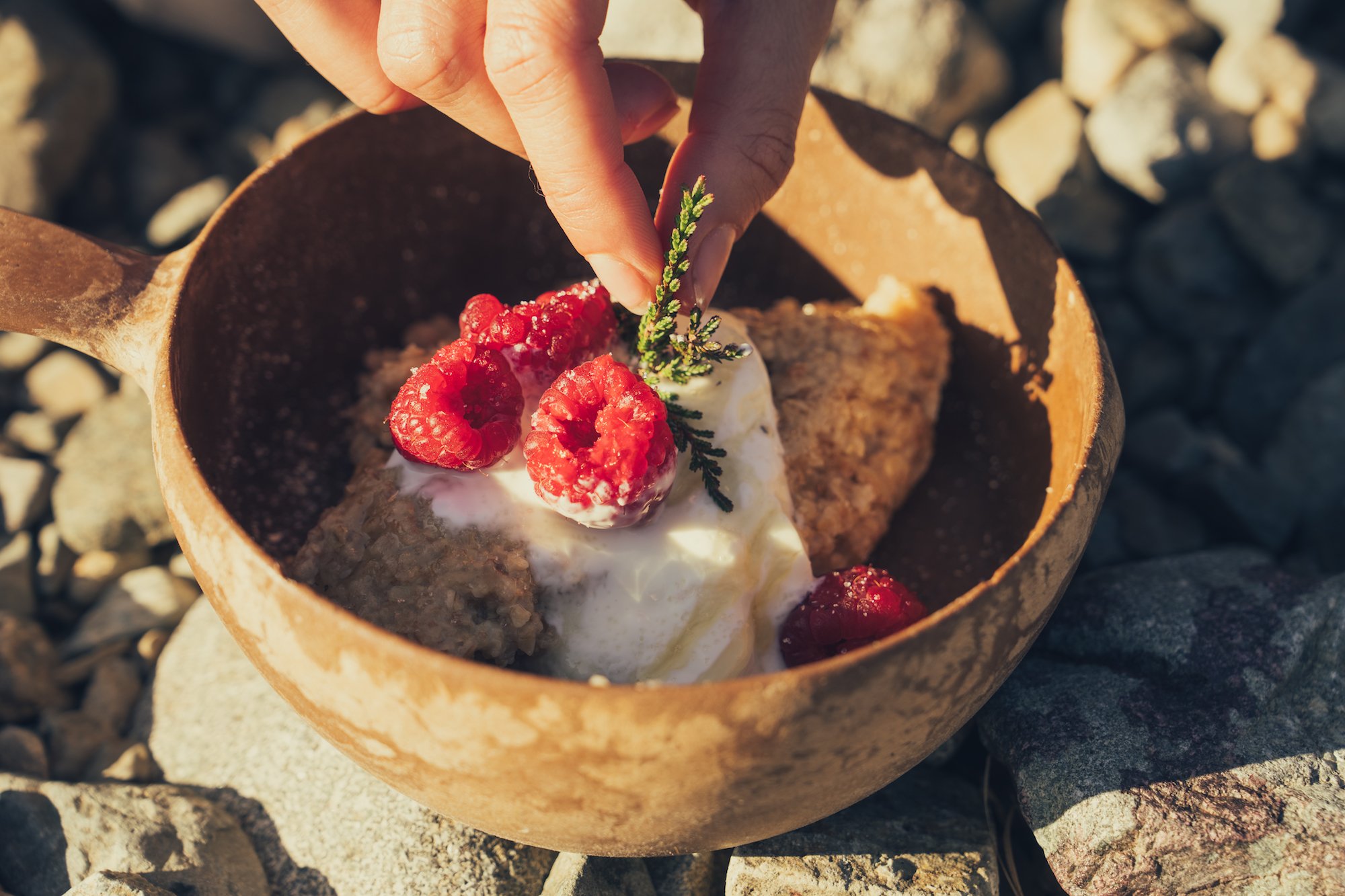
Method:
Bring water to the boil, add the oats and cook.
You should have a thick mixture.
Add 2 tbsp butter to the mix, and stir in.
In a pan, heat up the other tbsp butter.
Spoon some of oatmeal into the pan and flatted down to thick disks.
Fry on one side, flip and fry again.
Spoon into bowls and top with yoghurt, raspberries and honey.
You can also make this dish with cream instead of yoghurt and add a tot of good Scottish whiskey if you feel like it.




Cover Photographer - Louise Coghill
An interview with Australian photographer Louise Coghill.
We’re introducing you to Australia magazine cover photographer Louise Coghill, who hiked the Cape to Cape and Larapinta Trail for the issue, and mused on her journey to Karijini National Park. You can see more of Louise’s work here - and order a copy of the Australia mag here.
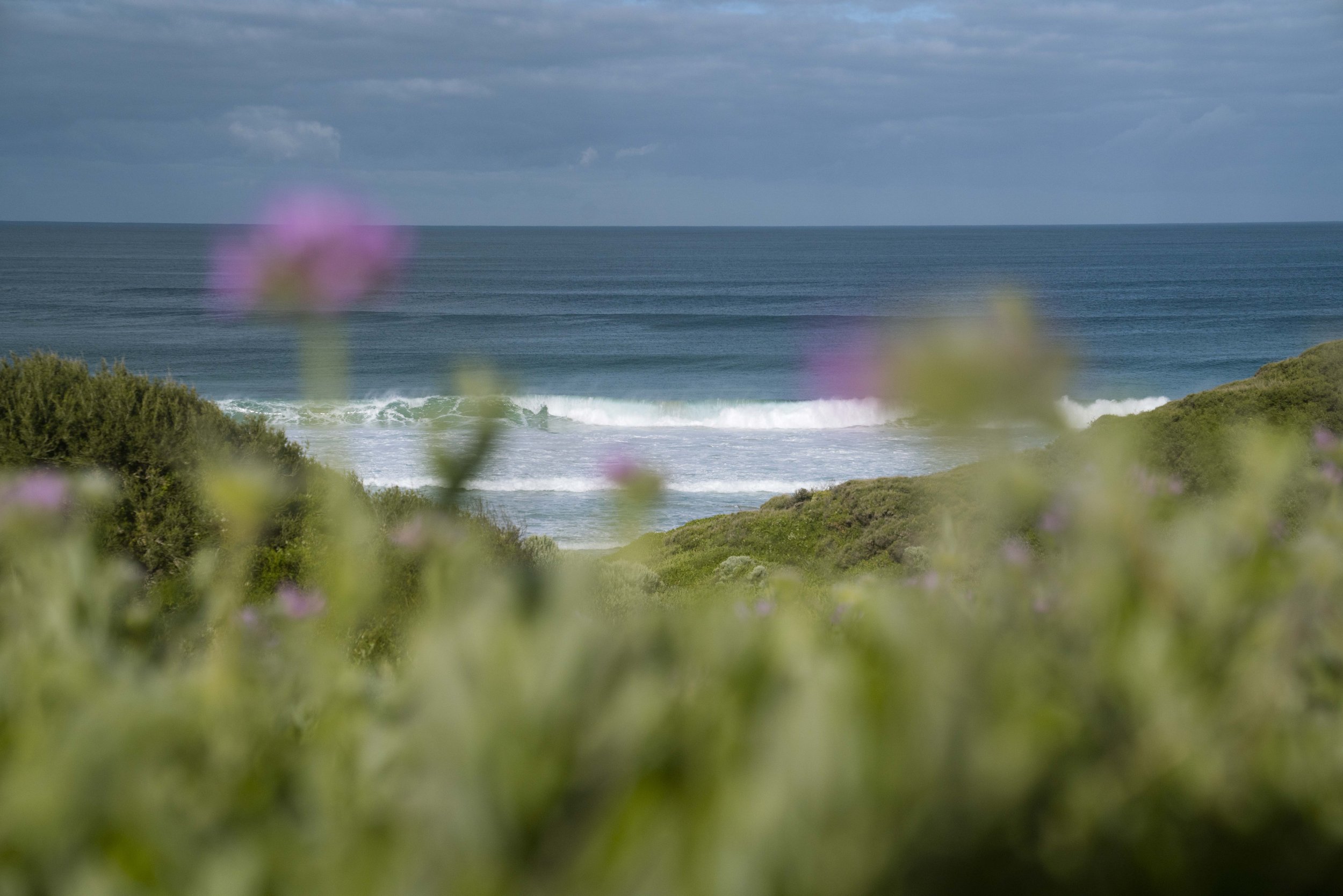
- When did your journey as a photographer begin?
I picked up a camera properly for the first time when I was 15, borrowing my fathers Nikon while we were living in Zambia. I used it as a way to explore the strange place we were in; it helped push me out of my comfort zone, and also created a comfort zone of its own. Having a filter to view the world through allowed me to explore further. I went on to study film and TV, wanting to make movies, and took a class in photography where I learnt the basics. I didn’t love the class though and I quit pretty quickly. The assignments felt so sterile in comparison to film and TV. Photography only re-entered my life when I moved to a sleepy little town in Far North Queensland where there was no film industry. I was a lonely young adult and photography became a tool for me to head off on little solo adventures into nature.
- What do you love about taking photographs?
Photography has helped me live a more adventurous and spontaneous life. It pushed me to book tickets abroad to find places and stories to photograph. As I began journeying further afield and travelling through Europe and Asia photography helped grow my comfort zone. When I was lonely on my solo journeys my camera would support me. When I was feeling out of my depth it felt ok because I was going to take a nice photo. I love the process as much as the final product.
It was a way to share my journey, even if I was there on my own at the time. I would capture it knowing it would go online and my friends and family would comment and enjoy it with me. Sharing the moments and stories, bringing my adventures back for other people to experience without the smelly clothes and sore feet and thousands of kilometres of hiking required, is incredibly special to me.

- What is your favourite thing to photograph?
I love telling the stories of my journey and of the places I’m exploring. Capturing the epic images alongside the reality of life on the road. And I love trying to capture time. Whether its a quiet moment when a butterfly lands, the movement of water, the morning sun striking the Australian bush. I love capturing these fleeting moments, the ones most people don’t notice. In a world where we take 2.6 billion photographs daily, and have travelled to nearly every corner of the globe, it’s those little moments that feel special and worth capturing.
- You've embarked on quite a few hikes now - what makes this kind of experience such a wonderful thing to photograph?
It’s a slow way to move through the world, and it gives me time to take my camera out and capture the landscape and the journey, while still enjoying the world around me. There is no rush to get home, there’s no bus to catch. I just walk and snap. While I love the process of photography, at times it can be overwhelming, the need to capture the spaces I inhabit, the sunsets I witness. With hiking I get the space to enjoy it all, and not worry so much. I have to keep walking, so I have to give myself up to the landscape. Sometimes I’m walking through a beautiful space when the lighting is stunning. Other times I’m walking through the spectacular landscape in the midday sun, and I just leave the camera in my backpack and enjoy the view.

- What does the word 'home' mean to you?
My parents property up in Gidgegannup was always what I thought of as home. I would move from share house to share house, packing my stuff into storage every 6 months to a year and hitting the road again. But Gidgegannup was the one place I could let my roots grow, and not worry about them dying away when I travelled again. Mum and dad always kept them watered for me. Everywhere else home felt like an elusive concept. I didn’t feel at home on the road, but the various spaces I lived in, never fully felt like home either. My parents’ property burned down earlier this year and I had to redefine that space. I began putting my own roots down, growing plants and letting myself stay in one place. Now home is more easily defined as the places my loved ones are. It’s not attached to the spot but to the people within it.
My definition of home has changed how I travel too. I have a place and people to come back to now, so my adventures have become more defined. I don’t aimlessly journey for months on end. I know where I’m going and when I’m coming back. And it feels really good.

- Is Western Australia a good photography subject?
Western Australia was a difficult place to photograph when I was younger. I wanted the mountains and the loooong golden hour. Australia is incredibly sunny, so much of the day can be difficult to capture. The majority of the land is flat and sparse. The16 hour drive to Karijini, one of my favourite spots in WA, follows a straight road and the landscape changes so slowly it’s hard to notice. We have so many spectacular sights, but they feel so spaced out it takes great effort to find them.
It took exploring other countries and returning to this rich, diverse, spacious, ancient, red rock country to fully appreciate it. And to finally see what made this place so special. The wildflowers, the gum trees, the kookaburras, the far-reaching ocean. It was all so normal and unchanging in my childhood. In my adulthood I see how old this place is, and the countless stories the landscape has to tell.
- Is there a creative community in Western Australia?
Perth has an amazing creative community. I think because it’s so isolated out here, it’s led to a creative explosion. We can’t just easily flit off to other cities to get our fix so we’ve had to create a thriving community right here. We’re a growing city, so we’re a bit behind the rest of the world, but everything is so close knit. Everyone knows someone who knows someone. Plus Brett from Kath and Kim lives just up the road from me, so you know that says a lot about what a happening place Perth is.

- Can you tell us a little about the image on the cover of Lodestars Anthology Australia? Where was it taken and what was the day like?
I was hiking the Larapinta Trail through the Northern Territory. I had to carry 6 litres of water that day as there was no water for the next day and a half. I was walking slowly, trying to enjoy the day despite my heavy bag. I hit a hill and trudged up it. I was sheltered from the wind on the way up but the sun beat down relentlessly. I reached the saddle and put my bag down to have a rest before walking down the other side. The wind blew past me, cooling me down while I peeled an orange. The juice ran down my arms as I bit into it and the sugar gave me a needed hit. I sat for 15 minutes enjoying the view, loving the unexpected colour of purple that covered this landscape thanks to the Mulla Mulla plant endemic to semi-arid Australian landscapes. It was midday so I didn’t expect to be able to capture a nice image. Eventually I had to get my camera out and give it a shot, even though I knew it wouldn’t be worth it. The outback is made for midday photography though. The landscape comes alive beneath that bright and cloudless sky. With no high mountains there’s no intense shadows to worry about, and as I snapped it I knew it was an image I was really proud of. It was just so unexpected.

- What's the best piece of advice you've ever been given - when it comes to photography, life, anything really?
There was a poem on the back of my childhood homes bathroom door called ‘I would pick more daisies next time’. It was a poem I would read every day. It was a poem about not living a life of regret.
Here’s a little excerpt: “I’d make more mistakes next time. I would take fewer things seriously. I would take more chances. I would climb more mountains and swim more rivers. I would eat more ice cream and less beans. I would perhaps have more actual troubles, but I’d have fewer imaginary ones.”
I was thinking about it recently, how much that message has impacted my life. I’m really thankful that mum chose that poem.
- What would your younger self think of the work you're doing now?
My dreams have changed a lot over the years. I am living a life I never expected, one that has taught me so many amazing things. I know little Lou would be proud of the human she was going to become. And yet I know I gave up dreams and wishes to follow this path, I gave up my community and dreams of being a filmmaker to follow a more isolated creative path. One that is driven by travel. I have no regret but I don’t want to let the path of least resistance guide my life, and so I try to dip back into my younger dreams and make sure I’m still exploring them. Creating stories, illustrating, exploring other forms of creativity. And trying hard to find that community again after so long on the road.


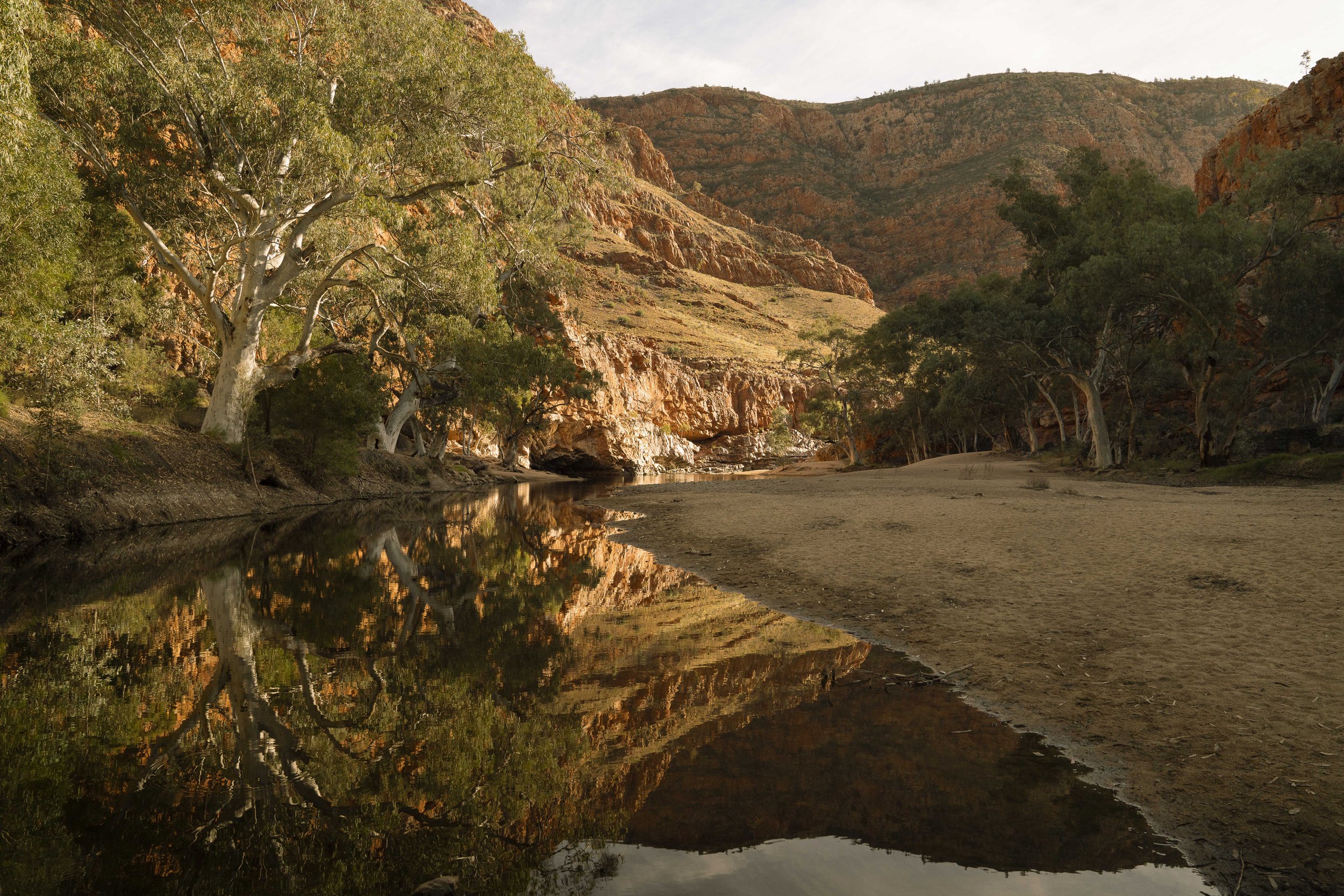


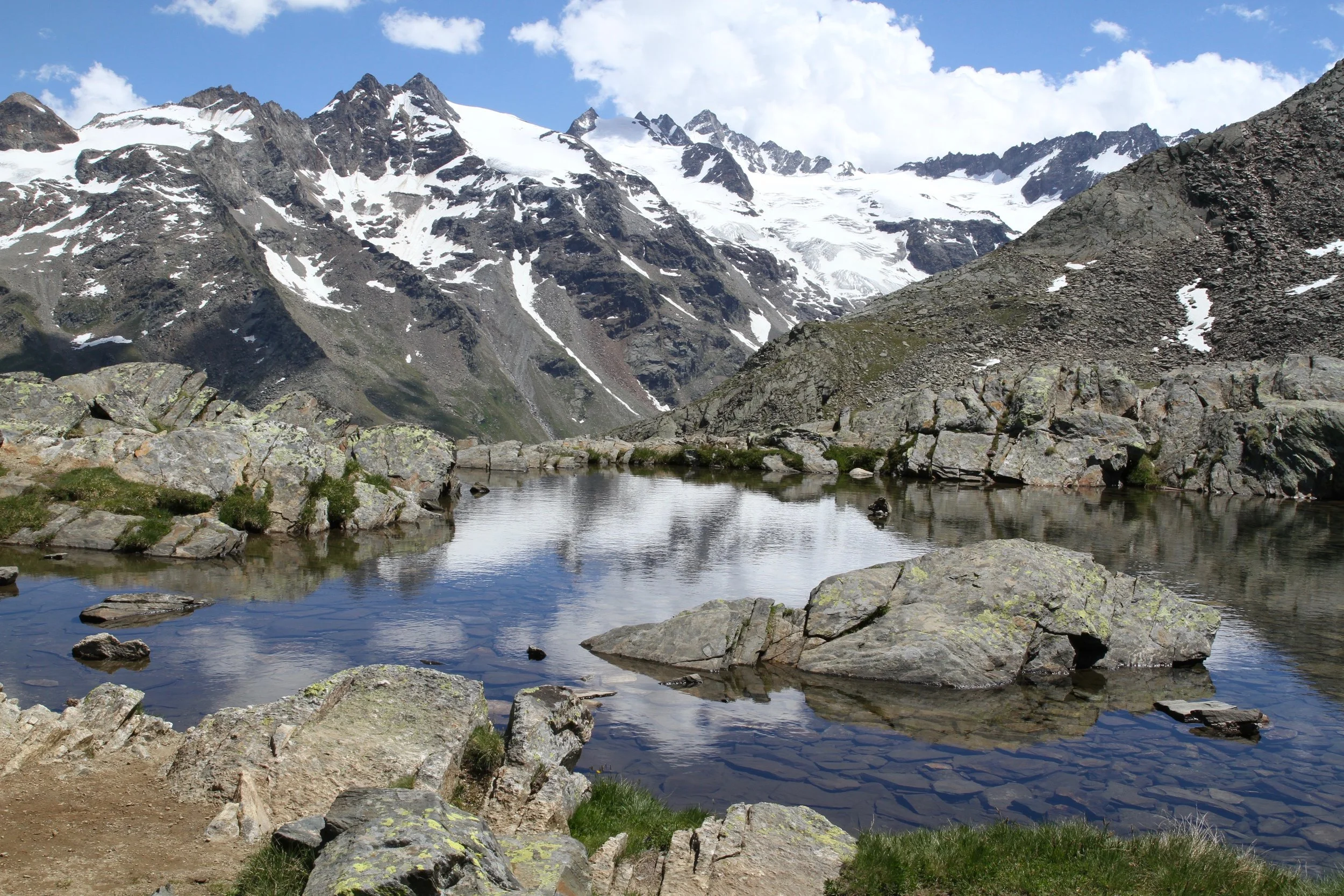
Terroir Tales
Pathways through the vines.
“A vineyard is like a son, nurtured by a family,” muses Davide as we gaze over the quilted countryside, the hills and valley folds streaked with vines clinging to the sun-kissed earth and crested by terracotta-hued villages. “I love all that’s behind a bottle of wine, the emotions, the ideas. It’s personal. Things taste better when you know the story.” While the scene before me was captivating, it was Davide’s words that revealed the emotion behind Piemonte’s beauty.
I wanted to explore this area by getting amongst it, so I turned to wine-besotted Davide Pasquero from Terroir Selection who took me cycling through historic villages (Neive being a particular standout) and along roads coiling through steep vineyards that made my heart pound as I began to understand why these vines are still largely tended by hand – just one of the factors that allows the Barolo from these hills to be viewed by many as the Ferrari of wine.


My mind wandered whilst pedalling. As the vineyards of the Lower Langhe rolled into the hazelnut groves of the Upper Langhe, the Alps remained a constant detail upon the horizon and I mused on the treasures to be found if I extended my path through Piemonte and headed towards these distant, snow-capped peaks. is being Italy (where wander-lust and whim walk hand-in-hand), I succumbed to curiosity and, the next day, swapped my bike for a car and travelled across the Po Plain towards the siren’s song: Val d’Aosta.
Even at its mouth the mountain grandeur was awe-inspiring. Aosta Valley may be Italy’s smallest region but has its highest peaks – Monte Bianco standing as a sentinel upon the French border. Driving along what was once the ancient route linking Rome to France, I passed the Roman bridge at Pont-Saint-Martin and chariot-wheel scarred road at Donnas, but it was the town of Aosta that held the most remark- able relics. Once rivalling Rome in magnificence, well-preserved ruins and the enveloping Alps helped me imagine just how formidable Aosta must have appeared to visiting emperors passing through its Augustus Gate.


Many epochs have left their mark here. Fairytale-like castles fill the valley and atop Coteau la Tour vineyards in Aymavilles I savoured Les Crêtes wine in a medieval tower, once a king’s lodgings. Only 100 kilometres from Piemonte but a world away in terroir, the difficulty of cultivating vines on these granite slopes means Valdaostan plots are small but roots grow deep, wines such as Les Crêtes' syrah and Fumin a luscious result of this mountain mineralogy. The Charrères family who own the winery have worked these hills for generations and as I looked towards the serrated peaks, sipping wine lovingly called ‘son of the light’, I appreciated that, like Piemonte, there is fervour behind this land.
An extract from our Pathways book, which you can purchase here. Words by Angela Terrell and photographs by Liz Schaffer.





Slowing Down in Style
A Blue Mountains escape with Chalets at Blackheath.
Words by Liz Schaffer & Photographs by Anson Smart
Over the past few years, I’ve started to appreciate the importance of slowing down. I’m not always great at it - the urge to be busy is hard to ignore - but I have managed to find increasingly brilliant ways to switch off from the everyday and appreciate the benefits of being still.
A good book and a long soak can get you in a leisurely mood. But when it comes to truly calming your mind, time in the wild can work wonders. We all know how freeing it is to dive into the natural world, to swim beneath a waterfall or hike across a valley. Your thoughts slow as you focus on your movements and the beauty around you. Yet simply having trees, sun and water as a backdrop - and a backdrop alone - can be all you need.
I discovered this while staying at Chalets at Blackheath, a collection of four gorgeously-crafted studio chalets adorned with sandstone, wood-burning stoves, Italian linen, armchairs that cocoon you, and a palette inspired by the world beyond your floor-to-ceiling windows. Celebrating sustainability and luxury, this Blue Mountains bolthole makes use of rain water and solar energy, while its internal walls are built from clay, hemp and stone.

My friend and I arrived with every intention of being active. We planned to hike the six-kilometre-long Grand Canyon Trail, which begins at Evans Lookout - found a mere 600 metres from Chalets at Blackheath. We were going to take a dip at the base of Minnehaha Falls, and make our way to Govetts Leap, following a trail we hadn’t walked since we were kids. But the weather gods (who often have a way of knowing what’s best for you) had decided to put on a particularly moody show. So, while sipping a welcome glass of Champagne in our chalet, we watched as the mist descended and the rain closed in. This felt like the perfect time to put my ‘slowing down and staying still’ skills to the test.
We lit a fire and threw open the blinds, our attention shifting from the scene before us to the books purchased en route at Leura’s Megalong Books. With a cheese plate and lush bath big enough to swim in, there was no reason to leave.

The following morning began with breakfast in the library, and while the beloved Black Cockatoo Bakery pastries are worthy of their praise, the ingredients from social enterprise NATIF took centerstage; think quandongs, Davidson plums, desert limes and lemon myrtle - which were particularly scrumptious scattered over yoghurt and muesli.

With the rain slowing to a drizzle, I set about exploring the hotel’s grounds. There is a communal fire pit (ideal for those with a penchant for star-gazing), a collection of e-bikes, and a thriving indigenous edible garden. Around me, rosellas darted amongst the foliage while flashes of sunlight made the paths and wildflowers glow. Standing there, I drank in the delicious post-rain aroma - a heady combination of eucalyptus, citrus and moss.
But what struck me most were the blackened trees, cloaked in vibrant veils of new growth. Scarred by the Black Summer bushfires, they are almost sculptural now and uniquely beautiful, poignant reminders of nature’s power, and the immense, cyclical wonder of it all.
I know I will go back to the Blue Mountains. I want to hike to Victoria Falls and swim in its Cascades, and wonder if I’ve stumbled upon another realm while following the Fairy Bower Track. I long to gaze across the Kedumba Valley from the Prince Henry Cliff Walk, and while away an afternoon at Everglades House and Gardens. But for now, this escape to Chalets at Blackheath was all that my busy mind required. Proof that when slowing down, a little nature-infused luxury is all you really need.
To learn more or book a chalet, click here. Originally written for Black Blaze.


Letter from Leogang
Meeting Austria for the very first time.
Words by Kasra Lang
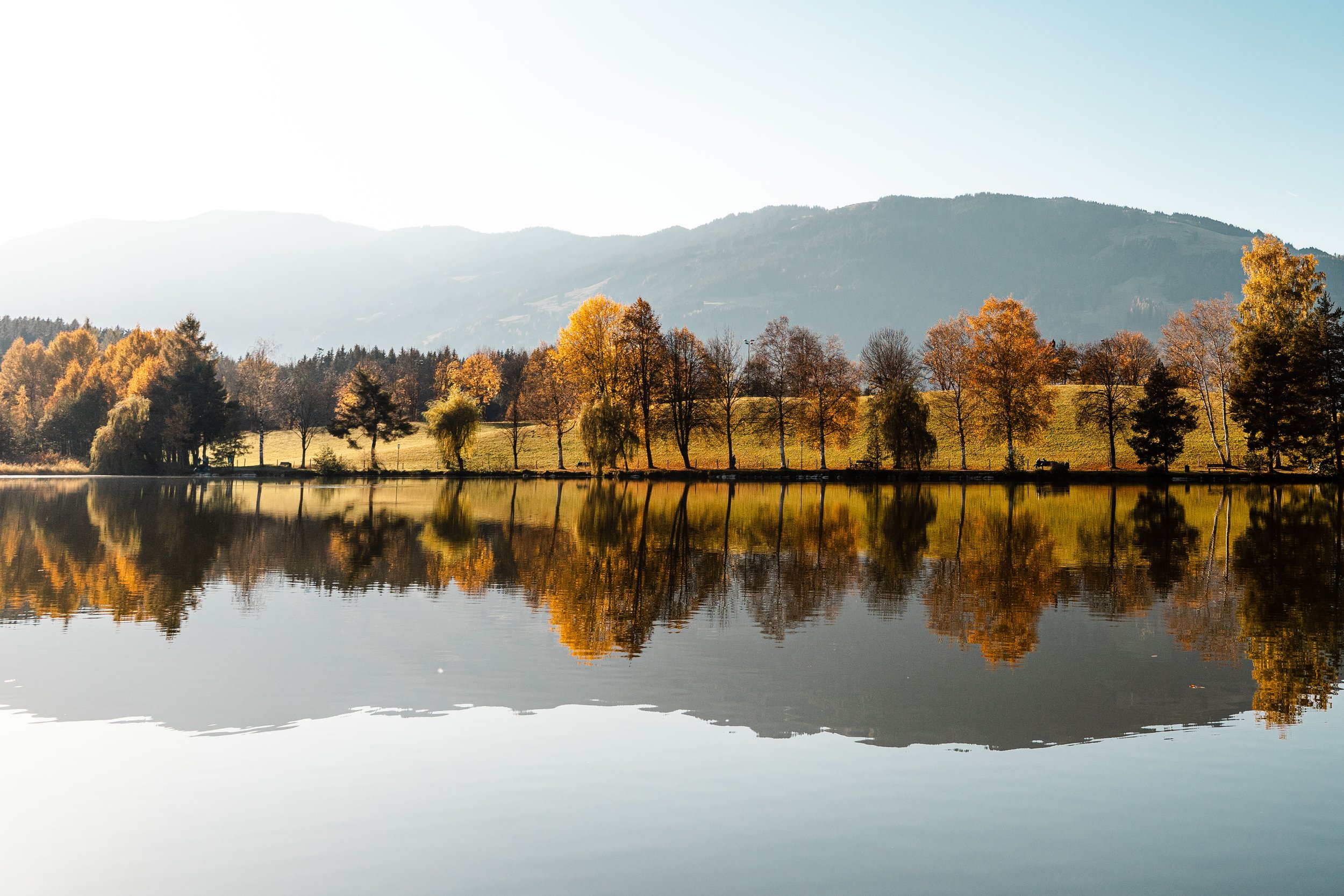
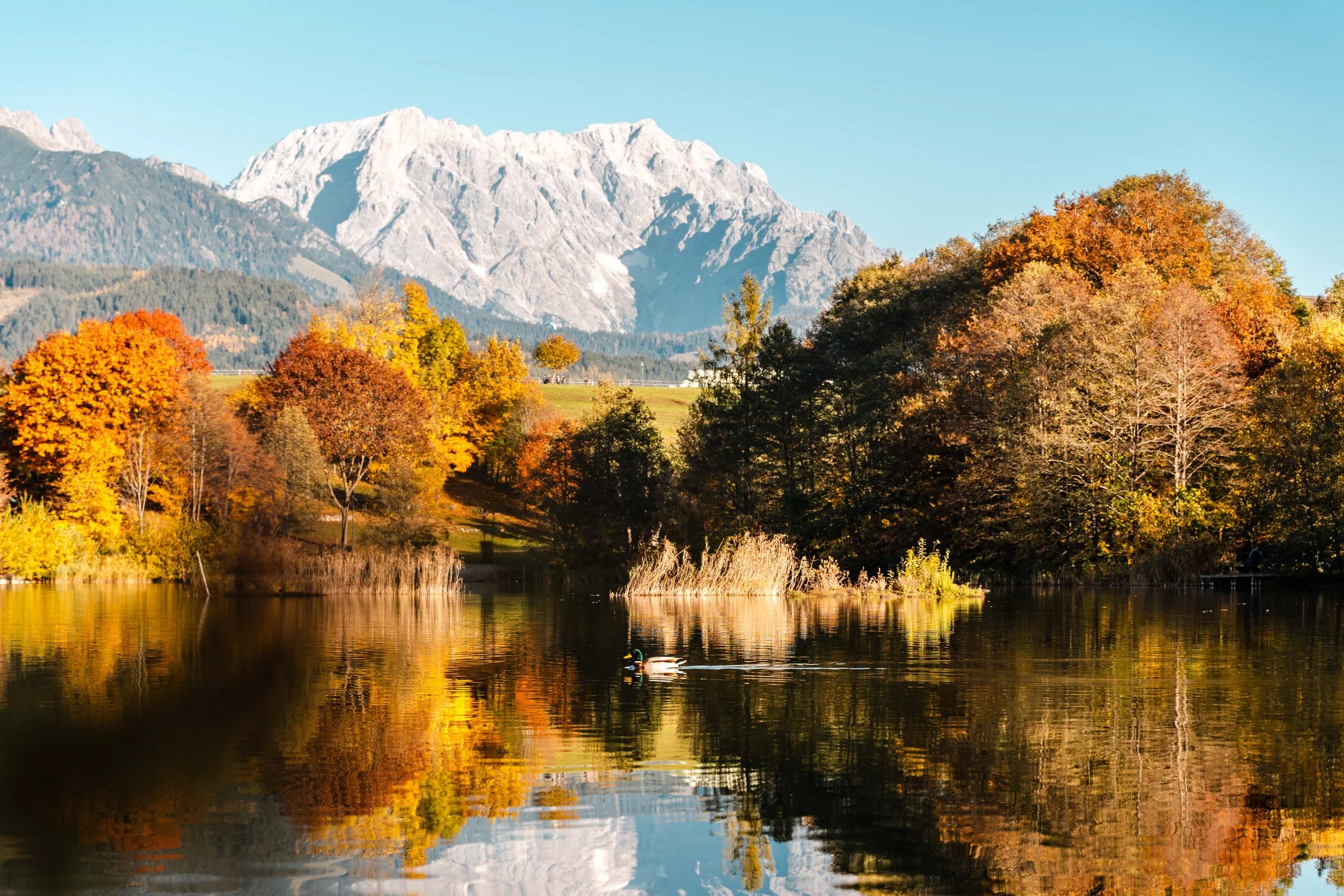
Austria really looks like Austria, if you know what I mean. It looks exactly as you’d expect, exactly as you’d hoped, like a quote of itself. There is an exact one-to-one ratio between the Austria of the mind and its rock-and-soil reality. I don’t think I’ve ever been to a place that corresponds so precisely with my preconception of it. There it is, heaven’s tricolour flag in the frame of my vision - green of greens on the valley floor, a holy blue up top, and in between, a more complicated shade of limestone silver: the Alps sheared upwards.

Every bad picture I take is a solid contender for the cover of a major international travel magazine. I swear it’s that easy - take aim, tap, and a marvel appears on the cracked screen of my phone. It’s as if the very concept of photographic skill disappears here. The real challenge is to take an ugly picture, and I just don’t have that sort of talent. Even a downward shot at my mud-speckled boots in the grass looks gorgeous. It’s uncanny, this self-referential image of beauty, as if I’ve been here before: a lingering memory of God’s garden.
Though in this Eden nothing is forbidden. (There is even an abundance of apple wine). There’s mountain biking in the summer, skiing in the winter, and year-round lounging about in the sauna, three sports which attract athletes of a professional standard. Nobody’s embarrassed at their nakedness in the spa, not even me, though admittedly it took me a moment to adjust to my renewed state of grace.

The local Leogang museum tells me the town relied on the salt trade for centuries. It was a terminally poor place, materially if not spiritually, until the miners and farmers reinvented themselves as hoteliers. The family-owned Naturhotel Forsthofgut (where I’m staying) hosted their first guests in 1990. Seven years later they sold their last cow. Despite this transformation the old spirit of the place remains, particularly in the 350 year-old farmhouse.
Given that I’m here during an Austrian autumn, I set out on a hike. Orange and red trees dot the otherwise evergreen mountain face, full of birch and spruce and coniferous larch. The constant hiss of the river follows us up the gorge. The higher you look, the rockier it gets above the treeline. Below us are alpine pastures, home to the most absurdly healthy-looking cows, well-fed and moaning.
My guides leads me to what they are tentatively calling a glacier. I say tentatively because there is apparently some debate whether this accumulation of ice - the result of successive avalanches over time - qualifies as a glacier at all. It is the Pluto of glaciers, so to speak, vulnerable to the caprice of human categorisation. One thing is certain: it’s vanishing. For decades the Bavarians, ever conscious of life’s priorities, used to drag huge blocks of ice over the mountains to cool their beers in the summer. Now, in October, there isn’t much permanent ice left.
The next day my guide bundles me into the ski lift. Above a certain elevation we vanish into the fog. It blocks the panoramic view, but I enjoy the atmosphere it imposes on us, the faint thrill of knowing what is there but can’t be seen. We walk for a few miles in the fog and drizzle, our anticipation heightening, until finally the sun breaks through the clouds, exposing the entire limestone massif drawn shut over the horizon. A wild, purple mountain.

The valley is its own contained world. The luxury restaurants never stray too far for their ingredients. That evening I am presented with a twelve-course meal, which is at least seven courses more than I have ever eaten in a single sitting. I was well-raised, so I obediently finished the whole dozen, even the fish (which I dislike) and the liver (which I despise) - but ten out of twelve courses are delicious, even on a full stomach. The main attraction is ultimately the irrepressible chef himself, who emerges from the kitchen to narrate the details of his concoctions. There is more than a twinge of madness to his brilliance. As the night progresses his English understandably deteriorates, until ‘goat’ and ‘God’ begin to sound like the same word, and after four hours of delirious eating, it’s not inconceivable that he is actually feeding us something perfect and holy, morsels of the divine.
God knows I’ve been treated well here. I spent my 20s camping in the mud in far-flung places, longing for my middle-of-the-road comforts, and admittedly I’m not opposed to this change. I’m a useless skier (that is, I’ve never touched a pair of skis) but somehow I’m already dreaming of a winter return, a day on the slopes, an evening in the spa. Normally I try my best to temper my expectations but on the available evidence - Austria’s autumn idyll - it feels safe to indulge in runaway anticipation, in good days delivered.
For more Austrian inspiration, click here.


The North Wales Way
Sea, salt and the sublime - travels in North Wales.
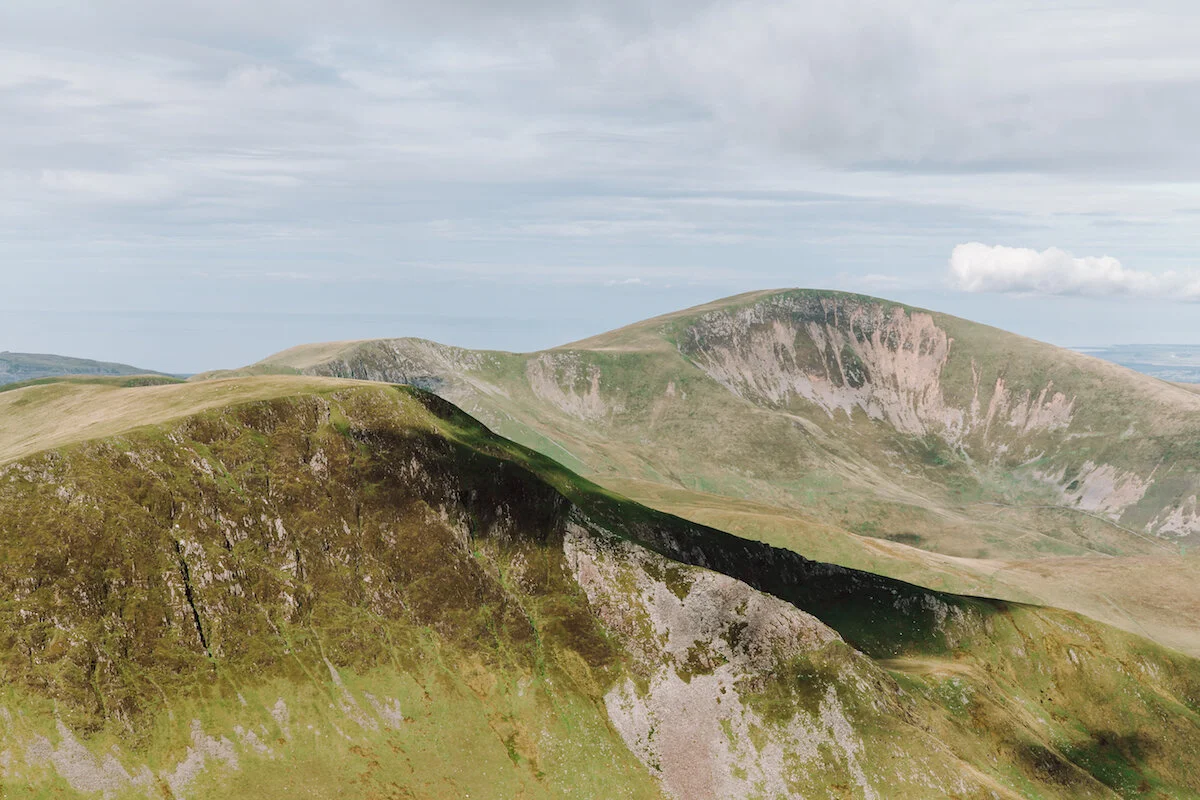
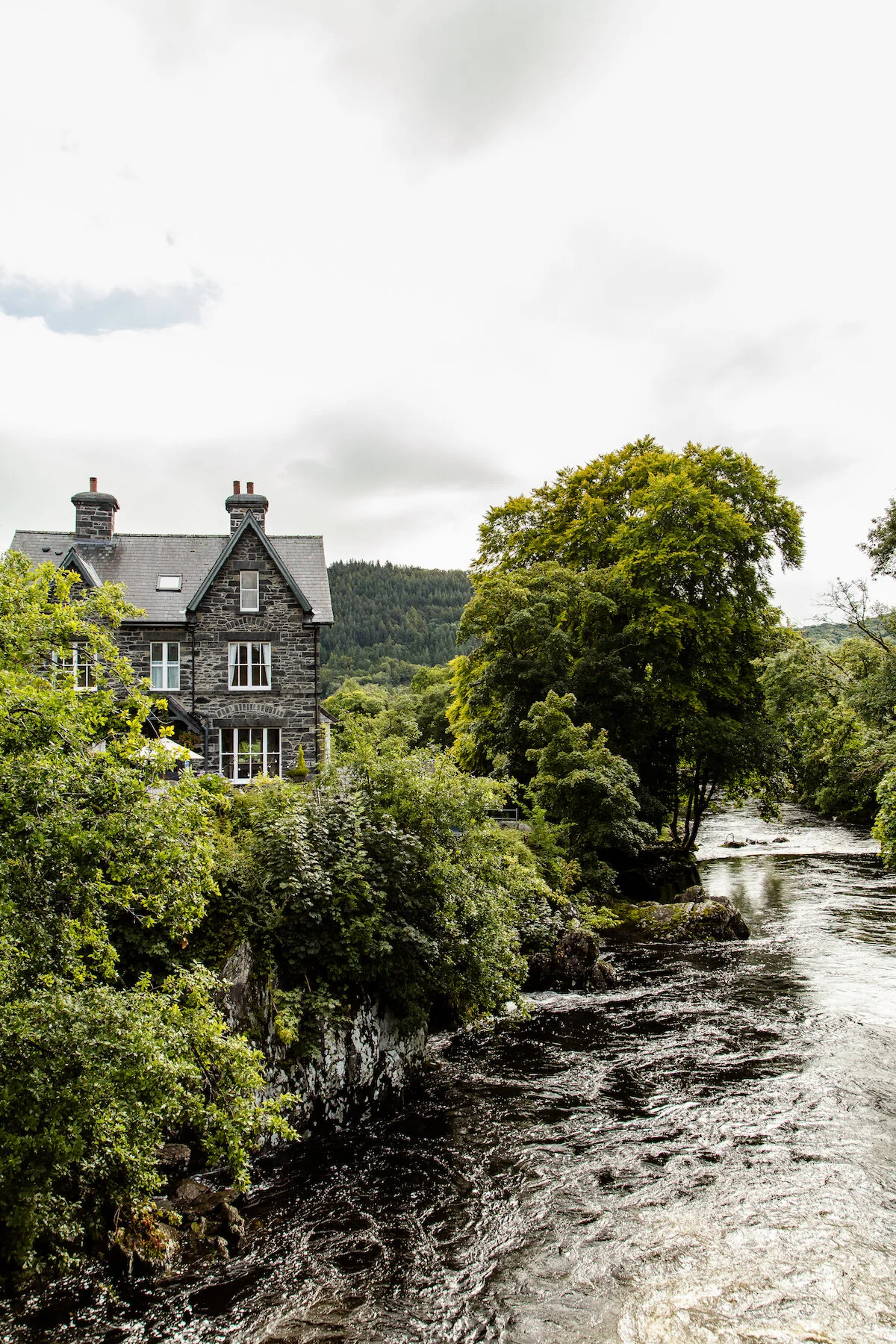
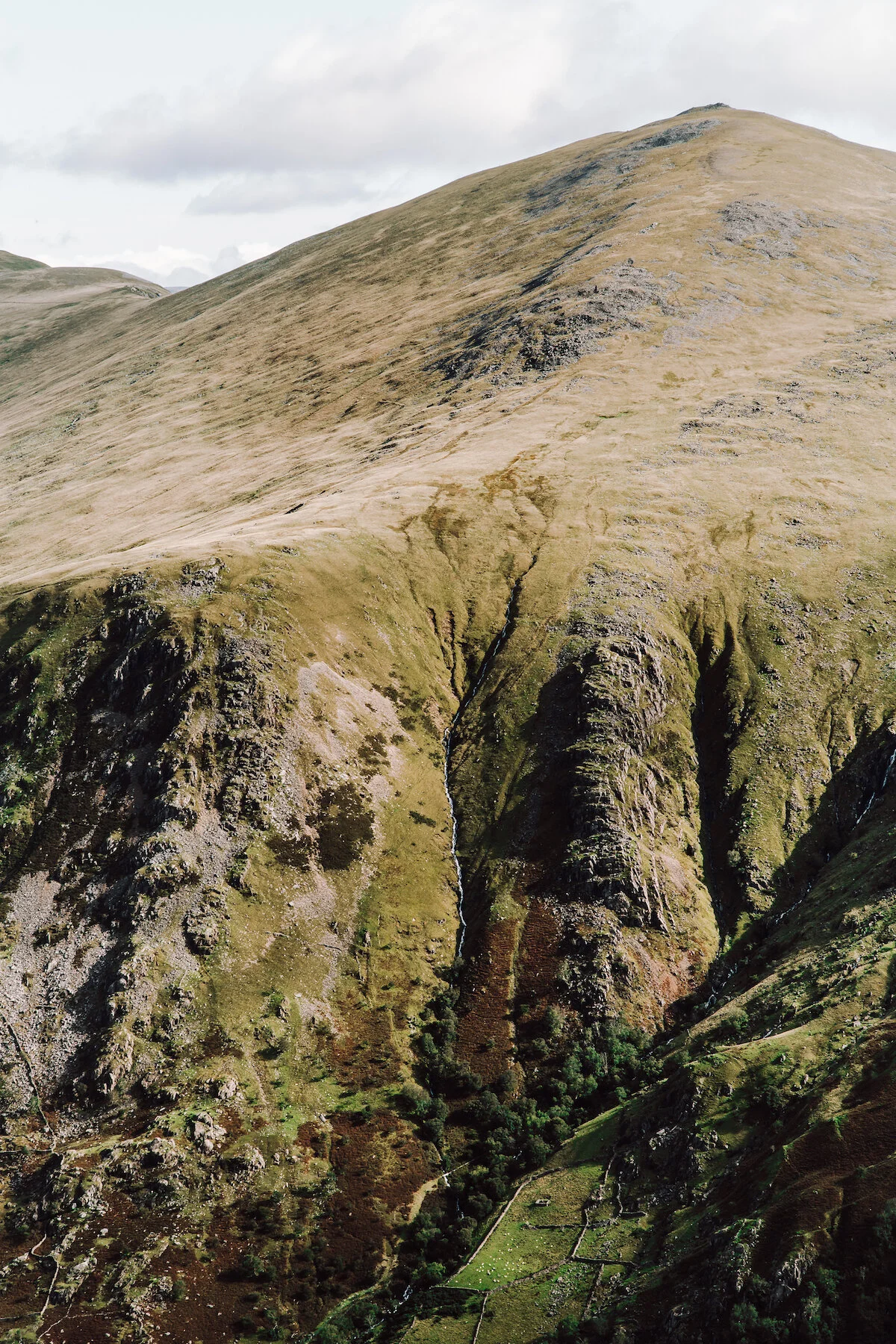
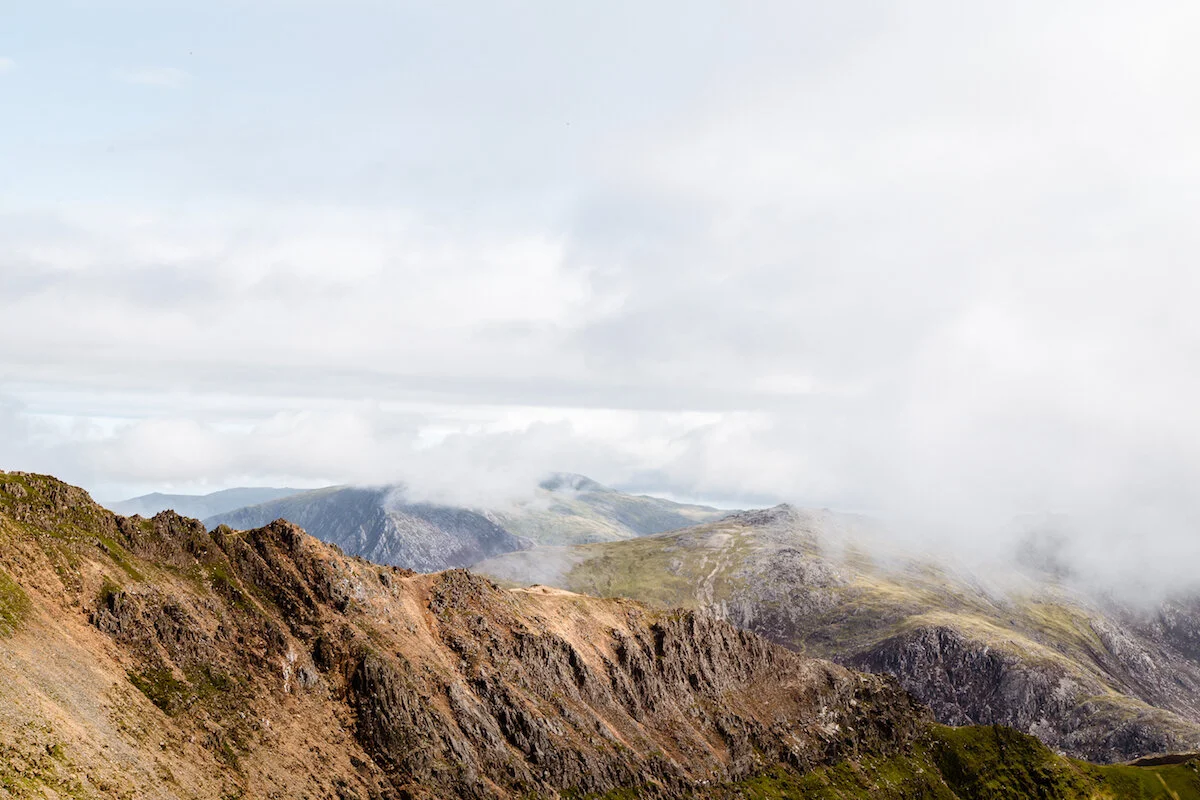
“In the green, grey and gold landscapes of North Wales, nature writes her own poetry. Her earthly odes range from the cloud-poking peaks of Snowdonia, alternately cloaked in wildflowers, sunshine or snow as the seasons shift, to shimmering lakes, beachy islands and verdant forests ripe for foraging.”
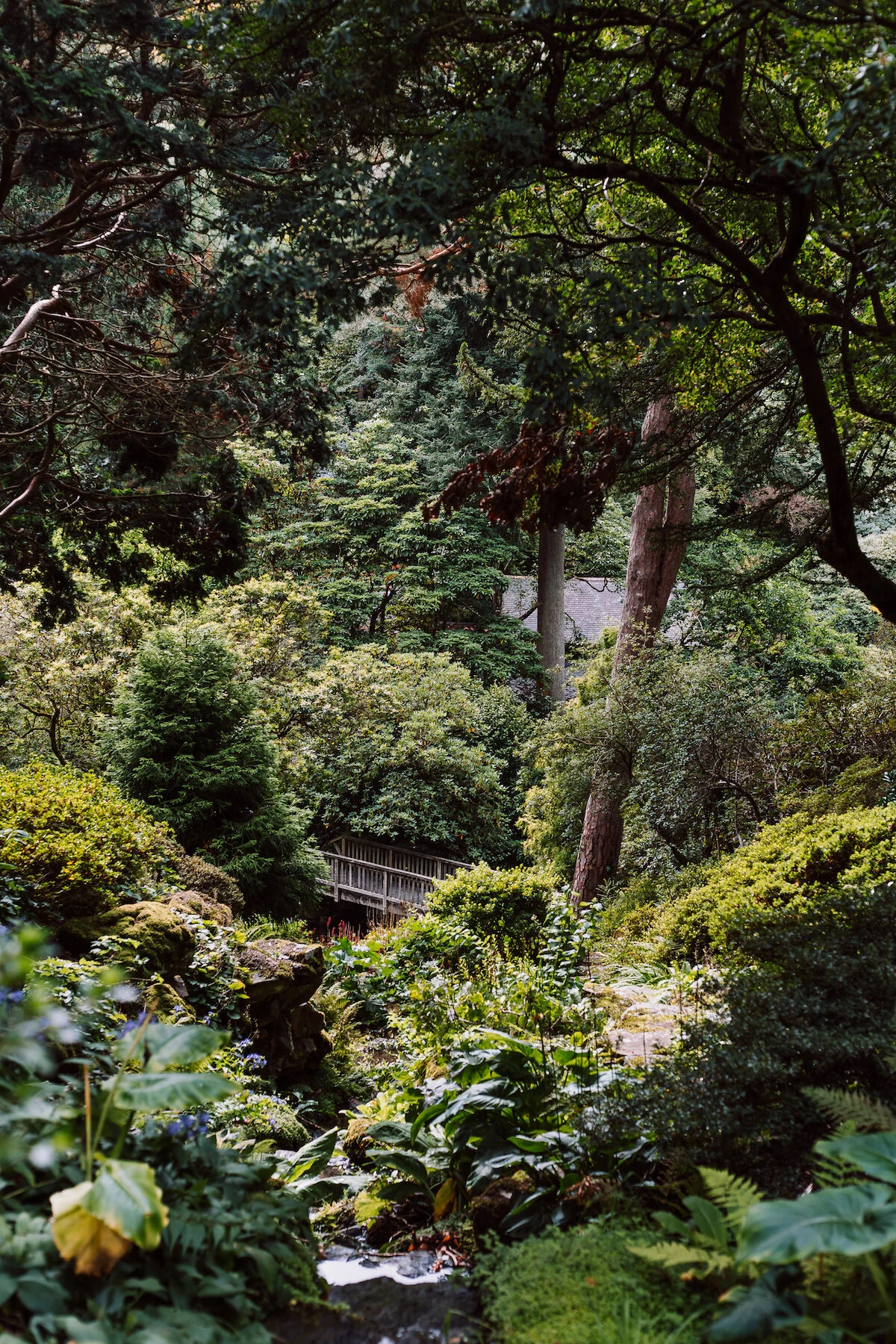
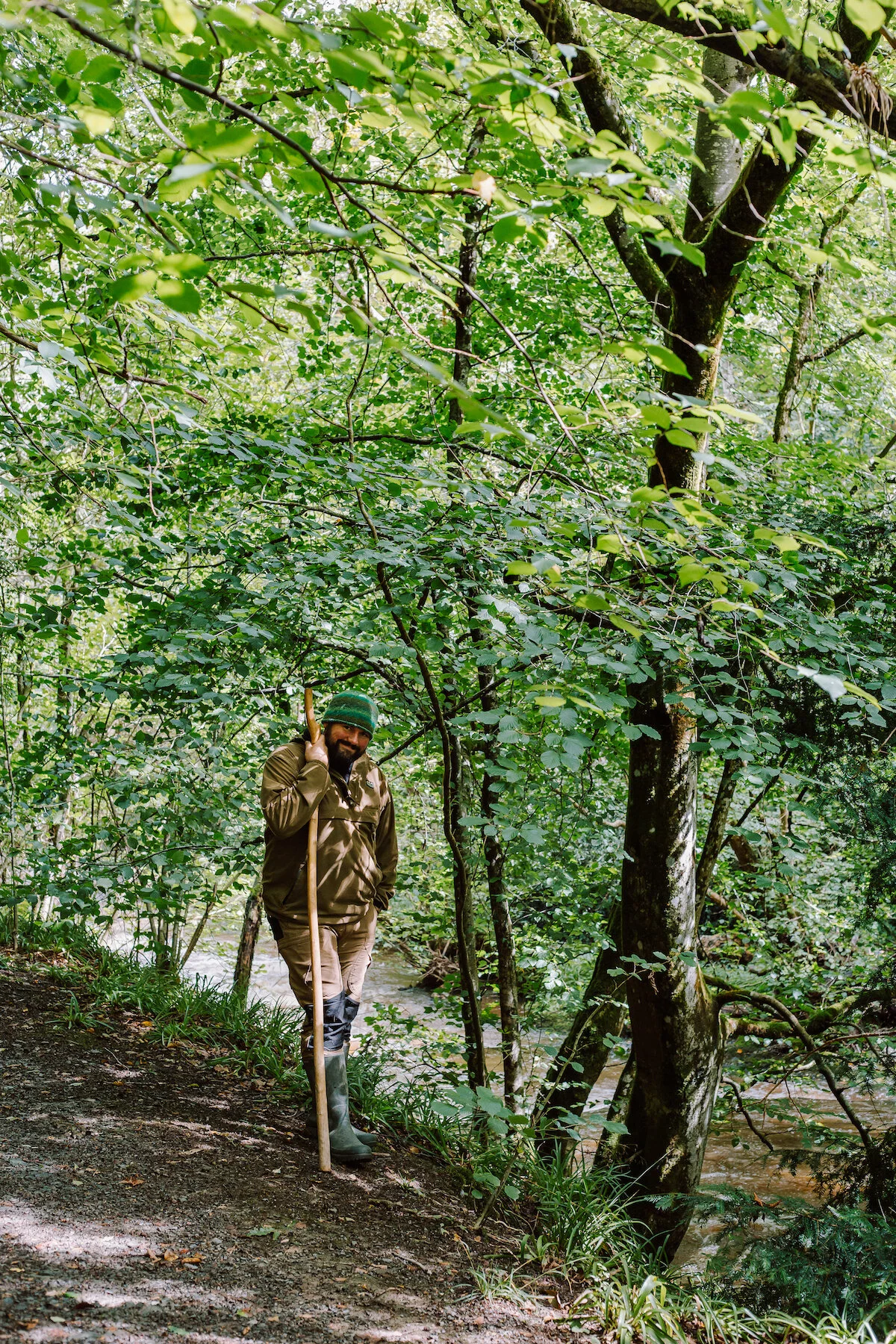
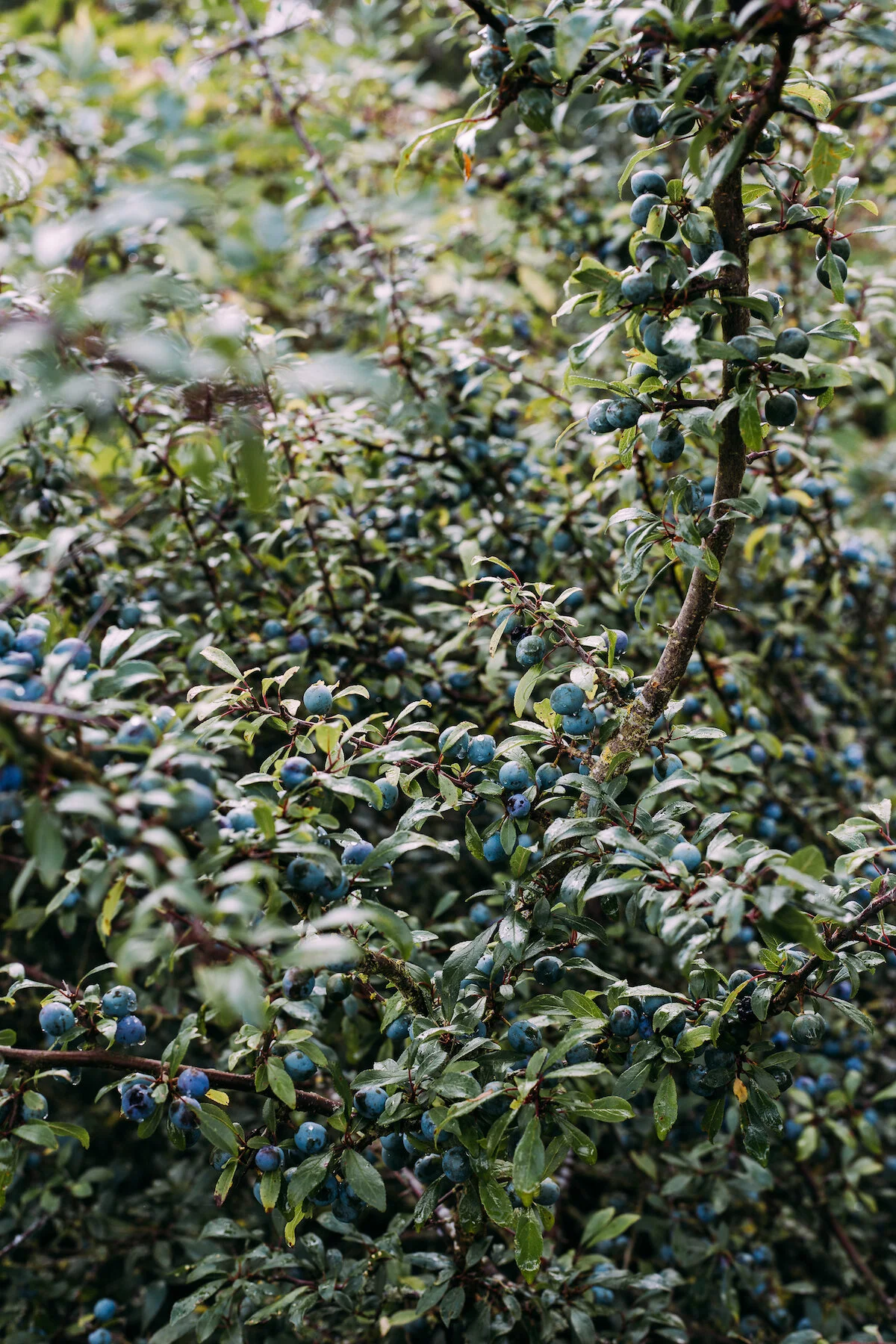
Every issue the Lodestars team runs into the same problem - too many fabulous photographs and not enough pages (although those who have been with us for a while will notice that every mag gets bigger and bigger … self control when it comes to publishing has never been my forte). So, to partially rectify this persistent problem, I’m sharing a few unpublished North Wales images from our Wales cover photographer Holly Farrier. She travelled here for a week over summer 2020 and her snaps were paired with musings from writer Sarah Jappy - who was equally under Wales’ spell. I hope they offer a little escape in these uncertain times and are a reminder of how much beauty awaits us close to home.

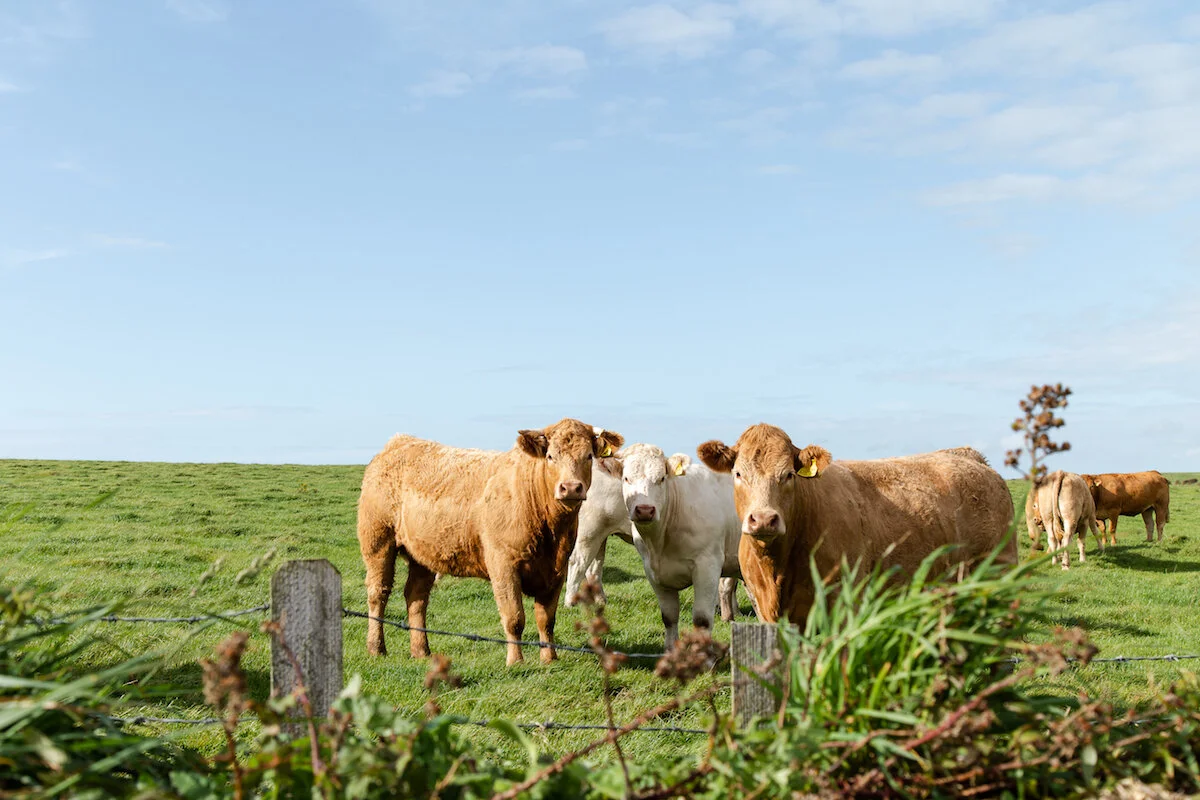
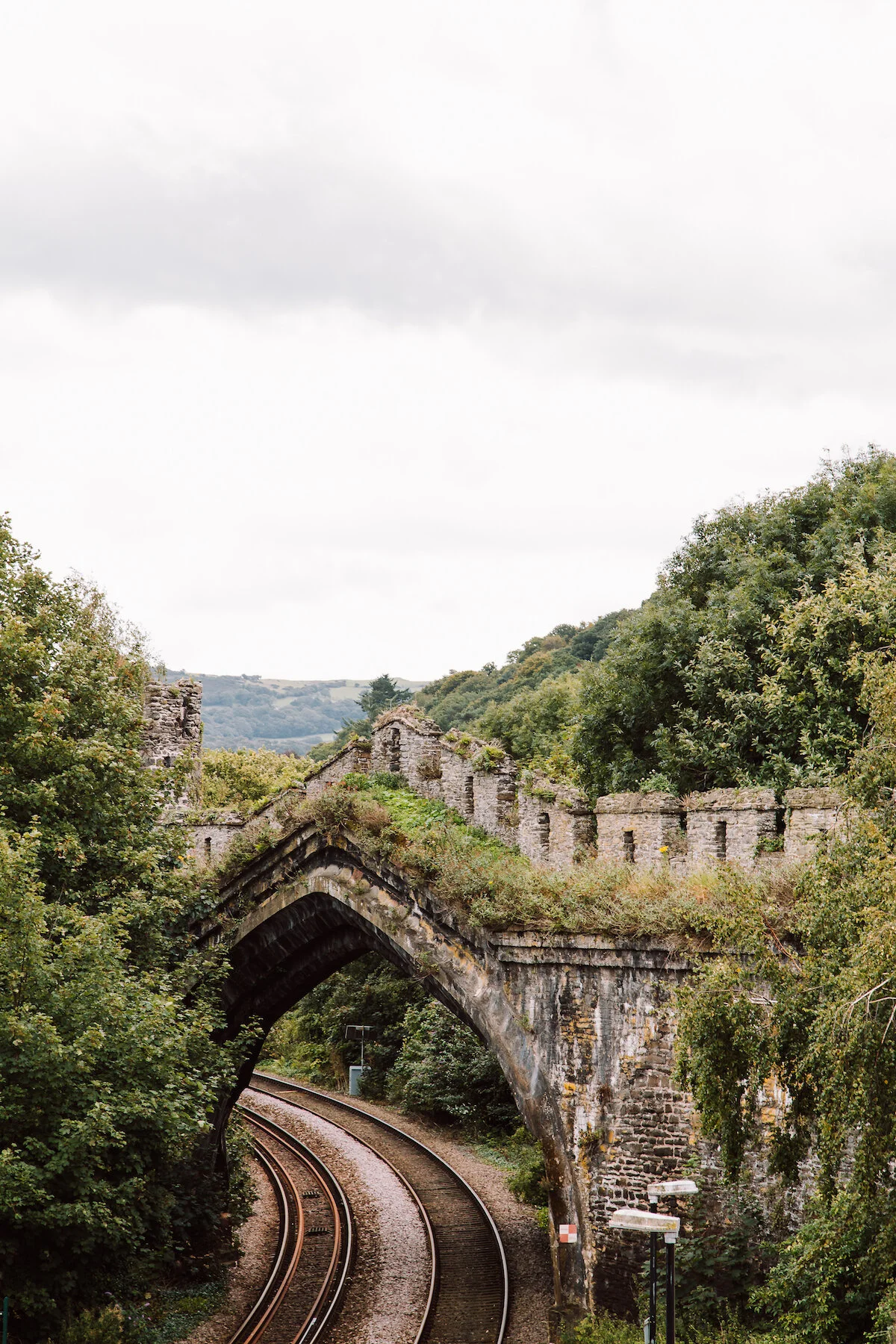
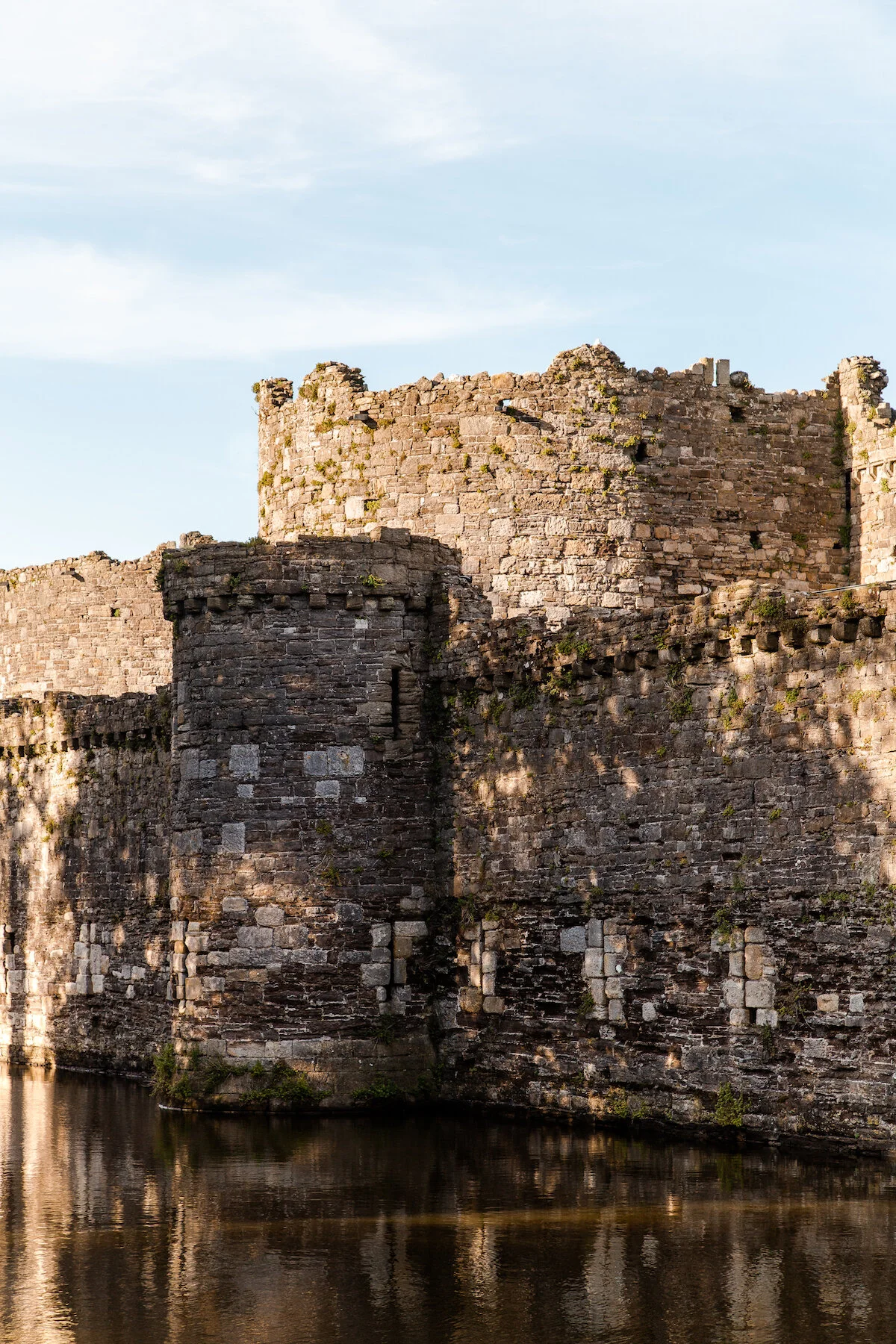
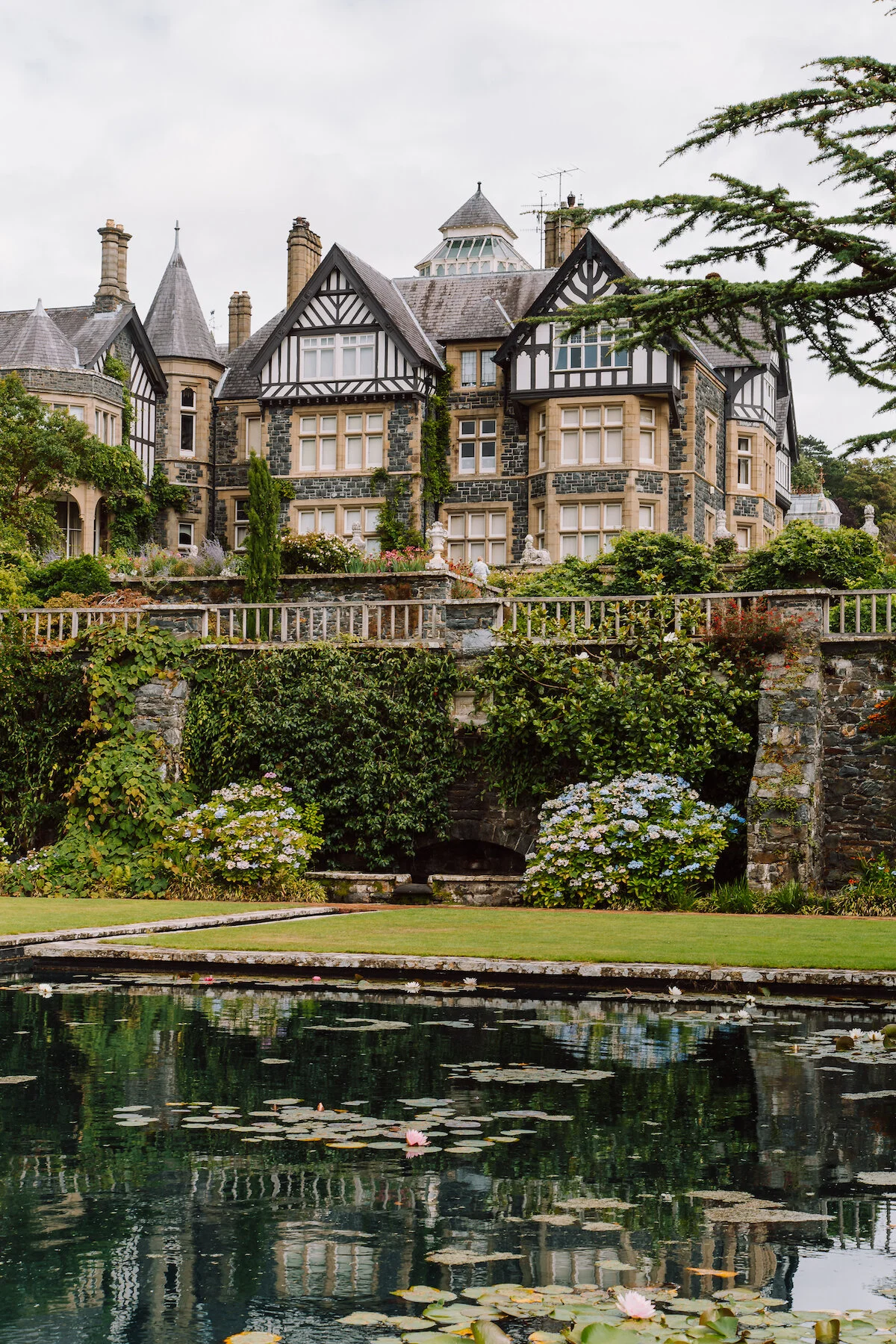


Mountain High
Going off-piste in Zillertal, a wintery hideaway in the Austrian alps.
Words by Liz Schaffer & Photographs by Chiara Dalla Rosa
Every time I get swept up in nature, I remember how blissful it can be. When standing beneath a cloudless sky, floating in the sea, or skiing downhill my body is soothed, my thoughts are caught up in the glorious present and I feel nothing but joy.
Stepping away from our desks and into wilderness is good for the soul. I know this, and am reminded of it each time I’m amongst trees or surrounded by snow. Why then do I sometimes struggle to get myself there? I am starting to wonder if it’s because the high I feel when switching off from deadlines and venturing into the wild is so exhilarating, the restoration so complete, that I keep it as a treat - a little bit of bliss amongst the buzz of the everyday.
So, I’ve decided that this year, the natural world will no longer be a reward. Instead, I will make it a regular ritual. Once a week I’ll lace up my hiking boots, load the polaroid camera, and seek out something beautiful. I will walk along rivers, toboggan down mountains, and search for scenes that are so much bigger than myself. I shall remember that natural fixes are good for me. I’ll be in the moment, and see these soothing getaways as the necessities they are. Some of my journeys will be close to home - the Seven Sisters Walk perhaps - while others will be a little more far-flung, the sort of adventures that will surely blow away the cobwebs of the everyday.

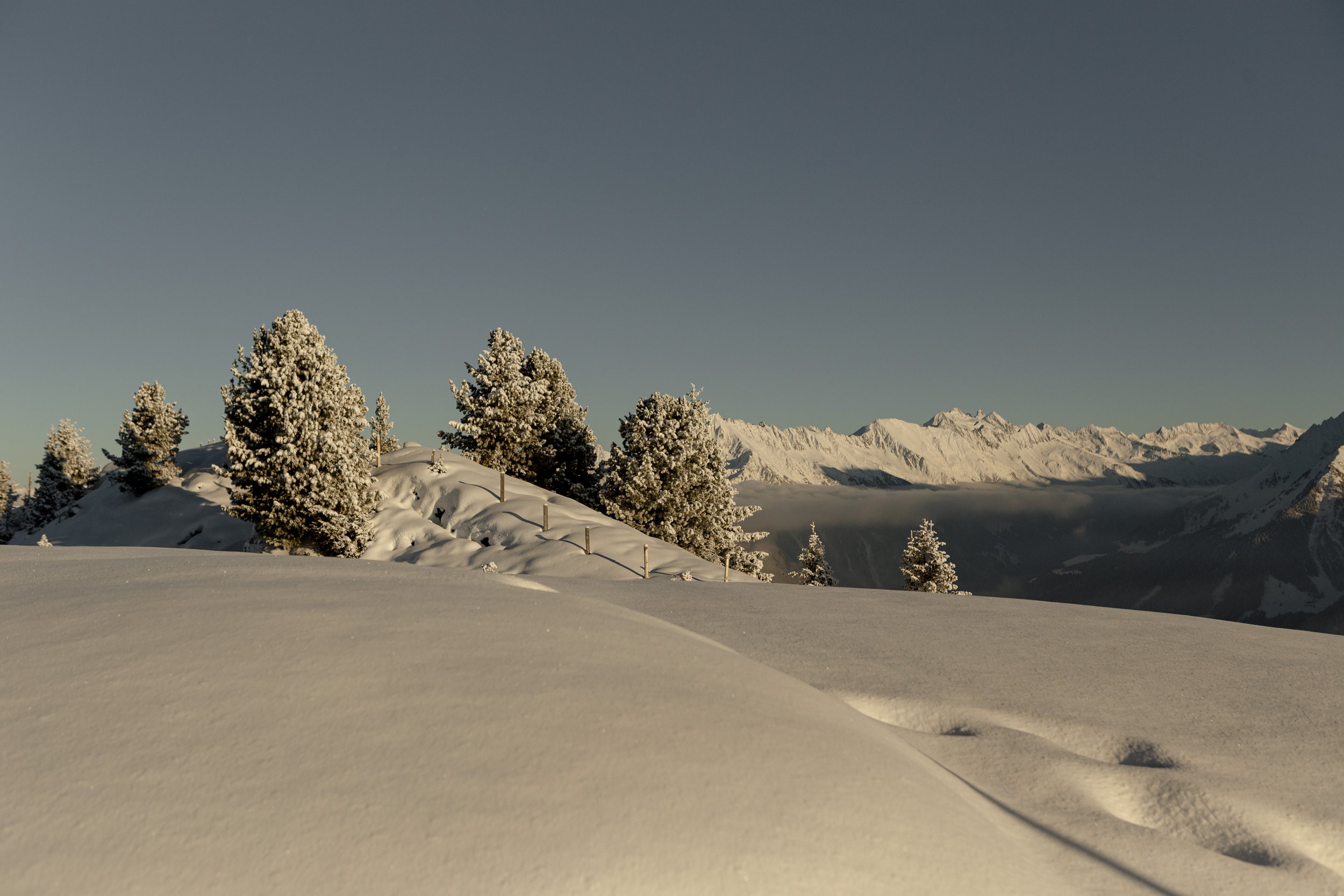
Keen to stick to my resolution, I decided to start the year in a suitably dramatic way and travel to Zillertal, a winter wonderland in Austria’s Tyrol. Many venture here for the fabulous skiing but, due to an extreme lack of grace and prowess, I opted to move a little slower through the landscape. So I instead came to explore the wanderwegs (winter hiking trails), toboggan down snow-and-sun drenched mountains, toast the day’s adventuring in Tyrollean villages, and celebrate the art of being in the moment. On this trip, I wanted to be part of the landscape, and to let the natural world work its magic.
…
I made the postcard-perfect alpine town of Mayrhofen my base (it’s famous among daredevils for the Harakiri piste, with its 78% gradient), and booked in to the charming, family-run Alpenhotel Kramerwirt. This hotel has been in the Kröll family since 1674, and while the rooms are modern, spacious and warm (and the wellness area comes with a view-boasting pool and sauna), everything still feels fabulously traditional, thanks in no small part to the woodcuts, frescoes and flowerpots.
From here, it’s a short drive to the Hintertux Glacier and Natur Eis Palast. Frozen year-round, this cave system sits beneath the ski fields and is adorned with glittering ice stalactites, frozen waterfalls that make you wonder if you’ve stumbled upon another realm, and an azure glacial lake you can paddleboard along. It is a wonderful introduction to the region - both beautiful and surreal, a subterranean marvel guaranteed to shock you out of the ordinary.


When it comes to winter walking, there is no shortage of trails. Making use of Zillertal’s 460 kilometres of cleared paths, you can hike between villages, along sparkling rivers (keeping company with cross-country skiers), and get swept up in the vistas in Fügen and Hochfügen. For me, though, it was the hour-long meander along the Penken Trail in the Mountopolis ski area that stilled my busy mind.
As I walked ever-upwards with a photo-taking fellow rambler, an unexpected blanket of cloud proved impossible to escape. Robbed of a view, all we could hear was the sound of snow underfoot, the birdsong and the breeze through the trees. I was aware that a cascade of peaks and valleys were out there, somewhere beneath the veil of white, but at the time, glimpses of snow-dusted trees and solitary wooden huts felt more than enough.
When we reached the Penkenjoch Plateau there was time to admire Granatkapelle - a geometric architectural marvel/chapel desired by Ticino architect Mario Botta - and refuel at Granatalm Mountain Lodge - a homely restaurant found 2,095 metres above sea level. While I tucked into zerggl (a traditional dish of potato and cheese, pan fried and served with sour cream), I kept one eye on the window, hoping for blue.
Our patience was rewarded on the descent when the weather gods finally graced us with sun. The valley opened up, the snow glowed and every walker we passed was beaming. Returning to the chairlift that would deliver us back to Mayrhofen, a rose-tinted sunset illuminated the landscape. Blame it on the endorphins, but the scene felt both otherworldly and deliciously calming, and I was thrilled to be part of it.
…
Walking over snow is wonderful, but sometimes you just need to be a touch faster. If such an urge grips you, I recommend strapping on the snow shoes, walking through the forest to the Hollensteinhutte mountain hut (opt for the Zillertaler käsespātzle - cheese noodles made utterly delicious by the addition of roasted onions), and then tobogganing back to the valley. It all seemed brilliantly enlivening, yet it wasn’t until I was overtaken by a father and his toddler, and manoeuvring his sled at a speed only possible after years of experience, that I realised I hadn’t really lifted my feet off the ground, my boots my brakes as I revelled in the scenery. Maybe sedate wanderwegs are more my style.
Even if I was considerably slower than a local, it took days for the smile to fade from my face.

This year, I will hike over snow-covered mountains again, I’ll toast my outdoorsy lifestyle with schnapps and zip down mountains. But I’ll also keep things simple. I will walk along the Kent Coast, ramble through Kew Gardens and take the time to watch the sunrise. I know time will pass and life will get busy. But my vow to keep up these regular jaunts into nature is something I’m going to stick to … because I’ve been shown time and again exactly how needed they are.
If Zillertal (and the wilderness) calls to you too, you can learn more and embrace the wanderlust by clicking here.


Indian Railways
The romance of the railway.
Words by Matt Hayes & Photographs by Ceri Davies
An extract from the India Magazine
Amongst travellers there’s one declaration that goes practically undisputed: India brings out the best in trains, and trains bring out the best in India - a statement that becomes clearer with the steady accumulation of miles.
When I recall my own year of train travel across India, it’s the succession of landscapes and people that passed me by as I sat in the doorway of the Kalka Mail that remains most vivid. Delhi’s Red Fort glimpsed by moonlight, the fields and forests of Uttar Pradesh at dawn, the gilt suburbs of Allahabad at sunset - from a train’s open doorway these already beautiful sights took on a more indelible quality than usual. Though some of the details inevitably slip from your grasp as the years pass, others retain their clarity - a flock of impatient swallows, a farmer leading his goats along a country road, a young woman glancing up from the maize harvest. How wonderful and dreamlike everything seems from a lumbering Indian railway carriage!
Another oft-mentioned charm of train travel is the fascinating social microcosm that develops over long journeys, when stories flow and barriers break. Newlyweds on their way to honeymoon in Srinagar might offer you some of their aloo matar and tinfoil-wrapped chapati. An elderly man en route to Manipur may tell you, while shaving, about his beloved grandson who’s currently serving as a soldier on the Chinese border. A young boy on his way to school in Darjeeling could ask you in fluent French, then English, whether you’d like him to turn the lights out. And when you wake up the next morning, he’ll perhaps explain why Rabindranath Tagore is the greatest poet India has ever produced.
All the while, chaiwallahs lug their huge pots up and down the aisle, handing out cups of sweet masala chai for a few rupees each. Samosas, tamarind-soaked chaat, puffy puri and refreshing mango kulfi (especially welcome on sweltering afternoons) are offered by a practically ceaseless stream of vendors who call out their wares and pass local delicacies through windows whenever the train begins to slow.

It was on my half-day journey traversing the northern state of Himachal Pradesh that I came to truly appreciate the magic of Indian rains. Between Pathankot and Palampur, a narrow-gauge railway feels its way, snake-like, through the Kangra Valley. The railway tends to follow the west-to-east line of the Dhauladhar range - unlike the main-gauge tracks that confidently criss-cross the Indian plains like Roman roads, the Kangra Valley Railway timidly bends in submission to the lie of the land. The elderly ‘toy trains’ that travel this route feel as though they have been brought out of retirement to tackle an impossible landscape with wisdom rather than strength. Decrepit engines slowly drag their hulking weight up long inclines and then apply the full force and screech of their brakes as they descend down the other side, twisting and flexing their aged spines, only to repeat their Sisyphean task all over again when they reach the bottom. To make their struggle slightly easier, the most daunting cliff-faces are tunnelled and the many rushing mountain torrents are creakily bridged; these uneven slopes, entangled with forest and savaged by rocky outcrops, must have been formidable opponents for engineers.
So often, a journey by train would ease my mind, lift my spirits and, by demonstrating how large and varied the world is, reveal the breadth of future possibility. This was true of the Kangra Valley Railway, one of the most beautiful of all these journeys. Craggy peaks tipped with glistening snow soared above us on the northern horizon. Scatterings of blue-green Himalayan pine, spindly deodar cedars, spire-shocks of Himalayan fir and shaggy Morinda spruce - a barely evolved Jurassic landscape - were softened by the occasional presence of a gentle oak. Together, conifers and angiosperms shrouded the valley floor and veiled the mountains themselves so that only in the thin stretch between tree line and jagged snow line did these peaks reveal their naked, wind-hewn rock.
Further down the slopes, villages were announced by sunlight flashing on windowpanes and smoke-plumes borne aloft by the wind. Clusters of houses could be glimpsed amid rain-freshened pastures and tea plantations. Closer to the tracks, yellow mustard flowers bloomed in anticipation of spring.

Our train began to chug its way, at quarter-speed, over a bridge that spanned an enormous grey riverbed. After half a minute, we came to the actual flowing water - much narrower than the rift it had carved through the land but wild nonetheless. A group of people, brilliantly lit by the afternoon sun, milled about at the water’s edge. Women and girls, clad in pink saris and blue kameez, beat their laundry against boulders, while shirtless boys jumped from rock to rock and two men stood in relaxed conversation, one of them pointing dramatically up the river towards the mountains.
Suddenly, I spotted a group of monkeys bounding across the rocks in the direction of the clothes-washers and craned my neck to follow their progress. Were these monkeys hoping to slake their thirst with icy river water, or were they headed for the carefully bundled food by the river’s edge? The train didn’t linger long enough for me to find out but the memory of this crossing lodged itself firmly in my mind.
I was to discover later that the river is a tributary of the Beas (or Hyphasis as it was known to the Greeks) which flows southwest into the Punjab Plain and marks the easternmost edge of Alexander’s conquests. It was water from this river, flowing from the same mountains two and a half thousand years earlier, that filled the hearts of Alexander’s men with despair and made them yearn for their homeland after eight long years of campaigning.
My delight at the epic river crossing was soon disturbed by a group of young boys lurking in the bushes beside the tracks who ran forward eagerly and flung bright gulal powder through the train’s windows. There was a flash of smiles, a burst of laughter, and then the moment had passed. Red, green, blue and purple powder clung to the window panels and the cracked leather seats. I glanced at the stern, saffron-robed sadhu who had been sitting opposite me throughout the journey. He had fared badly in the attack and yet I saw that even he was now smiling through his powder-sprinkled black beard. Just two days remained until March and the festival of Holi was already upon us.
It’s difficult to fully express the joy I felt during those few hours, simply looking out of an open window. There will perhaps come a day when India’s trains are modern, fast and completely sealed against the outside world. Although I would be the last person to wish for stagnation in the name of romance, I’ll nevertheless be a little sad when it’s no longer possible to hang out of the doorway of a train at dusk and not only watch but feel the countryside of India roll by.


The Bothy Revolution
Inverlonan is re-Imagining the Scottish Bothy tradition … and making it divine.
Words and Images by Emma Latham Phillips
The sun woke me up, streaming in through large rectangular windows. Beyond the glass, a carpet of bracken stood against the hillside as thick as a jostling crowd, fronds unfurling towards the sky like waving arms. I climbed down the ladder and opened the door of the bothy, stumbling towards the fire pit, my eyes still bleary with sleep and thick with pollen. I needed to light the fire so I could boil the kettle in time for breakfast. Perhaps we could use the water to have a warm shower too.
“Damn,” I swore. I’d left my antihistamine tablets in the car – a good hours walk, there and back. But there really wasn’t much to complain about. The day was warm, and we had nothing planned. Between the gnarled oaks in front of our bothy, the blues of the loch blended in with the blues of the sky. A few clouds rolled lazily past. Besides, the rock-strewn route I’d have to walk to the car delivered far-reaching views of the valley below, and I had plenty of time to get back before the kettle whistled.

We’re staying at Inverlonan, a site reimagining the iconic Scottish bothy tradition to deliver modern and ecologically-sensitive alternatives. We were spending a few nights in ‘Beatha’, one of two off-grid bothies thoughtfully set beside Loch Nell. Our home was balanced above the shoreline, ensconced like a jewel in green oak leaves. If the owners wanted, both bothies could be immediately removed, along with their ring-beam, ground screw foundations, leaving no trace upon the landscape.
Historically, a bothy was rudimentary accommodation provided for land workers in Scotland by estate owners. Today, they’ve become uniquely placed shelters available to anyone looking for a free roof over their head and the chance to escape the trappings of contemporary society. Typically, there’s no gas, electricity or water tap, and you need a spade and a long stroll before you can go to the bathroom. Thankfully, when it comes to Inverlonan, you don’t need to carry these home comforts in on your back. Simple luxuries have been added, and although they’re tastefully designed, these do not detract from the magic of going back to basics.

As I walk to the car, I look back over my shoulder to admire the rectangular shape of the cabin. The shimmer of corrugated black steel and oak-panelling matches the shadows of the tree trunks and golden summer grasses. Local artisans have contributed to the interior. The kitchen, table, shelves and ladder leading up to the mezzanine bed have been hewn from ash trees from the banks of Loch Awe, and crafted by Oban-residing Michael Acey. You’ll find stoneware from Argyll Pottery, sheepskins from Skye and Netherton Foundry cookware. But despite the aesthetic, Inverlonan is still very much embedded in both the landscape and the roots of bothying, which means you cannot rest without a little hard work.


In the afternoon, we steer our paddleboards out into the loch. The depths seem painfully dark, and it’s impossible to see the bottom. I slip quickly into the peaty brown water, my legs turn the colour of wotsits beneath my stomach. I imagine a metres-long lake monster brushing my feet and immediately jump back on board and paddle to the small shingle beach. “I’ll have a shower and start dinner,” I shout back. Having a shower here is a carefree (if cold) experience. For one, nothing beats getting nude beneath the sky. I fill the shower bag up with the remnants of the kettle water, clip it to the pulley system at the side of the bothy and hoist it up. The water doesn’t last long and is lukewarm at best. But it doesn’t matter; it’s summer, and I can watch the birds swoop and dive above me as I clean myself with soap.

Inverlonan is a lesson in patience. The modern world has forced us to speed up to an unsustainable pace. There’s no time to cook, find community or rest. But here, you have to slow down. Tasks that would take an instant now require careful planning. If you want a coffee with breakfast, you must make a fire, go to the outside tap, put the kettle to boil and grind the coffee beans – all before putting the sausages, eggs and bacon on the fire pit. Making our meals was the main event of the day, and I wouldn’t have it any other way. Once it was on the table it felt like a considerable achievement – one that deserved a glass of champagne and a beautiful view.
At your request, Inverlonan provides you with delicious provision boxes that include a range of hyper-local and sustainable ingredients. We seasoned our breakfast in wood smoke, handcrafted our own pizzas with Great Glen Charcuterie, and sizzled freshly caught scallops in boiling butter. Our shellfish box was filled with dressed crab, baby pink langoustines, new potatoes, salad and scallops – the making of a courses-long feast. Nothing beats the experience of cooking over fire and the flavour it brings to the food is unique. Cooking like this requires constant observation, and the chance to slow down and meet around the flames. The sun had started to set by the time we’d scooped up the last of our meal and washed up the plates outside. It looked like we would leave Inverlonan with a new skill set as well as simply a holiday. Though, we never did get the hang of that axe.


Hotel Review: Palais Amani
A Fez escape.
When the English weather turns a little grey, and the light refuses to linger, it’s only natural to crave sun and spice. And if such an escape is calling to you, I know just the place to set your sights on - the vibrant, artful and truly delicious Palais Amani in the bustling heart of Fez.
With a history reaching back to the 1600s, this lush riad - a former family-home - lay abandoned for decades until owners Jemima Mann-Baha and Abdel Ali Baha brought it back to vibrant life, creating an ornate haven amongst the Fez buzz. Today, the riad brims with Art Deco details, traditional textiles and ceramics, Iraqi stained glass, hand-woven carpets and tiling aplenty - all of which are paired with a dusting of citrus trees and an intoxicating sense of calm. Come night, lanterns are lit and live music from local performers blends with the mellifluous babble of the central courtyard’s fountain. As befitting a hideaway designed to make you feel like chilled-out royalty, mint tea and freshly-baked biscuits will also be offered (and in my case accepted) every time you take a seat.


Although I was besotted with my room (the sumptuous Grand Suite, which is larger than my London flat and topped off with a bed that was part cloud, and a tub I could swim in), my favourite Palais Amani space was its rooftop terrace. With views over the medina and onto the mountains beyond, there are few places better for sundowners as the call to prayer echoes across the city. That said, the hammam, all earthy tones and candlelight, is the sort of space where worries wash away - and you depart feeling deliciously silky.


When it comes to exploring the wondrously disorienting labyrinth that is the ancient medina - a World Heritage Site bejewelled with 13th-century buildings - it’s best to let yourself get lost. That said, all the Palais Amani staff are local, so if there are wares you desire, or museums that tempt you, all you need to do is ask.
One site you can’t miss is the Chouara Tannery, which has been running since the 16th century … if not before. Atmospheric and aromatic (holding a bunch of mint over your nose will help), you have to enter one of the adjacent leather stores to get a glimpse - but striking up the necessary conversations along the way is all part of the experience.
If you wish to feast beyond Palais Amani’s Eden Restaurant (months later, I’m still lusting for their couscous), there’s the beautifully-tiled Dar Roumana, where the menu is built around whatever is most scrumptious in the medina that day. For casual feasting with a view, there’s Cafe Clock (although the climb to the rooftop dining area is not for the faint-hearted), or settle in at the atmospheric Ruined Garden, which has a bread-making school to boot.


You can also hone your culinary prowess with Palais Amani’s Fez Cooking School, which celebrates Moroccan and Sephardic cuisine. Classes begin with a guided meander through the medina, collecting a melange of ingredients (and other tempting treasures) as you wander, before you head to the riad’s rooftop kitchen, and end with a feast by the fountain. Once you have mastered a tajine, the world really is at your feet.
I arrived in Fez sun-starved and (as we all seem to be) a little run down. But after a few days of Moroccan sun, sumptuous interiors, medina exploration, rooftop lounging and hammam scrubbing, I departed feeling like an entirely new woman - and with a suitcase full of ceramics. Palais Amani, I shall return!


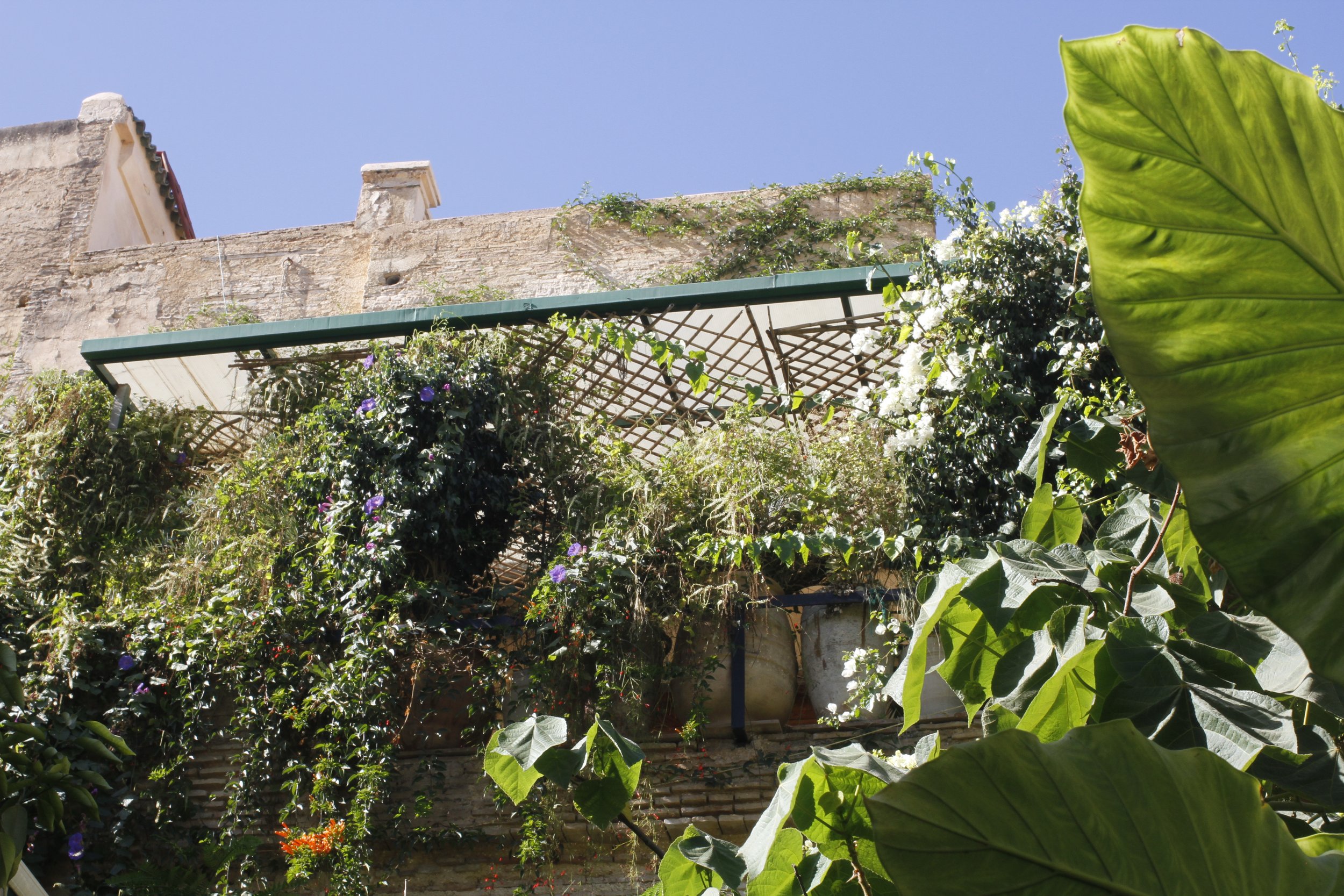
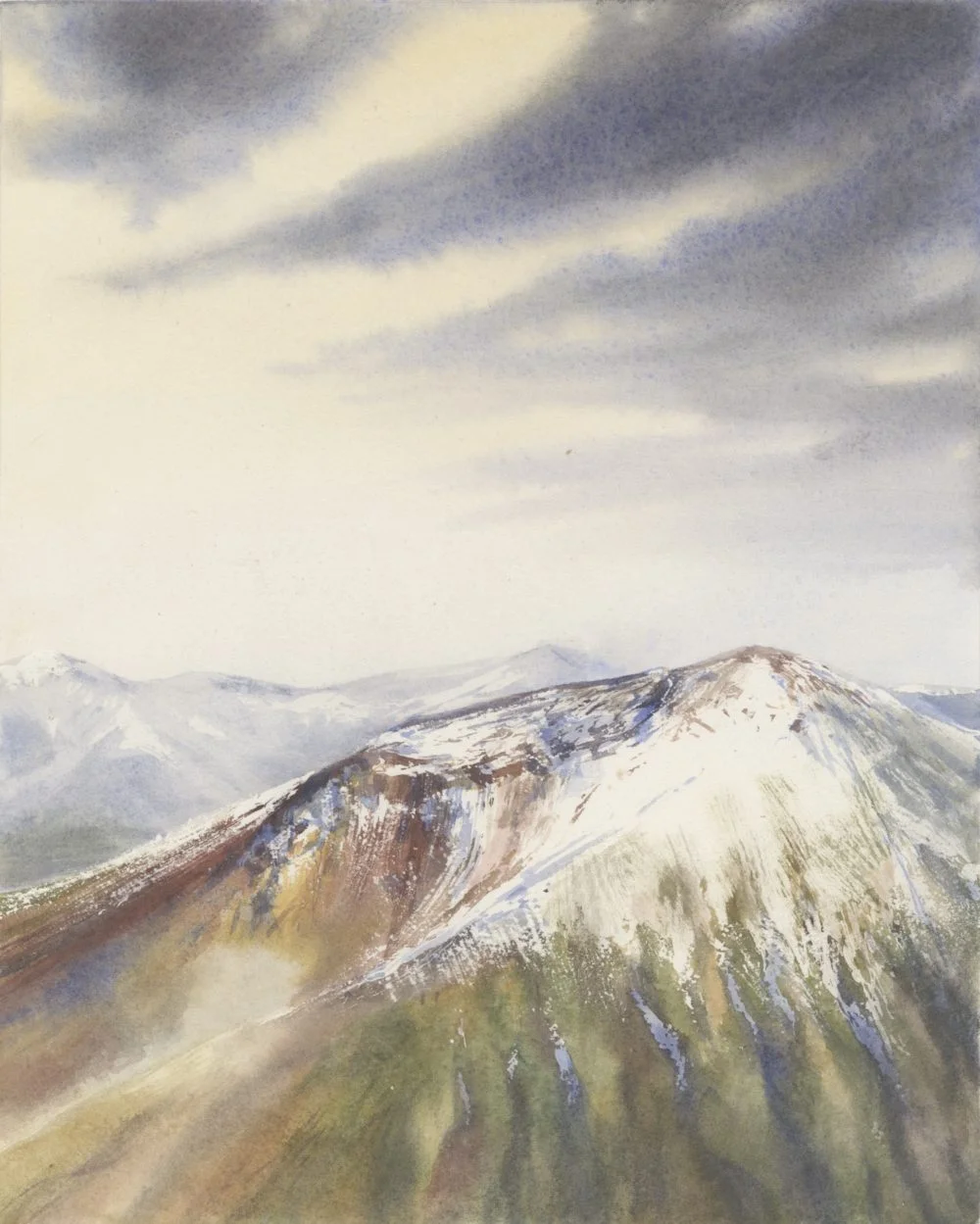
The Playground of the Gods
Hiking in Hokkaido.

An extract from the Japan magazine - words by Kasra Lang & illustrations by Marina Marcolin
Mount Asahidake, the highest point of this wild island, rose up before me in a great mass of black ash and eternal snow. The volcano hasn’t erupted for 200 years but the smell of sulphur still stings the nose. I stood on the edge of Sugatami Pond, one of many lucid pools that mark this marshland, and watched as the fog thickened around the slopes. The water at my feet was like glass, without crease or wrinkle despite the rain, almost mythical, and I was struck by an urge to kneel and drink from it. I refrained, of course - it would have sooner made me sick than strong - but perhaps I should have, for in the end I would need the courage. A typhoon was coming in from the Pacific and I had five days to walk the crescent spine of the national park before it made landfall over Honshū and climbed the length of Japan towards Hokkaido. At last I tore myself away from the spectral water and set off eastward, my hood pulled low over my eyes.
I passed no one on the way up, moving through slanted plains of crumbling volcanic glass which turned to ash as I climbed higher. Before long everything I could see seemed to reflect back to me in negative, divided between the black earth and a white sky. Indeed the only colour in that monochrome world was the moss growing under the rocks, glowing like green jewels, almost fluorescent as if to compensate. Then, further up still, the mountain broke out into a flush of red and pink, the primordial evidence of vast lava fields and the molten wasteland it had once been.
When I squinted it was as if the earth itself was burning. The summit, when I finally reached it, was exposed to the wind and rain and I did not stop to rest. Instead I scrambled in wide strides down the other side of the treeless mountain, digging my heels into the loose ground. Only the occasional lick of yellow paint marked the onward trail, which soon disappeared beneath a vast snow plain that stretched out into the mist without apparent edge or end. Somebody had attached a rope to lead the way but it too vanished only a few steps ahead. The scene felt like a warning, a border I shouldn’t cross. But I held the rope with both hands and walked out, testing the strength of the ice with every step. Halfway across, with the whole world washed clean of form or feature, unable to see where I had started but with the end not yet in sight, I felt blind and afraid. The only evidence that I was on earth at all was the mud I left trailing across the ice. When I finally reached the other side, I looked back and knew I had crossed a frontier from which I could not return. From then on I would only leave these mountains by walking out of them on the other side.

Shortly before sunset the mountain hut I was looking for emerged from the fog and I lunged impatiently towards its sodden door. Making a space to sleep in the corner of the bare room, I boiled a pot of water for a quick meal, wrung out the sweat and rain from my dripping clothes, and draped them over the rafters. Then I scribbled
Where the hell am I?
into the margins of my damp journal and fell asleep as soon as it was too dark to see.
In the morning, as if in reply to my fevered note, the sun came out, revealing at last where I had spent the night. The shelter was built on the northern crest of a narrow plateau, easy terrain and brilliantly green. Revived by the light, I walked for a few precious hours flanked on one side by cliffs and clouds that masked the depths of the fall and on the other by the surviving snow. I settled into a metronomic stride up and over Mount Chūbetsu, my blood pumping in a paired rhythm. My clothes were finally drying and I was growing confident; it was even sunny enough to burn my ears. But by the afternoon the clouds I had looked down on rose to meet me, and this time, although I did not yet know it, the fog would not lift again.
I slept that night by the shore of a large crater lake. Its water, reflecting the sky and the snow on the slopes, rippled white as milk. During a break in the rain I ate my dinner barefooted on the beach and buried my toes in the sand, hoping to shock them back to life after the afternoon’s numbing tramp through the mud. It half worked, and I went to bed feeling determined and resolute, exhilarated by the wild weather and the presence of mind it demanded of me.
The next morning the fog was thicker than ever, laced once more with black rain. Beneath the shadow of Mount Tomuraushiyama, I heard the sound of a bell - used by walkers in these mountains to warn the bears of one’s approach - and quickened my step towards it. Eventually two silhouettes appeared from the mist. Surprised to find me alone, the two men treated me like a lost lamb and offered me, in true Japanese fashion, almost all the food and water in their pack and even a kit to repair my torn trousers. I knew to refuse - one should never take another hiker’s provisions - but their presence alone comforted me and I prolonged the encounter as much as the language barrier allowed. They were homebound men in a way that I was not, and they knew it too; as I walked away I could feel them watching me, wondering if it was wise to let me leave at all.

I spent the rest of the day following my feet through the valleys, my sense of distance and time distorted by my sightlessness. With nothing of the outside world to stir the mind, my thoughts increasingly turned inwards, and I repeated the three Bashō poems I knew like a prayer. The land, shorn of its detail, seemed to echo the very essence of his haikus: austere and exact, giving me no more and no less than I needed. In other ways it was the physical manifestation of a Zen kōan, designed to provoke doubt in the whole enterprise. In that it succeeded; it was getting harder and harder to tease out meaning from that shrinking world. “Walking”, Rebecca Solnit wrote,
“is how the body measures itself against the earth.”
But what am I to do when the earth itself is hidden? And what if my body, denied the anchor of the horizon line, begins to vanish too?

By the afternoon I had run out of water, the streams that my map promised having never materialised. I paced on through the thicket and gathering storm, shouting now and then to alert the bears, continuing long into the first hour of darkness. When I could walk no further I found a small patch of flat earth softened by the rain and set up my tent. I ate a couple of oat bars to placate my hunger and tried to fall asleep quickly to forget my thirst.
With the dawn came a pounding headache. I sipped all the dew I could from the morning leaves and set off gingerly into the dull light. After an hour I reached a swollen stream and drank several litres squatting on my heels in the orange mud. To the southwest loomed Mount Oputateshike and I had no choice but to climb it; the path offered no shortcuts and to forge one of my own would have been suicide.

As I left the valley’s protection the wind grew so strong that I had to turn my back to it simply to breathe and soon it took all of my waning strength to walk at all. Every gust threw me sideways, whipping flints of ice into my face. The steep hairpin trail, littered with flaking pumice rocks, disintegrated beneath my feet. As I climbed higher the wind grew angrier still and it suddenly caught the rain cover of my pack like a sail and flung me backwards, sweeping my legs from under me. I heard the sound of something snapping: my walking stick, hanging in half, had broken my fall. I watched my rain cover fly away down the mountain, like a kite I would never see again. I don’t know how much time passed before I reached the peak. But there, instead of coiling downhill as I had hoped, the trail followed the ridge of the mountain. Parts of it were no more than a yard across, sinking into nothingness on either side. One wrong step would be my end. I had no choice but to fall to the ground, breathing heavily with my cheek in the mud, and crawl like a soldier from cover to cover. My naked pack, acting now as a sponge for the rain, felt like a boot pressed against my spine and I had to use all my experience to fight my rising panic. Don’t stop, I thought.
Don’t stop.
The full version of this article appears in Lodestars Anthology Japan.
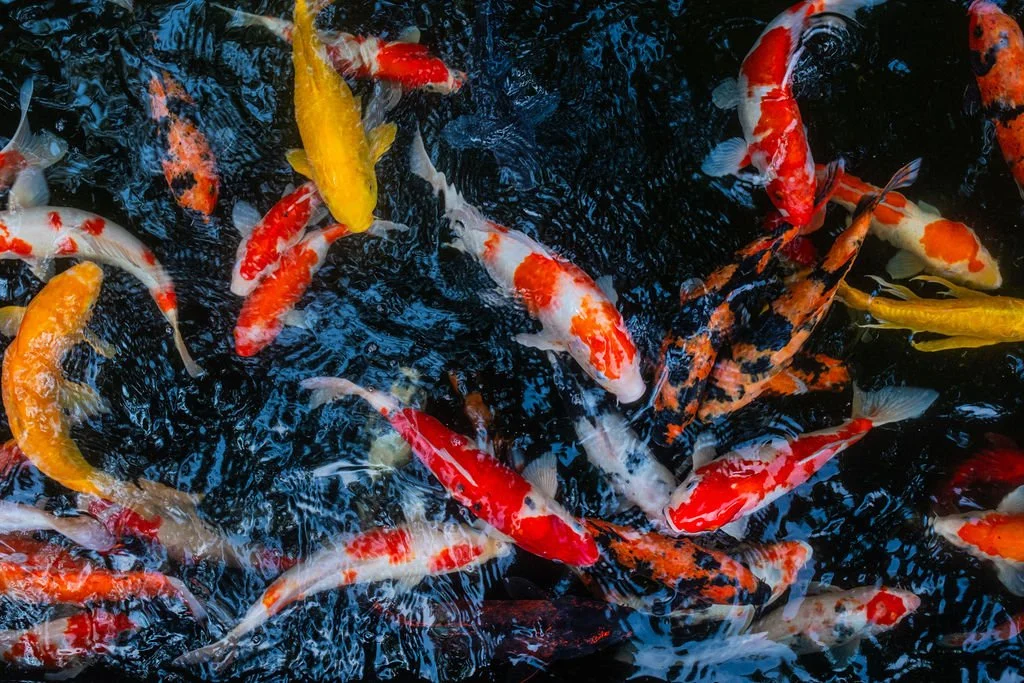
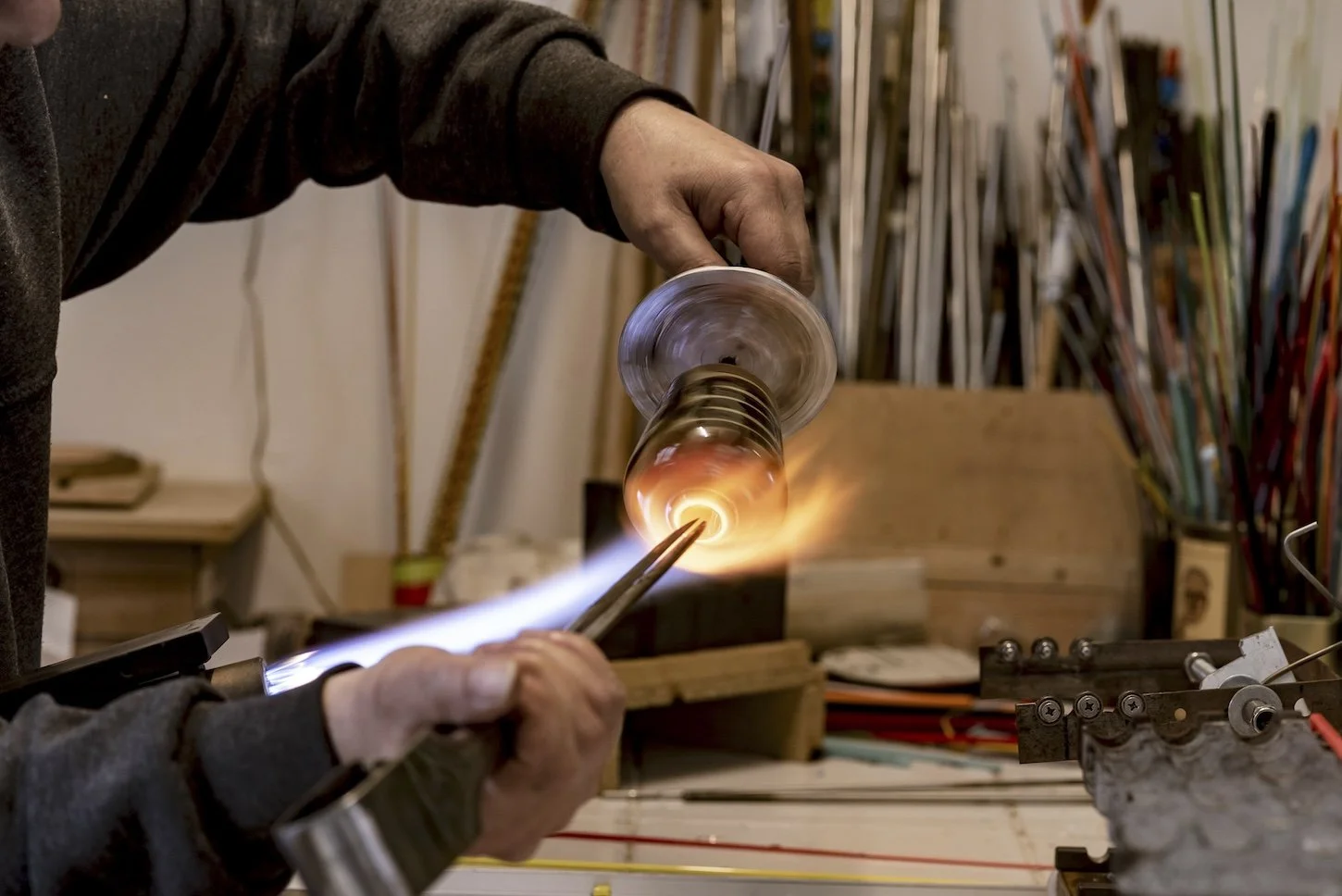
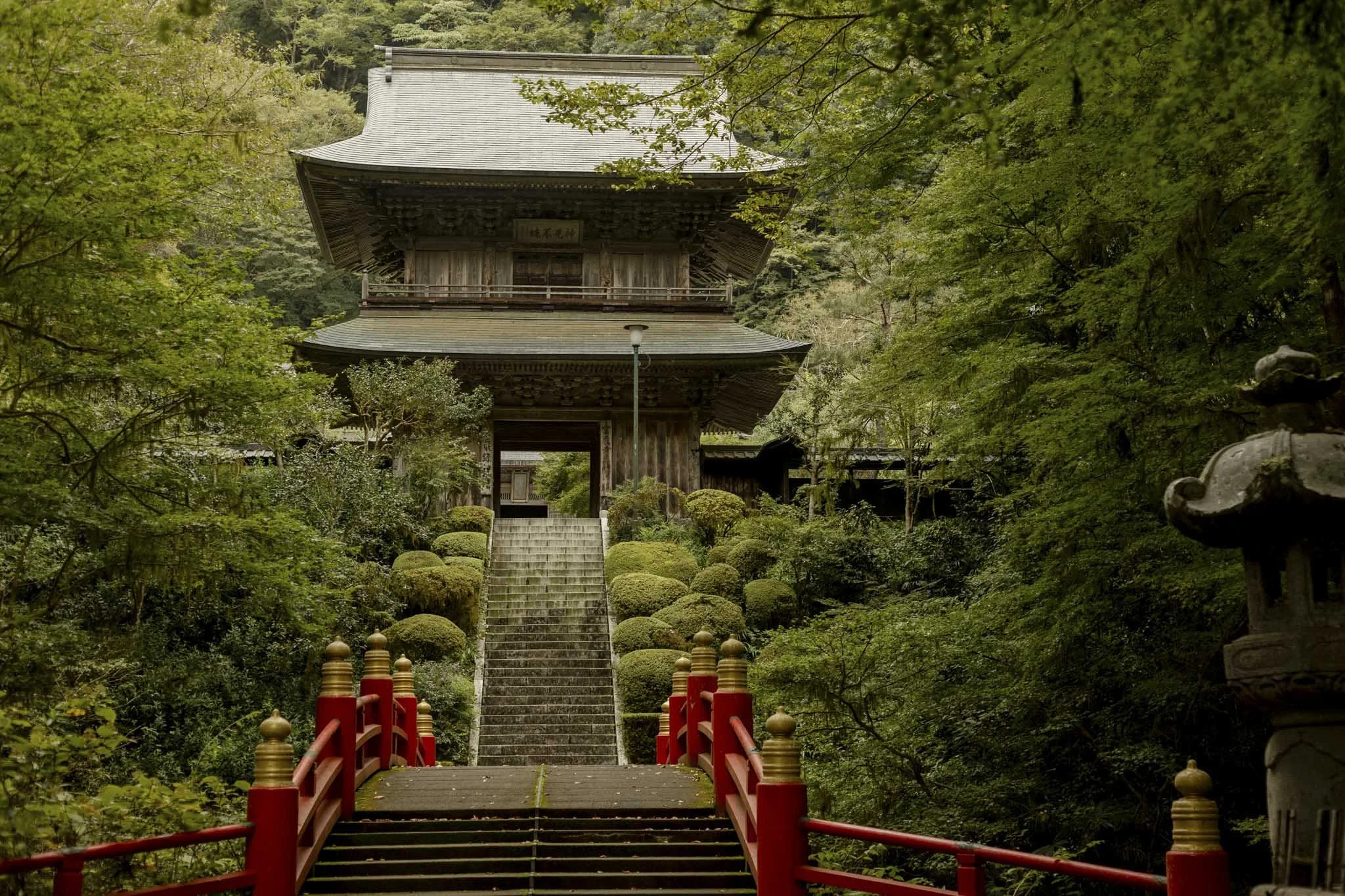


Celebrating Cecil Beaton at Wales’ Hawarden Estate.